
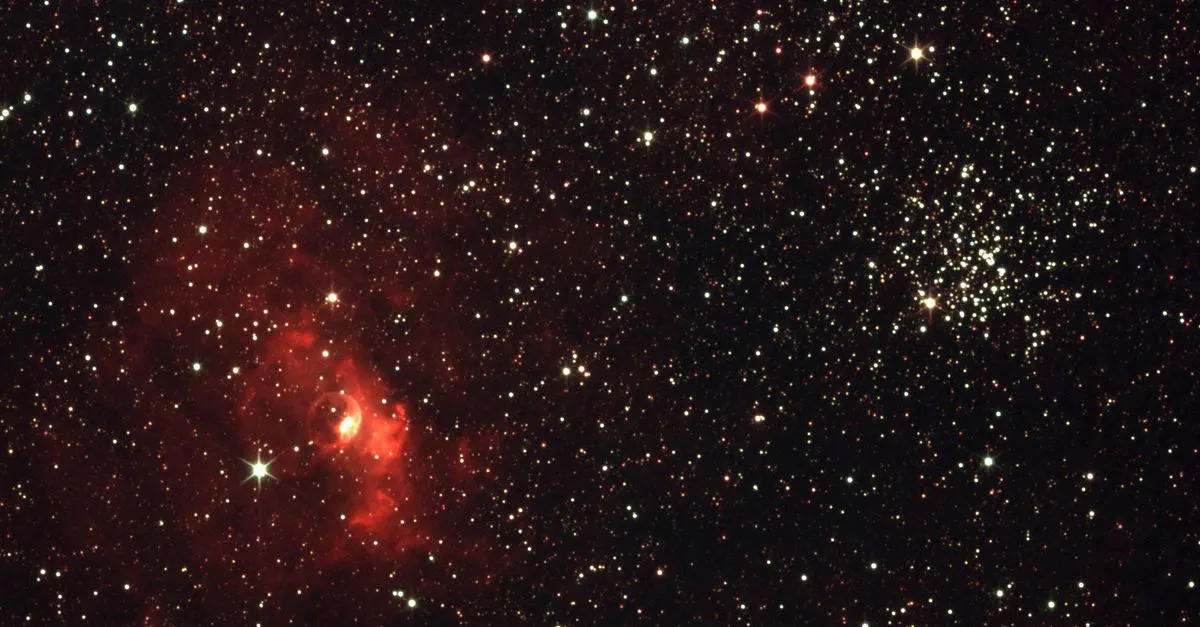
Look up on a clear night and every star is a single point of light, the Sun included if you could back far enough away. That sameness is a trick of distance. Some of those points are stars so large that, if one swapped places with our Sun, the Sun would not just be outsized. It would vanish inside, along with the ground you are standing on. The question is how far that goes, and the honest answer comes wrapped in more doubt than you might expect.
The biggest known stars are over 1,500 times the Sun's width
The largest stars we have found, red hypergiants like Stephenson 2-18 and UY Scuti, run on the order of 1,500 to 2,100 or more times the Sun's radius (Wikipedia). Stephenson 2-18, the current front-runner, has been estimated at about 2,150 times the Sun's width. To say that plainly: line up Suns side by side across the face of that one star and you would need more than two thousand of them.
Hold that next to our own star. The Sun is a G2 V yellow dwarf, a perfectly normal middle-of-the-pack star. It is not small as stars go, but it is nowhere near the top. The biggest known stars are to the Sun roughly what the Sun is to a grain of sand on the scale of width alone, and width is the gentlest way to measure this.
Drop one where the Sun is
The vivid version is to put one of these monsters at the center of our solar system and see what survives. A star around 1,700 times the Sun's radius, which is where UY Scuti was once measured, would reach out past the asteroid belt, toward the orbit of Jupiter. Mercury, Venus, Earth, Mars, the asteroid belt, and Jupiter itself would all be inside the star, under its surface, gone.
Push to Stephenson 2-18's high estimate and it gets worse. At about 2,150 solar radii the star's edge sits near 10 astronomical units from the center, roughly the distance Saturn keeps from the Sun at 9.59 (Wikipedia). Earth, in that picture, is not a small planet orbiting a big star. Earth is a fleck of dust buried a few percent of the way into the star's interior, with the rest of the inner solar system packed in beside it.
By volume the gap is wider still, because volume grows with the cube of width. A star about 2,000 times wider than the Sun holds roughly 2,000 multiplied by itself three times, which is around eight billion Suns' worth of space. Stephenson 2-18 has been estimated at near ten billion Suns by volume. The same arithmetic that turns "109 Earths across" into 1.3 million Earths inside runs again here, one rung up the ladder, and the result is a number the mind simply files under "a lot."
The honest part: nobody is sure which one is biggest
Here is where the wonder gets sharpened by doubt rather than dulled by it. These sizes are not measured with a ruler. A star's width is calculated from its distance and its brightness, and the distances to these particular giants are badly known. Stephenson 2-18 sits in a crowded patch of sky near the galactic center, and its distance has a stated uncertainty of more than 50 percent (Wikipedia). Get the distance wrong and the size goes with it.
So the leaderboard keeps reshuffling, almost always downward. UY Scuti was crowned at 1,708 solar radii in 2012, a clean record holder for years. A later estimate using newer distance data put it nearer 909 (Wikipedia), barely half its former glory. WOH G64 was once ranked among the very largest stars known, and a 2024 reanalysis revised it sharply downward, toward 800 solar radii (Wikipedia). The pattern is consistent: as the measurements improve, the giants shrink.
That does not mean these stars are small. It means "the biggest star" is a moving target, and the right way to hold the figure is as a range with honest edges, not a single trophy number. Roughly 1,500 to 2,100-plus solar radii covers the leading candidates today, and the safe summary is that the largest known stars are well over a thousand times the Sun's width, with the exact champion still up for debate.
Why an ordinary star is the better marvel
It would be easy to walk away thinking the Sun is a runt. It isn't. The same physics that lets a hypergiant balloon to Saturn's orbit is also burning its candle at a furious rate, which is why those stars live brief, violent lives and end as the dramatic deaths the Sun will not have for billions of years yet. Bigger is not better here. It is mostly faster and shorter.
And there is a quieter point worth keeping. Every one of these giants is a single dot to your eye, no brighter or grander in the sky than any other star, their true scale hidden by the sheer reach of space. The reason a star twinkles at all is that it is so far away its light arrives as a near-perfect pinprick for the atmosphere to wobble. A hypergiant two thousand times the Sun's width and our own modest Sun are both just points of light up there, and telling them apart takes the whole apparatus of modern astronomy. That, more than any single number, is the part worth looking up at.
Keep wondering: see how many Earths can fit in the Sun for the rung below this one, then how big the Sun is compared to Earth, and why stars twinkle in the first place.

Join the conversation
Comments are reviewed before they appear. Be kind and stay curious.
Loading comments…