
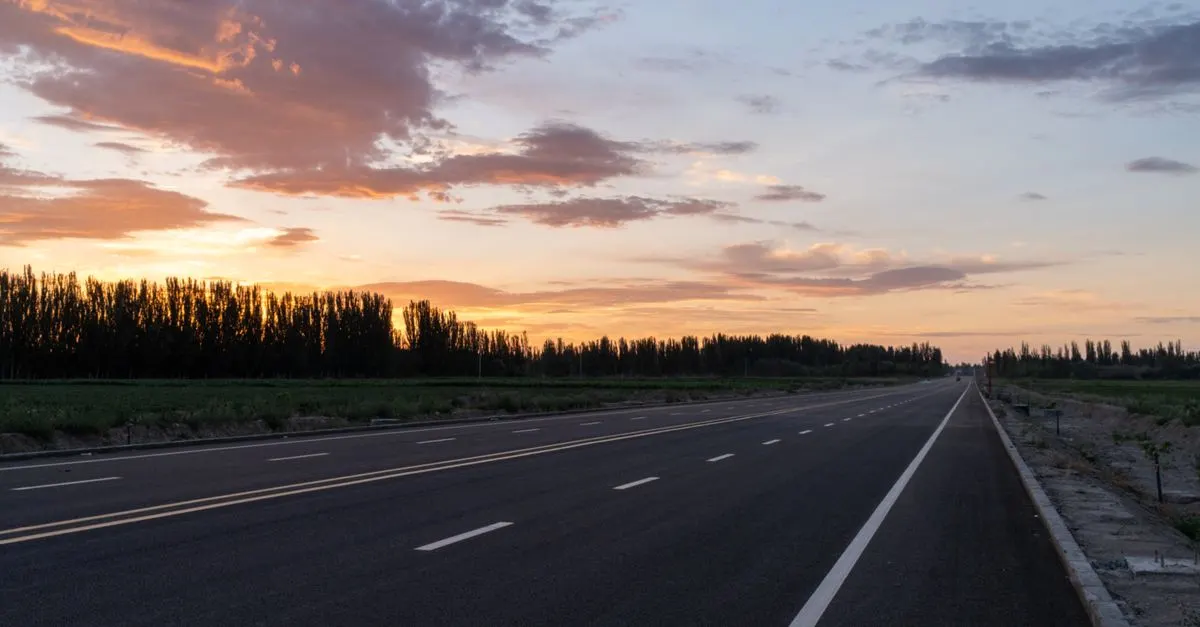
Every morning the Sun shows up looking close enough to touch, hanging there just over the rooftops. So picture the most literal possible road trip: you point a normal car at it, set the cruise control, and never stop. No gas breaks, no sleep, no traffic. How long is that drive? The honest answer is long enough to make a human lifetime look like a coffee break.
Driving to the Sun would take about 177 years
Pointed straight at the Sun and held at a steady 60 mph with no stops, the trip would take roughly 177 years. The Sun sits about 93 million miles away on average, which astronomers call one astronomical unit (NASA). Divide 93 million miles by 60 miles every hour and you get 1.55 million hours behind the wheel. That is about 64,600 days, or just under 177 years of driving that never once pauses.
Put a face on that number. If your great-great-grandmother had pulled out of the driveway around the time of the American Civil War, foot flat on the gas the entire time, the car would only be arriving about now. Seven or eight generations of one family would have to take shifts at the wheel, handing off the keys without ever coming to a full stop.
The car would die long before you did
Here is where it gets funnier. A well-built modern car is generally considered to last around 200,000 miles (Consumer Reports). The drive to the Sun is 93 million miles. Divide one by the other and you would burn through roughly 465 cars, each one driven to the grave, before the Sun came into reach.
So the real problem was never the distance in some abstract sense. It is that the distance is so absurdly large it outlasts the machine, the driver, and most of recorded history several times over. You would need a fleet, a dynasty, and a very patient mechanic.
Now race the car against light
The same 93 million miles that swallows 177 years of driving is nothing to a beam of light. Sunlight makes the crossing in about 8 minutes and 20 seconds (NASA). That is the strangest souvenir of the whole trip: the Sun you glance at on your way out the door is not the Sun as it is right now, it is the Sun as it was eight minutes ago. You are always looking slightly into the past.
Light wins by such a margin that the words "faster" and "slower" stop feeling adequate. By the time light arrives in eight minutes, our 60 mph car has covered eight miles. It has barely cleared the next town while light has crossed the solar system. It is the same gap you run into when you ask how long it takes just to reach the Moon, which is far closer and still humbling.
What about the fastest thing we have ever built?
So scrap the car. Strap yourself to the quickest machine humanity has ever made. NASA's Parker Solar Probe, on its closest passes by the Sun, has reached around 430,000 mph (NASA), fast enough to cross from Philadelphia to Washington, D.C. in about one second. At that blistering pace, the 93 million mile trip drops from 177 years to roughly 9 days. A week and change instead of two centuries.
And yet even that record-breaking probe still takes nine days to do what light does in eight minutes. The Sun is genuinely, stubbornly far. It only looks close because it is unimaginably bright and unimaginably large, a furnace so big it could hold more than a million Earths inside it.
The part where the car melts anyway
There is one last catch, and it is the kind that ends the road trip early. You could not finish the drive even with 177 years and 465 cars, because there is no road, no air, and nothing for the tires to grip in the vacuum of space. The wheels would just spin. And long before any of that mattered, the heat would settle the question. The Sun's surface sits at around 10,000 degrees Fahrenheit, hot enough to turn the car, and you, to vapor well before arrival.
Which is the quiet lesson hiding in a silly question. The Sun feels like a neighbor because it warms your face and lights your street. Measured in a car, it turns out to be 177 years away, a furnace at the end of a road that does not exist. Familiar and impossibly distant at the same time, which is exactly the sort of thing worth wondering about the next time you squint up at it, the same way you might wonder what happens when it finally burns out.
Keep wondering: see how long it would take to reach the Moon by comparison, then how the Sun's true size stacks up against Earth, and what will happen when the Sun eventually dies.


Join the conversation
Comments are reviewed before they appear. Be kind and stay curious.
Loading comments…