
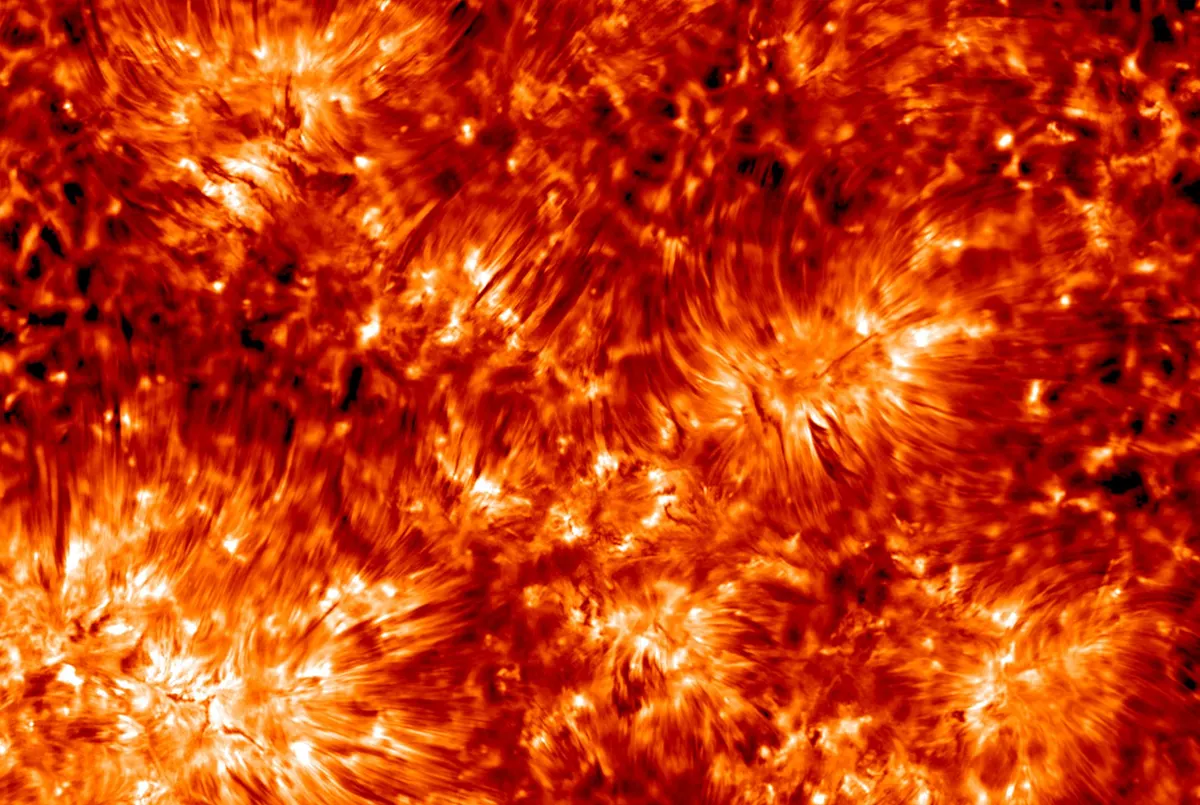
The Sun is not on fire. There is no flame, nothing burning in the way a campfire burns. That mental image, a giant ball of fire hanging in the sky, is wrong in a way that hides what the Sun actually is and what it is made of. So here is the real answer.
The Sun is mostly hydrogen, and it's all plasma
The Sun is made almost entirely of hydrogen and helium, the two lightest elements in the universe. Counted by number of atoms, it is roughly 92% hydrogen and 8% helium, with less than 1% left over for everything else (NASA Imagine the Universe). That leftover sliver holds oxygen, carbon, neon, and iron, the same atoms that make up rock and people and air, just present in tiny traces.
None of it is solid, liquid, or even ordinary gas. The whole thing is plasma: gas heated so violently that electrons get stripped off their atoms, leaving a soup of loose nuclei and free electrons (NASA Science). The Sun has no real surface. What looks like a sharp edge is just the layer where the plasma thins out enough to let light escape. You could not land on it. You would not even find a "there" to land on.
So picture less of a fireball and more of an enormous, glowing cloud of charged hydrogen, held in a ball by its own gravity, hot all the way through.
Why "the Sun is on fire" is a real mistake, not nitpicking
Fire is a chemical reaction. Wood or paper or gas combines with oxygen, and that reaction throws off heat and light. The key word there is oxygen. Take it away and the fire dies, which is why smothering a flame works.
Space has no oxygen. The Sun sits in a near-perfect vacuum. If it were burning the way a bonfire burns, there would be nothing to feed the flames, and it would have gone out long ago. NASA puts it plainly: "The Sun does not 'burn', like we think of logs in a fire or paper burning" (NASA StarChild). When scientists casually say the Sun "burns hydrogen," that is, in NASA's words, "just a figure of speech."
There is also a math problem with the fire idea. A chemical fire releases a certain amount of energy per reaction, and a ball of fuel the Sun's size would burn through itself fast on those terms, in thousands of years, not billions. The Sun has been shining for about 4.6 billion years and has roughly 5 billion left (NASA Science). Fire cannot do that. Something far more powerful is at work.
The real engine is fusion, squeezing hydrogen into helium
What actually powers the Sun is nuclear fusion, and it happens only in the core. Down there, the weight of the entire star pressing inward creates crushing pressure and a temperature of about 15 million degrees Celsius (EUROfusion). At those conditions, hydrogen nuclei get jammed together so hard that they stick, merging step by step into helium. That is fusion: small nuclei combining into a bigger one, the opposite of the fission that splits atoms in a nuclear reactor.
Here is the part that does the heavy lifting. When four hydrogen nuclei end up fused into one helium nucleus, the helium weighs slightly less than the four hydrogen pieces did. That missing scrap of mass is not gone. It has turned into energy, following Einstein's famous equation linking mass and energy. A pinch of vanished mass becomes a flood of light and heat.
The scale is hard to hold in your head. Every second, the Sun's core fuses roughly 600 million tonnes of hydrogen into helium (EUROfusion). About four million tonnes of that mass is converted straight into energy, every second, and has been for billions of years. The reason the Sun lasts so long is simply that it is enormous. There is that much hydrogen to spend.
The light you feel on your face took a strange, slow journey to reach you. Energy born in the core has to claw its way out through the dense plasma above, bouncing and being reabsorbed for a very long time before it finally breaks free at the surface and crosses to Earth in about eight minutes. By the time sunlight warms your skin, it started its life deep inside a fusion furnace.
We read the Sun's recipe in its light
You might wonder how anyone knows what the Sun is made of when no probe has ever scooped up a sample. The answer is that the Sun tells on itself through its light. Every element absorbs and emits specific colors, like a fingerprint. Split sunlight through a prism or a spectrograph and you get a rainbow stamped with dark and bright lines, and each line points to a particular element present in the Sun. This trick, spectroscopy, is how we measure the hydrogen and helium and everything else without leaving Earth.
That same method handed science one of its great surprises. During a total solar eclipse in 1868, astronomers studying the Sun's spectrum spotted a bright yellow line that matched no element known on Earth (Smithsonian Magazine). It sat near the yellow lines of sodium but did not belong to it. The line was recorded at a wavelength of about 587.5 nanometers and labeled the D3 line (Wikipedia).
The element we found in the Sun before we found it here
Whatever was making that yellow line, it appeared to be a brand new element, and it was sitting 150 million kilometers away inside the Sun. Astronomer Norman Lockyer named it helium, from helios, the Greek word for the Sun (Smithsonian Magazine).
For years, plenty of chemists doubted it. An element nobody could touch, known only from a streak of color in starlight, sounded more like a mistake than a discovery. Then in 1895, the chemist William Ramsay pulled helium out of a uranium mineral and confirmed it was real, here on Earth, the same stuff that fills party balloons.
Sit with the timeline for a second. Helium was found in the Sun 27 years before anyone found it on our own planet. It is the only major element discovered in space first. The second most common element in the entire universe, the second most common element in the Sun, and we learned of it by reading sunlight, not by digging in the ground.
That is the quiet payoff of the whole question. Asking what the Sun is made of sounds like asking what is in a rock. But the Sun is not a rock, or a fire, or anything you can hold. It is a self-lit ball of plasma running on fused hydrogen, and we cracked its ingredients open from 150 million kilometers away by paying very close attention to its light. The next clear morning, that warmth on your face is a 4-million-tonnes-per-second fusion reaction, eight minutes after the fact.
Keep wondering: find out how big the Sun really is next to Earth, where the heavier elements like gold actually come from, and what finally happens when the Sun runs out of fuel and dies.

Join the conversation
Comments are reviewed before they appear. Be kind and stay curious.
Loading comments…