
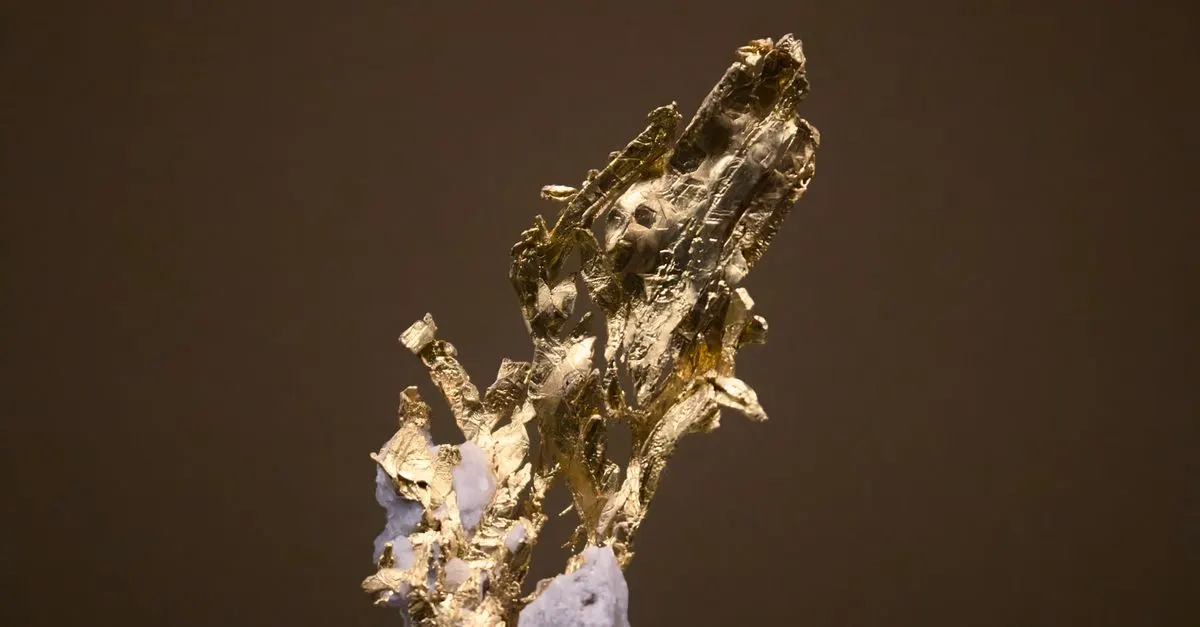
Where does gold come from? Not a mine, it turns out. The gold in a wedding ring came from a catastrophe so violent it shook the fabric of spacetime and was visible from 130 million light-years away. Before it sat in a jeweler's case, that gold was forged in a fraction of a second during the death spiral of two collapsed stars. Every atom of it is a relic of one of the most extreme events the universe produces.
Two dead stars make everything you can't explain
Gold is too heavy for stars to build during their normal lives. Ordinary stellar fusion stops at iron. The reason is thermodynamic: fusing elements lighter than iron releases energy, but fusing anything heavier than iron actually costs energy. Stars are not in the business of losing energy, so the process stalls. For decades, that left physicists with a problem. A periodic table full of elements heavier than iron, and no convincing place to build them.
The answer turned out to be neutron star mergers. When a massive star dies in a supernova, it can leave behind a neutron star: a city-sized ball of matter so dense that a teaspoon would weigh about a billion tons. Sometimes two neutron stars end up in orbit around each other. Over millions or billions of years, they radiate energy as gravitational waves and spiral inward. When they finally collide, the result is a kilonova, a brief explosion roughly a thousand times brighter than a regular nova, and one of the few environments in the universe that can produce gold.
The reaction that builds gold atom by atom
The process inside a kilonova is called the r-process, short for rapid neutron-capture process. In the extreme neutron-rich environment of the merger, free neutrons slam into existing atomic nuclei faster than those nuclei can decay. Each capture adds mass. A nucleus keeps absorbing neutrons, stepping up through the periodic table, until it eventually beta-decays into a stable heavy element.
Gold (element 79) and platinum (element 78) are classic r-process products. So are uranium, thorium, and most of the other elements at the heavy end of the periodic table. The r-process is responsible for roughly half of all elements heavier than iron, according to LIGO/Caltech. No other known process can account for them.
For decades this was theory. Then, on August 17, 2017, it became something you could watch.
The day we watched gold being made
At 8:41 a.m. EDT on August 17, 2017, the LIGO and Virgo gravitational-wave detectors picked up a 100-second-long ripple in spacetime. The signal matched the final spiral and collision of two neutron stars in NGC 4993, a galaxy about 130 million light-years away in the constellation Hydra. Then, 1.74 seconds later, NASA's Fermi spacecraft detected a gamma-ray burst from the same direction. That short delay between gravitational waves and gamma rays was itself a confirmation: the two signals came from the same event, the merger of the stars and the jet of radiation that followed.
Within 11 hours, 70 observatories on seven continents had turned toward the spot, peering through the same shimmering air that makes stars appear to twinkle. What they found was the kilonova AT2017gfo: a rapidly expanding, cooling cloud of material moving at roughly 10 percent of the speed of light. Its light shifted from blue to red over several days as heavier elements built up in the ejecta. Analysis reported by Berkeley News found that single event produced around 200 Earth masses of gold and nearly 500 Earth masses of platinum. Total heavy element output: about six percent of the sun's mass, roughly 20,000 times the mass of the Earth, crammed into an explosion that lasted days.
It was the first direct observation of a kilonova and the first real-time confirmation that r-process nucleosynthesis happens in neutron star mergers.
The strontium smoking gun
Gold and platinum are hard to identify spectroscopically in a kilonova because the spectra are messy: thousands of emission lines from hundreds of elements overlap in a hot, fast-moving cloud. But in 2019, a team led by Darach Watson at the University of Copenhagen reanalyzed the GW170817 spectra using data from ESO's X-shooter instrument on the Very Large Telescope and pulled out something unambiguous. They identified strontium (element 38), a lighter r-process product, written clearly in the light of AT2017gfo.
"By reanalysing the 2017 data from the merger, we have now identified the signature of one heavy element in this fireball, strontium, proving that the collision of neutron stars creates this element in the Universe," Darach Watson said when the team's strontium identification was published in Nature. Strontium was the first r-process element ever directly identified being born in a neutron star merger. It closed the loop between theory and observation in a way that gold's messy spectrum could not, at least not yet.
20,000 Earth masses of treasure, scattered into space
Here is the number worth sitting with. One neutron star merger, one single event in one galaxy 130 million light-years away, a near neighbor on the scale of the whole universe, produced 20,000 times the mass of the Earth in heavy elements. That is not a laboratory trace amount. That is enough material to change the chemical composition of whatever galaxy it scatters into.
Over cosmic time, these events repeat. The gold and platinum flung outward mix into gas clouds. Gas clouds collapse into new stars and planets. Those planets cool, concentrate their metals, and eventually produce things like ocean floors and asteroid belts and, on at least one unremarkable rocky planet orbiting a yellow star, ore deposits that a species 4.5 billion years later will dig up and shape into rings.
The gold in a wedding band has a biography that starts with two dead stars grinding toward each other for hundreds of millions of years. The ring is a souvenir.
Keep wondering: the stars that eventually become neutron stars first go through a longer, quieter life that ends in a very different way than our own sun will, and the heaviest stellar corpses go further still, collapsing into black holes that eventually die too.
Join the conversation
Comments are reviewed before they appear. Be kind and stay curious.
Loading comments…