
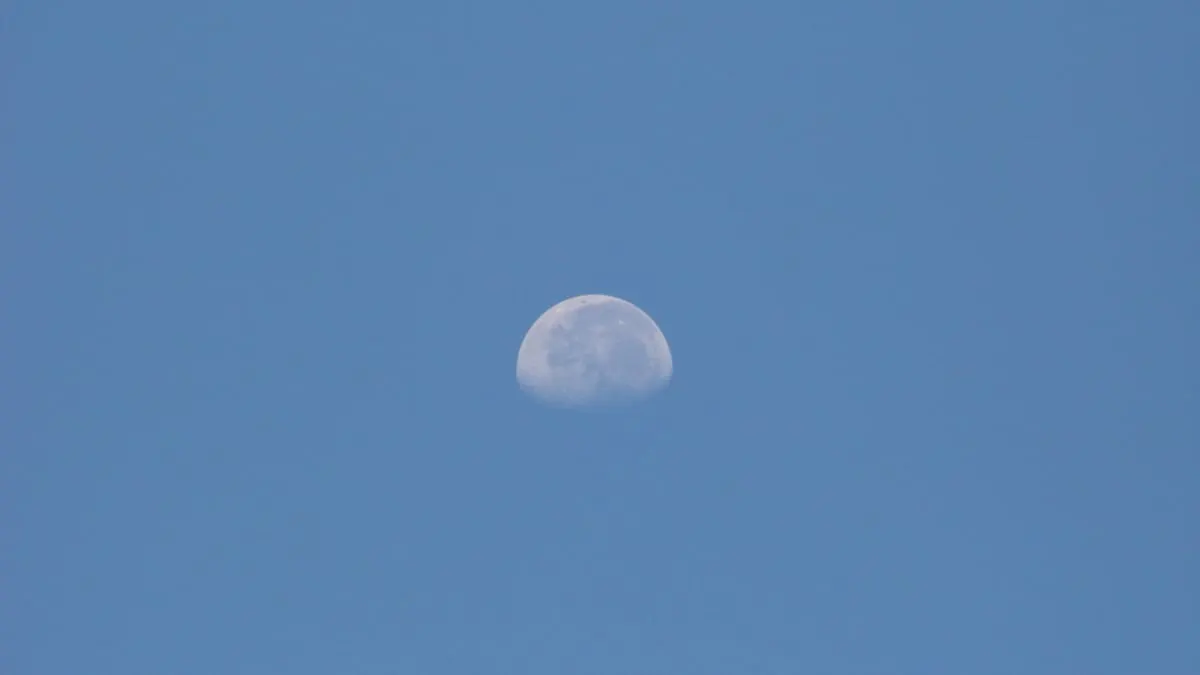
There it is on a Tuesday afternoon: a pale, ghostly Moon hanging in a bright blue sky, looking like it showed up early by mistake. People point it out as if they have caught nature in a glitch. They haven't. The daytime Moon is one of the most ordinary sights in the sky, and most of us just never look up to notice it.
It shares the sky with the Sun more than you'd think
So can you see the Moon during the day? Yes, on most days of the month. The Moon is above the horizon for about twelve hours out of every twenty-four (BBC Sky at Night Magazine), and those hours drift later and later because the Moon rises roughly fifty minutes later each day (Farmers' Almanac). That steady slip means that for much of its monthly cycle, a big chunk of the Moon's time up is during daylight, not at night. It is not sneaking into the day sky. It lives there about half the time.
What lets you actually see it is brightness. After the Sun, the Moon is the brightest thing in our sky, bright enough to stand out against the blue (Live Science). As one NASA scientist puts it, "the Moon actually shines bright enough that you can see it day or night, as long as it's in the right part of the sky" (NASA).
Why it sometimes goes missing
If the Moon is up half the daylight hours, why can't you always find it? Because two phases bookend the trouble. Around the new moon, the Moon lies almost in the same direction as the Sun, drowned in its glare. Around the full moon, the opposite happens: the Moon sits across the sky from the Sun, so it rises near sunset and is below the horizon all day, only showing up at night (BBC Sky at Night Magazine).
In between those two, the Moon is easy daytime game, and the sweet spots are the quarter moons. A first quarter Moon climbs the afternoon and evening sky; a last quarter Moon owns the morning (Farmers' Almanac). Catch either and you get a clean half-Moon floating in full daylight, no telescope required.
The thing was there all along
None of this is rare, and none of it is strange. The reason the daytime Moon feels like a surprise is simply that we file the Moon under "night" and stop scanning the sky once the Sun is up. The stars genuinely do vanish in daylight, washed out by the bright sky, so we assume the Moon must too. It doesn't. It is just bright enough to break that rule.
So tomorrow, sometime in the afternoon, glance up. Odds are decent the Moon is right there, pale and patient against the blue, the way it has been on countless days you never thought to look.
Keep wondering: the same scattered sunlight that washes out the stars is why the sky is blue, there's a knack to spotting our galaxy too in can you see the Milky Way with the naked eye, and the atmosphere puts on another show in why stars twinkle.


Join the conversation
Comments are reviewed before they appear. Be kind and stay curious.
Loading comments…