
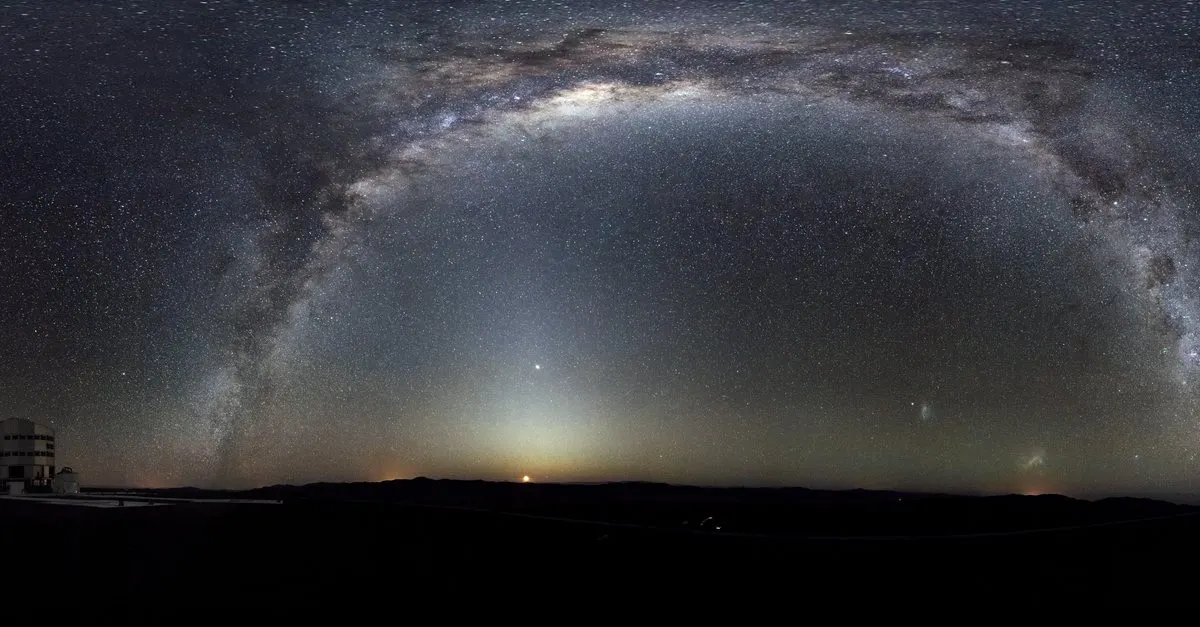
On a moonless night far from any town, a pale river of light spills across the sky from one horizon to the other. People who grow up under city lights often mistake it for a cloud the first time they see it. It isn't. That band is our galaxy, seen from the inside. Can you see the Milky Way with the naked eye? Yes, and without a telescope.
You don't need a telescope, you need a dark sky
You can see the Milky Way with the naked eye, but only from a genuinely dark location. The galaxy appears as a soft, hazy band of light arching overhead, and how much you see depends on sky brightness, atmospheric clarity, altitude, and how long your eyes have had to dark-adapt. According to the 2016 New World Atlas of Artificial Night Sky Brightness, led by Fabio Falchi and published in Science Advances, atlas modeling estimated that the Milky Way was hidden from more than one-third of humanity, including roughly 60 percent of Europeans and nearly 80 percent of North Americans, under its study conditions. City dwellers may therefore never see it from home even though it is visible from a sufficiently dark site.
What that fuzzy band actually is
The Milky Way isn't a separate thing in the sky. It's the galaxy we live inside, viewed edge-on. Picture a dinner plate packed with a few hundred billion stars. Our Sun sits inside that plate, about 27,000 light-years from the center, roughly halfway out toward the edge in a minor structure called the Orion Spur. When you look toward the plane of the disk, your line of sight passes through layer after layer of distant stars, too far and faint to separate by eye. They blur together into a glowing haze. That's the band.
Look the other way, out of the plane, and you see only the sparse local neighborhood, far fewer stars. That's why the Milky Way is a band and not an all-over glow. It traces the densest plane of the galaxy wrapping the whole sky in a complete circle, though half of it is always below your horizon.
The brightest, most textured stretch sits in the constellation Sagittarius. That's the direction of the galactic center, where the disk thickens into a central bulge of stars and a supermassive black hole lurks, the kind of object that will one day slowly evaporate into nothing. The dark rifts splitting the band aren't gaps. They're enormous clouds of interstellar dust blocking the light behind them.
The Bortle scale: a ruler for darkness
Amateur astronomer John E. Bortle gave stargazers a common language for sky darkness in a February 2001 article for Sky & Telescope. The Bortle scale runs from Class 1, the darkest skies on Earth, to Class 9, the washed-out glow of an inner city.
Here's the part that matters. At Class 1, the Milky Way is so bright it casts a faint shadow on the ground, and the limiting magnitude (the faintest star you can detect) reaches about 7.6 or better. At Class 2 and 3, the band is still rich and structured. By the time you hit Class 5, a typical suburb, the Milky Way is faint or gone. From Class 7 through 9, forget it. The skyglow drowns everything diffuse, and you're left with a handful of bright stars and planets. The Falchi atlas found that more than 99 percent of people in the U.S. and Europe live under skies polluted enough to dim or erase it.
Where to actually go and when
The fix is distance, darkness, and timing. Get well away from city lights, aim for a Bortle Class 1 to 4 site, and let your eyes dark-adapt for 20 to 30 minutes (no phone screens). DarkSky International has certified more than 200 International Dark Sky Places worldwide, starting with Flagstaff, Arizona, in 2001, and over 40 sites within the U.S. National Park System now hold that status.
Timing matters as much as location. The bright Sagittarius core is a summer object for the Northern Hemisphere, best from roughly May through September, with June and July at the peak. Shoot for a night near the new moon, when no moonlight competes, and the moon is below the horizon. A clear, dry night helps too, since humidity scatters stray light.
The light reaching your eye left before there were humans
Here's the detail that stops me cold. When you look at the galactic center in Sagittarius, the photons hitting your retina left that region around 27,000 years ago, during the last Ice Age, before agriculture, before cities, before the electric lights now hiding the view. Some stars in that band are so distant their light has been traveling for tens of thousands of years to land, tonight, on the back of your eye in a quiet field. You're not looking at a picture of the galaxy. You're catching ancient light in real time, with no instrument but the eye you were born with. From down here it is silent and odorless, though astronauts who go up there report that space has a smell, like seared steak.
And most people will go their whole lives without ever once looking up and seeing it.
Keep wondering: the same starlight that makes the Milky Way shimmer is the reason stars twinkle, every faint point in that band is a hint at how big the universe really is, and the Sun threading through that disk will one day face its own end, which is its own strange story about what happens when the Sun dies.
Join the conversation
Comments are reviewed before they appear. Be kind and stay curious.
Loading comments…