
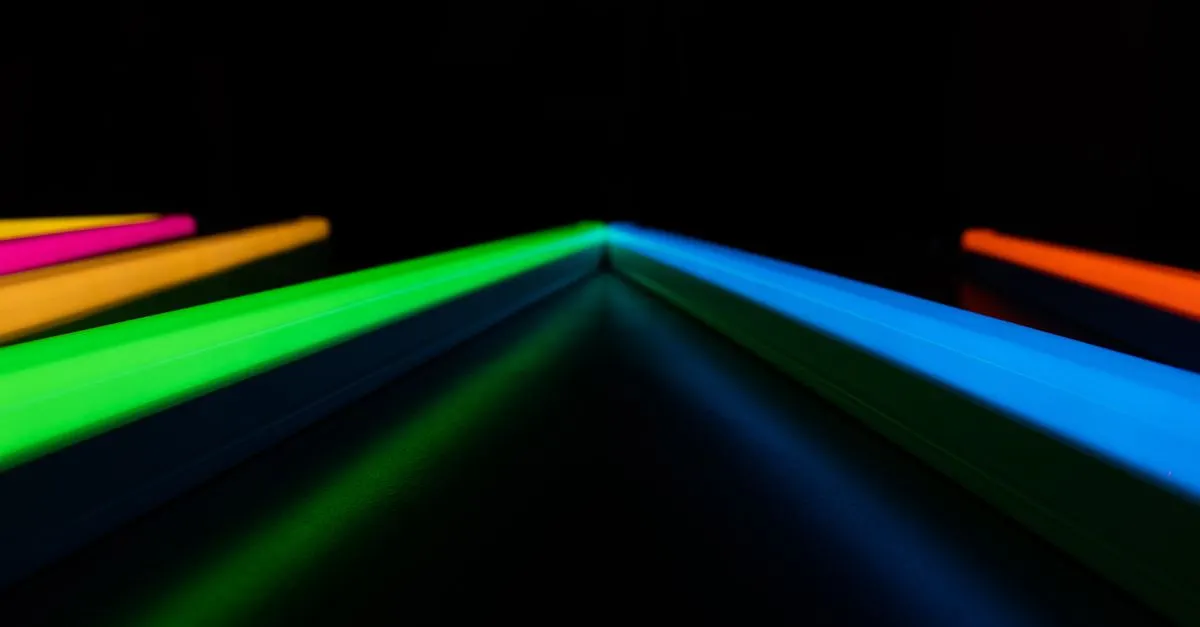
Snap a glow stick and something quietly impossible happens. A cold plastic tube starts pouring out light, steady and bright, with no bulb, no battery, no spark, and no warmth at all. Hold it against your cheek and it stays cool. So where's the light coming from? You're holding a tiny chemical reaction, and the glow is the reaction breathing out.
Two chemicals, kept apart until you snap
Here's how glow sticks work: the light comes from chemiluminescence, a chemical reaction that releases its energy as light instead of heat. To pull that off, a glow stick keeps two ingredients separated until you're ready. The outer plastic tube is filled with a solution of fluorescent dye mixed with a compound called a phenyl oxalate ester. Floating inside that solution is a thin sealed glass vial holding hydrogen peroxide (HowStuffWorks).
When you bend the stick, that's the snap you feel: the glass vial shattering. Now the peroxide spills into the dye solution, the two react, and the tube lights up. Shake it and you're just helping them mix faster.
What the reaction actually does
The chemistry runs in a quick chain. The hydrogen peroxide attacks the oxalate ester and turns it into an unstable, high-energy molecule. That molecule immediately falls apart into ordinary carbon dioxide, and as it breaks down it dumps a burst of energy (C&EN, American Chemical Society). The energy doesn't escape as heat. Instead it's handed to a nearby dye molecule, which uses it to kick one of its electrons up to a higher energy level. The electron can't stay up there, so it drops back down, and on the way it throws off the extra energy as a single particle of light, a photon.
Multiply that by trillions of molecules and you get a steady glow. The clever part is the dye. The reaction itself is colorless; the dye is what sets the color. Swap the dye and you get green, blue, pink, or orange out of the very same peroxide-and-ester reaction, because each dye releases its photons at a different wavelength (C&EN, ACS).
Why it's cold, and why the freezer trick works
A light bulb makes light by getting something hot enough to glow, which wastes most of its energy as heat. A glow stick skips the heat entirely and sends its energy straight into light, which is why it's called cold light and why you can safely hold one against your skin.
That also means temperature is a dial you can turn. Like most chemical reactions, this one speeds up when it's warm and slows down when it's cold. Drop a glow stick in hot water and it flares brighter, but it burns through its chemicals faster and dies sooner. Put it in the freezer and the reaction crawls: the glow goes dim, but it lasts far longer, and a frozen stick can be paused and then woken up again hours later by warming it back up (University of Washington, Department of Chemistry). You can have it bright or you can have it long. You can't have both.
The same trick a firefly uses
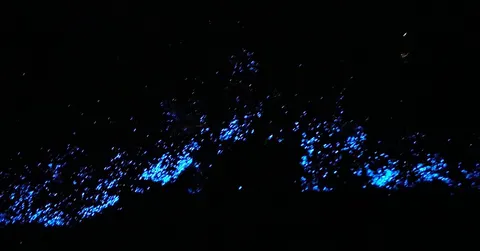
Here's the part that lifts a glow stick out of the party-supply aisle. That fundamental move, coaxing a chemical reaction to release its energy as light without heat, isn't a human invention. Life got there first. A firefly's lantern, an anglerfish's lure, the blue shimmer of glowing waves at night, all run on the same principle: chemicals reacting to make cold light. The firefly just uses its own molecules, built by its own cells, instead of a snapped glass vial. When you crack a glow stick at a concert, you're holding a plastic, store-bought version of one of the oldest light shows on Earth.
Keep wondering: light has more tricks than you'd think, from why the ocean glows to why the sky is blue, and the everyday physics behind how static electricity works.

Join the conversation
Comments are reviewed before they appear. Be kind and stay curious.
Loading comments…