
You scuff across the carpet in wool socks, reach for the light switch, and snap. A tiny blue spark and a sting jump from your fingertip to the metal. You did not touch anything electrical. So where did that come from? The answer is hiding in the atoms of everything you brushed against, and it scales all the way up to lightning.
Static electricity is a buildup of electric charge on a surface
Static electricity is an imbalance of electric charge that collects on a material instead of flowing away as a current (Science Made Simple). To see why it builds up instead of draining away, you have to zoom into the atoms.
Every atom has a dense core of positively charged protons, surrounded by negatively charged electrons. Normally the two balance out, so the atom is neutral and you feel nothing. The protons are locked in the core and stay put, but the outer electrons are loosely held and can move (Science Made Simple). That one fact, electrons wander while protons cannot, is where all of this starts.
The trick is two surfaces touching and pulling apart
Here is the move that does it. When two different materials press together and then separate, charge can be left unevenly distributed between the surfaces. In many everyday examples electrons are the important carriers, so one material ends up with extra electrons and a negative charge while the other has an electron deficit and turns positive (American Physical Society). Physicists call this the triboelectric effect, from the Greek for "rubbing," though contact and separation matter more than the rubbing itself.
So why does rubbing feel like it works better? Because rubbing is just touching and separating many times very fast, over a much larger area. Each tiny contact is another handoff of electrons. The more you rub, the more charge stacks up (Science Made Simple). Drag your socks across the rug long enough and your body holds a real surplus of electrons, just waiting.
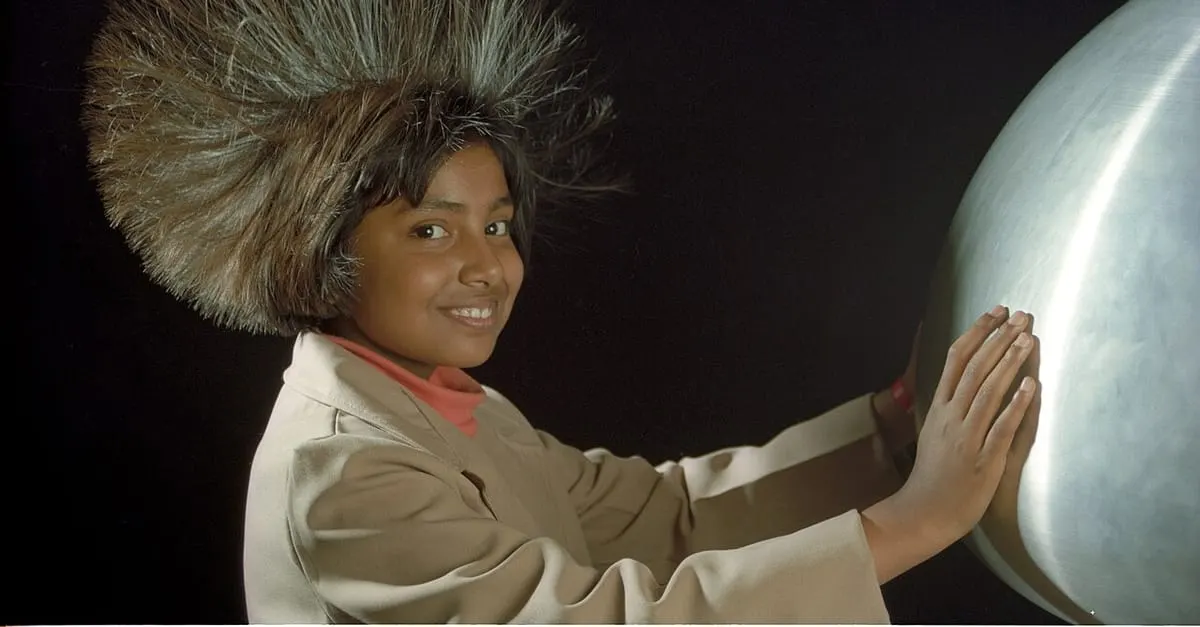
Once a surface is charged, it starts pushing and pulling on its surroundings, because charge obeys one blunt rule: like charges repel, opposites attract. Rub a balloon on your hair and the balloon steals electrons, going negative; your hair, now positive, is drawn to it and sticks to the wall. Stand a kid on a Van de Graaff generator and every strand of hair picks up the same charge, so the strands shove away from each other and stand straight out. It is the same rule that makes magnets snap together or refuse to, except here the force comes from charge sitting still rather than charge in motion.
The shock is the charge finally escaping
A static charge does not want to sit forever. It wants to even back out, and it will the instant it finds a path. That is the doorknob moment. You cross the carpet holding a load of extra electrons, your hand nears the metal knob, and because metal lets charge flow freely, the electrons jump the last sliver of air all at once. That sudden rush is the spark and the sting (Science Made Simple). You feel it on a doorknob and not a wooden door because metal is a conductor and wood is not, a difference that also explains why metal feels colder than wood.
Now take the related charge-separation process into a thundercloud. Updrafts and falling ice slam soft hail and water droplets into each other, and the collisions redistribute charge between the particles. The result is a cloud with a negatively charged base and a positively charged top (NOAA). The air between them is an excellent insulator, so the charge keeps piling up. When it finally overwhelms the air's resistance, the whole imbalance discharges in one blinding spark (NOAA). That spark is lightning. It is related to the static zap off your finger, but the storm's charged particles, electric field, and long discharge path make it a different physical setting. The storms that build all that charge are the same ones behind why it rains.
The part scientists still cannot fully explain
Here is the honest catch. We can tell you charge transfers when surfaces touch. What we cannot fully say is why a given material gains electrons rather than loses them. The neat list that ranks materials by how they charge, called the triboelectric series, has resisted every attempt to pin it to one clean cause, getting tangled up in surface chemistry, moisture, and even the tiniest physical roughness (Physics World).
It gets stranger. In a 2025 study, researchers at Austria's Institute of Science and Technology rubbed together two pieces of identical material and still got them to charge oppositely, which should be impossible if charge depended only on what a thing is made of. Their finding, published in Nature, was that the surfaces seem to carry a kind of memory: a sample that has been touched many times charges differently from a fresh one, apparently because repeated contact smooths its surface at the nanometer scale (Physics World). One of the lead scientists put it plainly, calling it "a seemingly simple effect" whose experiments are "plagued by unpredictability" (Physics World). So the next time a sweater crackles in the dark, know that you are watching one of the oldest effects in physics, and one we still do not completely understand.
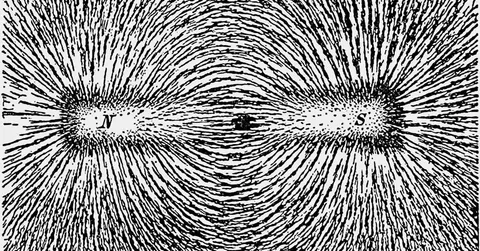
That same restless charge shows up all over the place once you start looking. It is a cousin of the force in how magnets work, and some animals have learned to weaponize it, which is the whole trick behind how electric eels make electricity.


Join the conversation
Comments are reviewed before they appear. Be kind and stay curious.
Loading comments…