
13.8 billion years. That is the number, and it is one of the most precisely known big numbers in all of science. Write it out and it looks almost casual: 13,800,000,000 years since everything began. The strange part is not the figure itself. It is that we can pin it down at all, given that nobody was there with a stopwatch and the event in question is the start of time. So how do you put an age on the entire universe, and how confident should you actually be in that answer?
The universe is about 13.8 billion years old
The universe is about 13.8 billion years old, measured from the Big Bang, the moment it began expanding out of an extremely hot, dense state. The most precise figure comes from the European Space Agency's Planck mission, which puts the age at 13.787 billion years, with an uncertainty of only about 20 million years. That is a margin of error well under one percent, which is remarkable for a measurement of literally everything. NASA's earlier WMAP satellite landed on essentially the same value, 13.77 billion years, using a completely separate set of observations.
To be clear about what "the universe began" means: it does not mean an explosion that flung matter out into empty space. The Big Bang was the start of space and time themselves expanding everywhere at once. Run a film of cosmic history backward and galaxies do not fall toward a center. The whole grid they sit on shrinks, until everything is crushed together about 13.8 billion years ago. That is the clock we are reading.
The oldest light in the sky is the first clue
The single most useful object for dating the universe is something you cannot see with your eyes but which is, right now, passing through your body: the cosmic microwave background, or CMB. It is a faint hiss of microwaves arriving from every direction in the sky, and it is the oldest light there is.
Here is where it comes from. For its first few hundred thousand years the universe was so hot that atoms could not hold together. It was a glowing fog of loose particles, and light could not travel far before bouncing off something, the way a flashlight beam dies inside thick cloud. Then the cosmos expanded and cooled enough for electrons and protons to settle into the first hydrogen atoms. The fog cleared. Light suddenly had open road. That moment happened when the universe was just 380,000 years old, and the light released then has been streaming across space ever since.
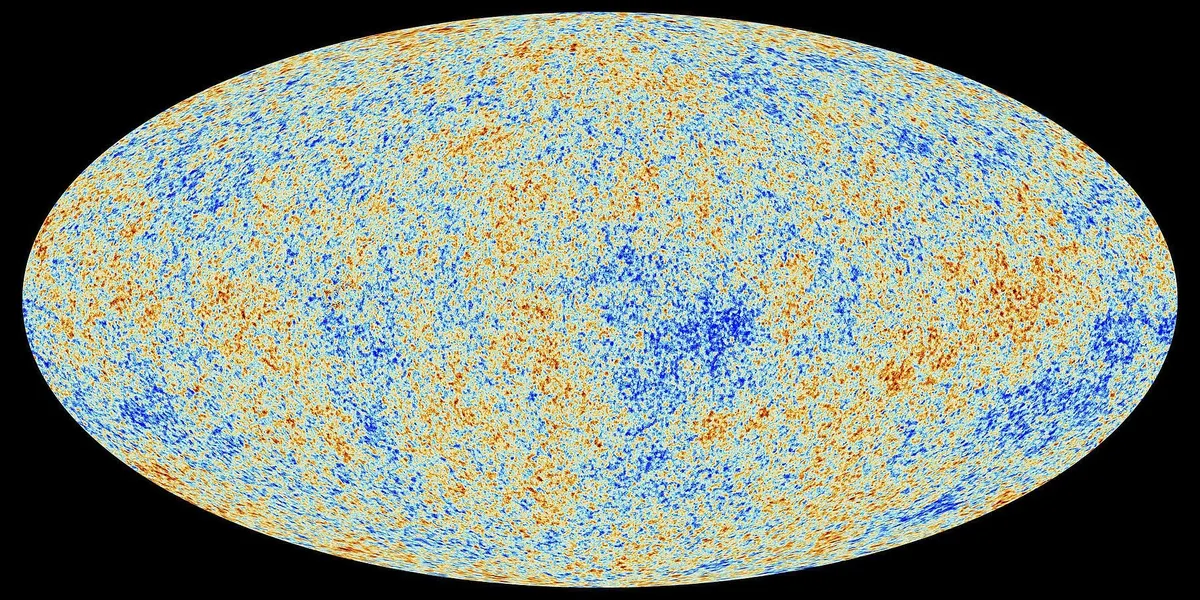
Stretched out by 13.8 billion years of cosmic expansion, that ancient light has cooled from a blinding glare to chilly microwaves. Planck mapped it across the entire sky in extraordinary detail. The map is mostly a single even temperature, but it is freckled with tiny hot and cold spots, differences of a hundred-thousandth of a degree. Those freckles are the seeds that later grew into galaxies, and their exact sizes and spacing encode the recipe of the early universe.
Reading the freckles tells you the age
This is the part that feels like a magic trick but is really just physics done carefully. The pattern of hot and cold spots in the cosmic microwave background depends on what the early universe was made of and how fast it was expanding. Feed that pattern into the equations of general relativity, Einstein's theory of how matter and space and time fit together, and you can run the clock backward to time equal zero, as NASA puts it. The spacing of the spots fixes the age.
Plugging in the freckle pattern also tells you the ingredients, and the recipe is humbling. Ordinary matter, the stuff that makes up stars and planets and everyone reading this, accounts for only about 4.9 percent of the universe. Another 26.8 percent is dark matter, invisible material we detect only by its gravity. The rest, the large majority, is dark energy, a mysterious push driving the expansion to speed up. The model that holds all this together, with its precise age, is called Lambda-CDM, and it fits the data with almost uncomfortable accuracy. Almost, and we will get to the crack.
The second clue: measure the expansion and rewind it
There is a completely different way to age the universe, and it leans on a single fact discovered nearly a century ago: distant galaxies are flying away from us, and the farther one is, the faster it goes. The universe is expanding. The number that captures how fast is the Hubble constant, named after Edwin Hubble.
If you know today's expansion rate, you can in principle reverse it, the way you would rewind a balloon deflating to figure out when it started inflating. From the cosmic microwave background, Planck's model gives an expansion rate of about 67 kilometers per second per megaparsec, meaning that for every megaparsec (about 3.26 million light-years) farther out you look, galaxies recede about 67 kilometers per second faster. Rewind that rate, with the dark matter and dark energy mix folded in, and you get the same answer the freckles gave: 13.8 billion years. Two independent methods, the oldest light and the expansion rate, agreeing to a fraction of a percent. That agreement is the real reason cosmologists trust the number.
The crack in the picture: the Hubble tension
Now the honest wrinkle, because the agreement is not perfect, and pretending otherwise would be lying about the science.
There are two ways to measure today's expansion rate, and they keep disagreeing. One reads it off the early universe through the cosmic microwave background, the Planck route, and gets about 67 to 68 kilometers per second per megaparsec. The other measures it directly in the nearby universe, using a chain of distance markers, pulsing stars called Cepheids and exploding stars called Type Ia supernovae, to clock how fast real galaxies are moving away. That local method, run by a team led by Adam Riess, gets a higher number, around 73 kilometers per second per megaparsec.
Those two numbers should match. They do not, and the gap has stubbornly refused to close. It is called the Hubble tension, and for years the obvious suspect was a mistake somewhere in the local measurement chain, some hidden flaw in how distances are read. That suspect has now been largely cleared. When the James Webb Space Telescope re-observed the same Cepheid stars with sharper eyes, it confirmed the Hubble measurements were accurate. Riess put it bluntly: "We've now spanned the whole range of what Hubble observed, and we can rule out a measurement error as the cause of the Hubble Tension with very high confidence."
So both numbers seem to be right, and they still disagree. NASA's own summary is that something may be wrong with our understanding of the early universe, with exotic particles, alternative theories of gravity, and early forms of dark energy all floating as candidates. Nobody has nailed it. Riess called what remains "the real and exciting possibility we have misunderstood the universe."
It is worth being precise about what the tension does and does not threaten. It does not knock 13.8 billion years off its perch; the age is anchored by far more than this one quarreling number, and a few percent disagreement in the expansion rate nudges the age only slightly. What it threatens is the comfortable sense that we have the full recipe. The freckles fit Lambda-CDM beautifully, and yet two good rulers held up to the same universe give different lengths. That is the kind of small, sharp discrepancy that has, more than once in history, pried open a whole new layer of physics.
What 13.8 billion years actually buys you
Step back from the decimal places and the number does something to your sense of scale. The Sun and Earth are about 4.6 billion years old, which means the universe was already two-thirds of its current age before our planet existed. The heaviest atoms in your blood and bones were forged inside stars that lived and died long before the Sun ignited, and the iron and gold in those stars trace back even further, toward that first clearing of the cosmic fog. You are made of very old material that has been recycled through generations of stars across most of cosmic time.
And the clock is still running. The same expansion we rewound to find the age is, right now, carrying distant galaxies away faster and faster. 13.8 billion years is not the universe's final age. It is just the reading on the odometer today, on a journey with no signs of stopping. The wonder is not only that the cosmos is this old. It is that a species barely two hundred thousand years into its own existence learned to read the universe's birth certificate off a faint glow in the sky, and got an answer it can defend to within a fraction of a percent.
Keep wondering: if the age stretches your mind, go bigger and ask how big the universe actually is, then look forward to what happens when our own Sun dies and the long, strange way that black holes eventually fade out.
Join the conversation
Comments are reviewed before they appear. Be kind and stay curious.
Loading comments…