
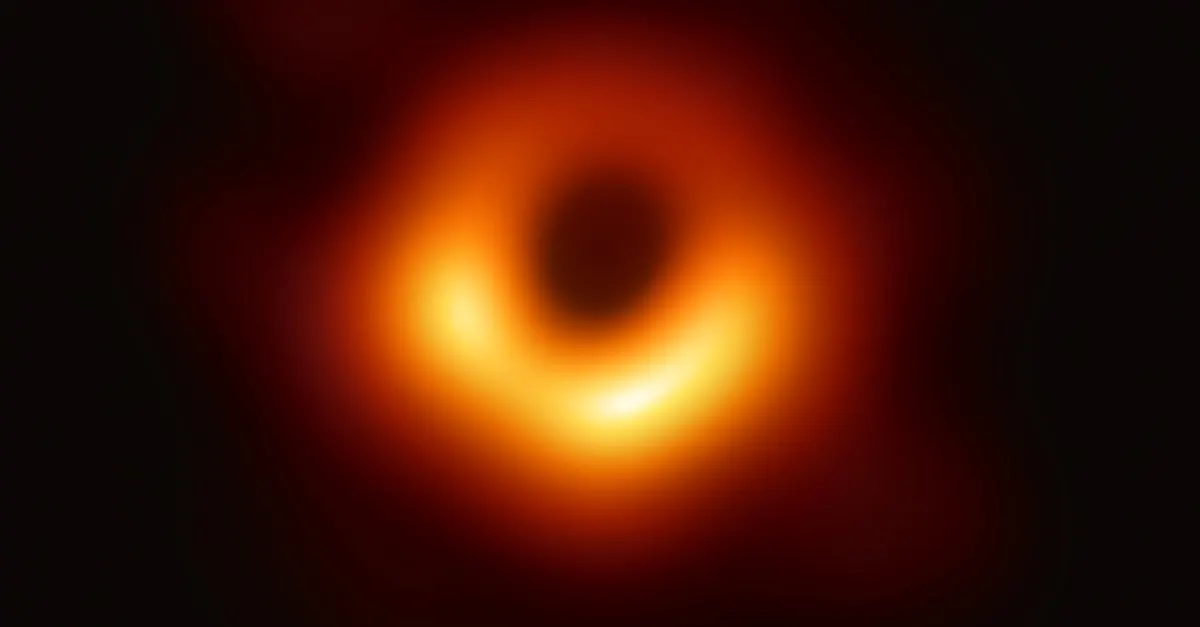
A black hole is the closest thing the universe has to a one-way door. Its gravity is so extreme that nothing, not even light, can escape once it crosses the edge, and what lies on the other side of that edge may be a question physics can never fully answer. For most of the 20th century, physicists assumed black holes were eternal: things only ever fell in, so they could only grow. Then a young Stephen Hawking did the math and found something astonishing. Black holes can, very slowly, die. But how do black holes die, if nothing can ever leave them?
They die by evaporating
Black holes die by evaporating. Thanks to a subtle quantum effect called Hawking radiation, a black hole continuously leaks a tiny trickle of energy into space. Over almost unimaginable stretches of time, that trickle drains the black hole's mass until it shrinks away to nothing and vanishes, possibly in a final burst. For a typical black hole, this takes far longer than the current age of the universe.
How anything escapes a one-way door
To see how something can escape a black hole, you have to zoom in on empty space itself. According to quantum physics, a vacuum is never truly empty. On the tiniest scales, pairs of "virtual particles", a particle and its antiparticle, constantly pop into existence and almost instantly annihilate each other, borrowing a flicker of energy and paying it back. This is happening everywhere, all the time, including right at the edge of a black hole.
Hawking's insight was about what happens when one of these pairs appears right at the event horizon, the point of no return. Occasionally, one partner falls in while the other escapes. The escaping particle carries energy away from the black hole. To keep the cosmic books balanced, the black hole has to pay for that escaped energy out of its own mass. So, particle by particle, the black hole loses a sliver of itself. From the outside, it looks as though the black hole is faintly glowing, radiating energy it should have been able to hold onto forever.
That faint glow is Hawking radiation, and it means a black hole isn't perfectly black after all. It has a temperature, and anything with a temperature radiates and eventually cools away.
Why the biggest black holes die slowest
Here's the twist that surprises everyone. You'd expect a giant black hole to die faster, more to lose. The opposite is true.
A black hole's temperature depends on its size, and the relationship is backwards from intuition: the smaller the black hole, the hotter it is and the faster it radiates. A small black hole is fierce and quick, blazing away its mass. A supermassive black hole, millions or billions of times the sun's mass, is unbelievably cold, barely above absolute zero, and leaks energy so slowly that the trickle is almost nonexistent.
So black holes don't all die on the same schedule. The little ones go first; the giants are the last things standing.
A number with 67 zeros
Just how slow is this? A black hole with the mass of our sun would take roughly 10^67 years to fully evaporate. Write that out and it's a 1 followed by 67 zeros. The universe is currently about 1.38 × 10^10 years old, a 1 followed by just 10 zeros. The sun-mass black hole would need to outlast the present universe by a factor so vast that the comparison loses all meaning.
The supermassive black holes at the centers of galaxies are even more patient, lasting something like 10^100 years, a span called a "googol" of years. There's a real sense in which black holes are the most durable objects the cosmos will ever produce. Long after the last of the stars that twinkle in our night sky has burned out and the universe has gone dark and cold, black holes will still be there, quietly glowing, the final embers of everything.
The final flash
When a black hole finally nears the end, the process runs away with itself. As it shrinks, it gets hotter; as it gets hotter, it radiates faster; which makes it shrink faster still. The last moments are not a whimper but a flash, the black hole's remaining mass converts to energy in a final burst, and then it's simply gone. The most inescapable object in the universe ends its life not by collapsing, but by evaporating, releasing back into space, atom by atom, everything it spent eons swallowing, from stray hydrogen to gold forged by colliding dead stars. The ultimate trap turns out to be the ultimate slow leak.
Keep wondering: most stars, including our sun, end as something far gentler than a black hole, and to grasp the timescales here, it helps to know just how big the universe is.
Join the conversation
Comments are reviewed before they appear. Be kind and stay curious.
Loading comments…