
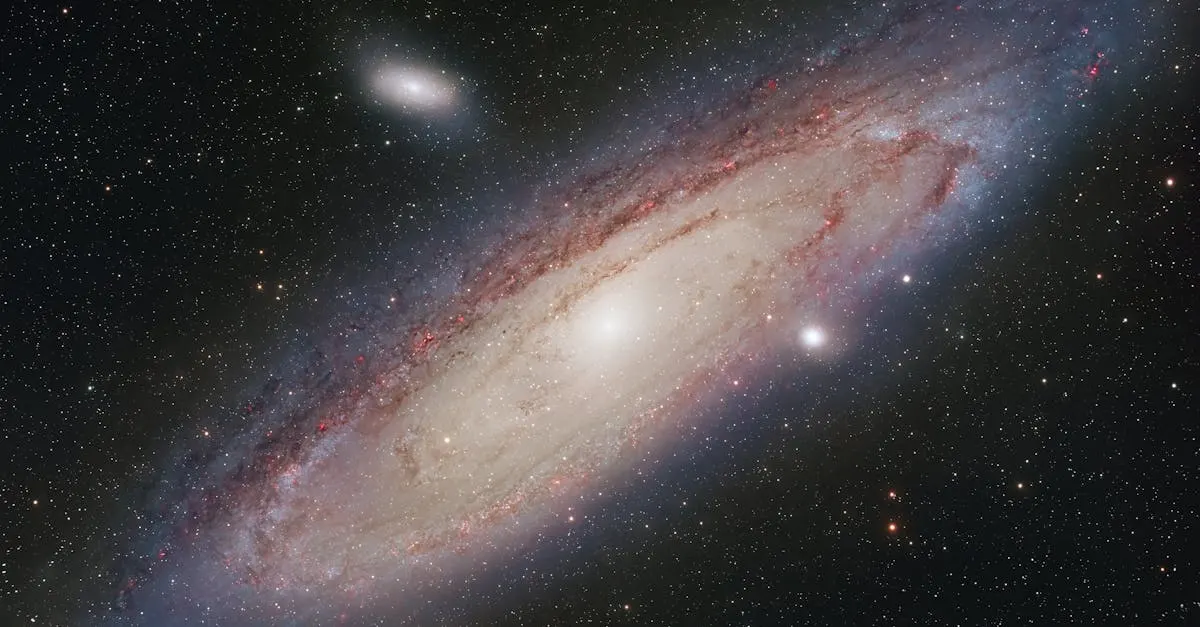
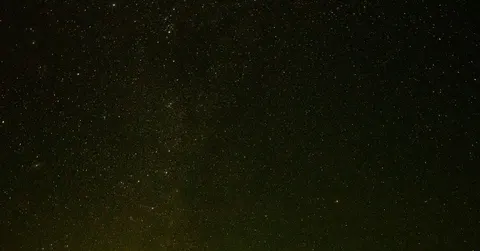
Step outside on a dark night and the universe looks big but countable, a few thousand twinkling stars, a hazy band of Milky Way. Just how big is the universe? So large that the human mind has no honest way to picture it. The numbers are real, though, and they lead to one of the strangest questions in all of science: does the universe have an edge, and if so, what's on the other side?
At least 93 billion light-years, probably far more
The observable universe, everything we could possibly see, is about 93 billion light-years across. But that's not the whole universe; it's just the part whose light has had time to reach us since the Big Bang. The complete universe is much larger, and may well be infinite, with no edge and no "outside" at all.
Why 13.8 billion years old means 93 billion light-years wide
First, the unit. A light-year is the distance light travels in one year, about 6 trillion miles. Light is the fastest thing there is, and the universe is measured in billions of them.
Now the puzzle that trips everyone up. The universe is 13.8 billion years old. You'd think that means we can see 13.8 billion light-years in any direction, the distance light could have traveled since the beginning. But we can actually see about 46.5 billion light-years in every direction, for a total span of roughly 93 billion light-years. How can we see farther than light has had time to travel?
The answer is that space itself has been stretching the entire time. When a distant galaxy emitted the light we're now receiving, it was much closer to us. While that light crawled across the cosmos, the space in between expanded, carrying the galaxy farther away. So the light traveled for 13.8 billion years, but the object that sent it is now some 46.5 billion light-years distant. The universe isn't expanding into anything; every point in space is simply getting farther from every other point, like raisins drifting apart in rising dough.
Why we can't see the whole thing
The 93-billion-light-year figure is the size of the observable universe, the bubble of space close enough that its light has reached us. Beyond that bubble lies more universe, but its light simply hasn't had time to arrive yet, and because the expansion is accelerating, some of it never will. That boundary is called the cosmic horizon. It's not a wall or an edge in space. It's a horizon in the same sense as the one at sea: a limit on how far you can see, not the end of the ocean. Stand somewhere else in the cosmos and you'd have your own 93-billion-light-year bubble, centered on you, overlapping ours.
So is there an edge?
As far as we can tell, no. Astronomers have measured the geometry of the universe with great precision, and on the largest scales it appears flat, meaning it could extend forever in every direction. Flat does not prove endless, though, and whether the universe is truly infinite is a question the measurement cannot quite close. If the universe is truly flat and infinite, then it has no center, no edge, and no boundary. It just keeps going.
That collides head-on with intuition. Our brains demand that everything be inside something. But the universe may be the one thing that isn't. Asking what is "outside" the universe may be like asking what is north of the North Pole, a grammatically fine question with no place to point. There may simply be no outside, because space and even the framework of "location" don't extend beyond the universe; they are the universe.
The scale, made (barely) imaginable
Try to climb the ladder. Earth is one of eight planets around the sun, and already the first rung breaks your sense of scale once you see how vast the sun is next to our planet: the sun alone could hold about 1.3 million Earths. The sun is one of roughly 100 to 400 billion stars in the Milky Way galaxy. The Milky Way is one of an estimated two trillion galaxies in the observable universe alone. Each of those galaxies holds its own hundreds of billions of stars, many with their own planets. The number of stars within reach of our telescopes outnumbers the grains of sand on every beach on Earth, many times over, and that's just the part we can see. In a cosmos this size, even the rarest events are routine; somewhere out there right now, dead stars are colliding and forging fresh gold.
Every glance into the depths is a glance into the past
Because light takes time to travel, looking out into space is also looking back in time. The sun you see is eight minutes old. The nearest big galaxy, Andromeda, appears as it was 2.5 million years ago. The most distant galaxies the James Webb Space Telescope can spot are shining as they were more than 13 billion years ago, near the dawn of everything. You can't see the universe as it is right now, only as it was. The night sky isn't a snapshot. It's the deepest history book in existence, with every page at a different distance.
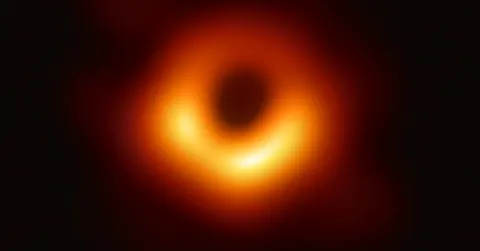
Keep wondering: this vast cosmos is full of stars living and dying, find out what happens when our own sun dies, and what becomes of the universe's strangest objects when black holes themselves die.


Join the conversation
Comments are reviewed before they appear. Be kind and stay curious.
Loading comments…