
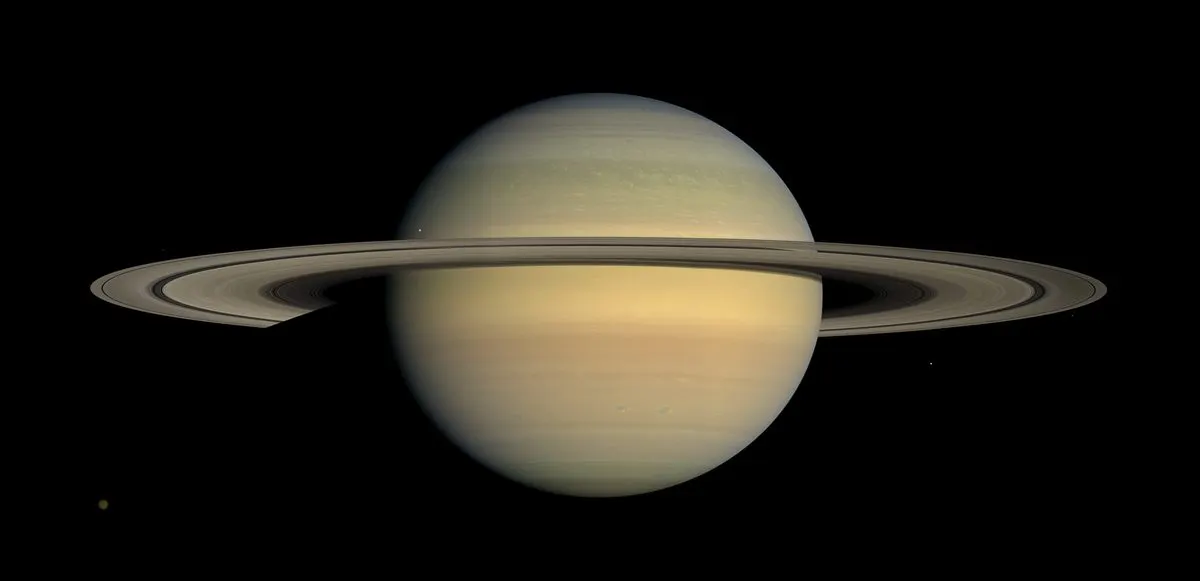
Saturn's rings look solid from a distance, like a vinyl record spun around a planet. They are not. They are a swarm, billions of separate pieces of nearly pure ice, each one orbiting Saturn on its own, the whole crowd packed so densely that from afar it reads as a single bright disk. Fly in close and the record dissolves into a blizzard. So what are Saturn's rings made of, and why is the answer mostly one surprising thing?
The short answer: it is almost all ice
Saturn's rings are made overwhelmingly of water ice, by most measures well over 95 percent and possibly above 99 percent, with only a thin seasoning of rocky dust and dark organic material mixed in. That is why they are so bright. Ice is an excellent reflector, so a ring system made mostly of clean ice throws sunlight back at us with a brilliance that rocky debris never could. The faint reddish-brown tint in places comes from that small contaminating fraction, the grit and soot caught up in the ice.
The pieces come in every size. The smallest are specks finer than a grain of sugar. The largest are boulders the size of a house. In between is everything you can imagine: snowballs, ice cubes, frozen rubble, all of it tumbling around Saturn at thousands of kilometers per hour, gently jostling and colliding. When you look at a photo of the rings, you are looking at a frozen avalanche that never lands.
Wide as a planet, thin as a whisper
The single most underappreciated fact about the rings is how flat they are. The main ring system stretches roughly 280,000 kilometers across, comfortably more than two-thirds of the distance from the Earth to the Moon. And yet, across most of that enormous span, the rings are only about ten meters thick. In places they thin to a few meters; in others, ruffled by small moons, they bunch up to a kilometer or so. But the basic ratio is staggering.
To picture it, scale the rings down. If you shrank the whole 280,000-kilometer disk to the width of a city block, the rings would be far thinner than a sheet of paper laid across it, thinner than the paper's own coating of ink. This is one of the flattest large structures known anywhere in the solar system. From directly edge-on, Saturn's rings nearly vanish, which is exactly what happened in 1612 when Galileo pointed his telescope at Saturn and the "ears" he had seen two years earlier had simply disappeared. He had no idea why. He was looking at the rings edge-on.
They are probably young, and that is strange
For centuries people assumed the rings were as old as Saturn itself, leftovers from the planet's formation 4.5 billion years ago. The Cassini spacecraft, which spent thirteen years at Saturn before its deliberate plunge into the planet in 2017, undercut that assumption.
By flying through the gap between Saturn and its innermost ring, Cassini measured the rings' total mass with new precision. The rings turned out to be relatively lightweight, and a low mass points to a young age. Here is the logic: the rings are constantly bombarded by tiny meteoroids and dusted with dark debris, which should grime them up over time. Bright, clean, low-mass rings look fresh, not ancient. The analysis suggested the rings may be no more than a few hundred million years old, with some estimates reaching 100 million years or less (CBS News).
Sit with that for a second. If the rings are a few hundred million years old, they did not exist when Saturn formed, did not exist for most of the dinosaurs' reign, and may have appeared on the cosmic equivalent of last Tuesday. The leading idea for how they formed is destruction: an icy moon, or a wandering comet, strayed too close and was torn apart by Saturn's gravity, its shattered remains spreading into the disk we see today. The age question is still genuinely debated, but the young-rings camp has the better recent data.
They are also disappearing
The rings are not only young. They are temporary, and we can watch them go.
Saturn's magnetic field and gravity are slowly draining the rings into the planet in a process called ring rain. Sunlight and tiny impacts give some ring ice particles an electric charge. Once charged, a particle gets caught by Saturn's magnetic field lines and pulled inward, where it falls into the upper atmosphere and vaporizes. James O'Donoghue and colleagues at NASA's Goddard Space Flight Center measured this rain and found it is heavy: enough water pouring out of the rings to fill an Olympic-sized swimming pool roughly every half hour (NASA Goddard). At that rate, O'Donoghue's team estimated, the rings could be gone in under 300 million years.
It may be faster still. During its final orbits in 2017, Cassini flew through the region between the planet and the rings and directly sampled material falling straight onto Saturn's equator, including not just water but organic compounds (National Geographic). That additional, equator-bound drizzle, on top of the magnetic ring rain, shortens some estimates to under 100 million years (Smithsonian Magazine). Either way, on the clock of the solar system, the rings are a passing feature.
We happen to be here for the show
Put the two findings together and you arrive at something almost eerie. The rings probably did not exist for most of Saturn's history, and they will not exist for most of its future. They are a feature of this particular era, a few hundred million years wide in a story that runs to billions. Humanity invented the telescope and pointed it at Saturn during the narrow window when the rings were there to be seen.
That is the part I find hard to shake. We did not just get a beautiful planet. We got it at the right moment. A civilization arriving a billion years too early, or a billion years too late, would have found Saturn bare, a fat striped ball with no halo at all, and never known what it missed.
Keep wondering: the rings survive partly because Saturn is so far from the Sun that the ice never melts, which connects to how cold is space; the same era of careful measurement that revealed the rings' age is what got Pluto reclassified as a dwarf planet; and Saturn itself will outlast the rings but not the Sun, so it is worth knowing what happens when the sun dies.
Join the conversation
Comments are reviewed before they appear. Be kind and stay curious.
Loading comments…