
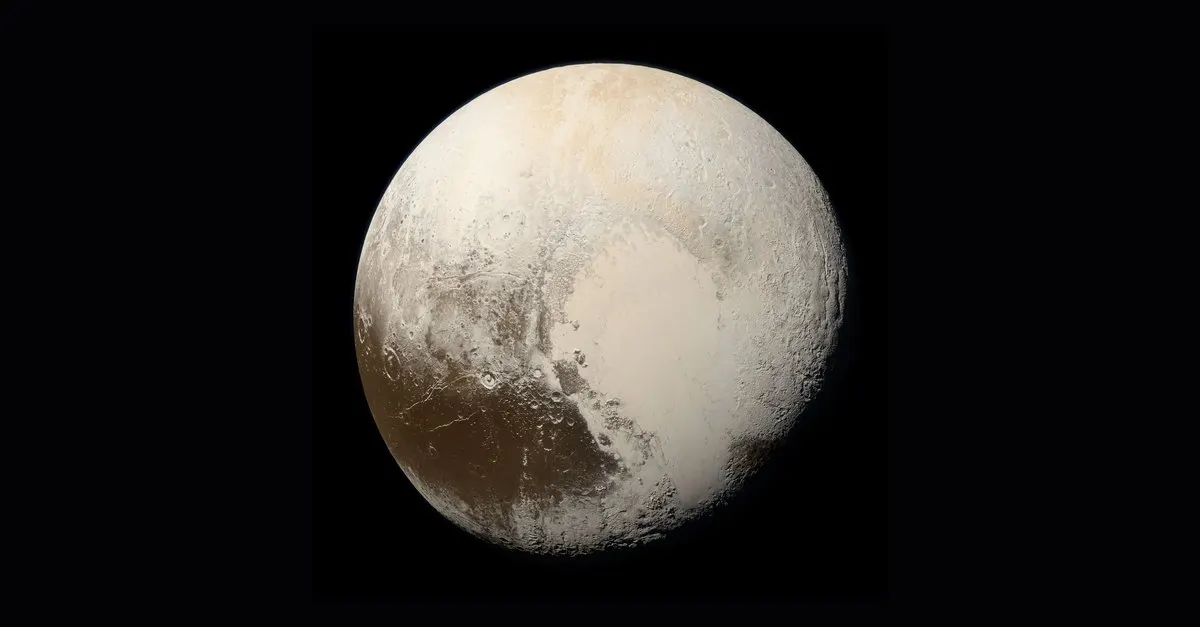
For 76 years Pluto was the ninth planet. Children memorized it at the end of the line, the small cold afterthought past Neptune. The solar system it once capped only gets stranger the closer you look, right down to how many moons Jupiter has. Then, on a single day in 2006, a few hundred astronomers in a conference hall in Prague voted it out of the club. So why is Pluto not a planet? Pluto itself did not move, shrink, or change. The definition of "planet" did, and Pluto fell on the wrong side of a brand-new line.
In plain terms, Pluto is not a planet because it never cleared its orbit of other objects. It shares its zone with countless icy bodies in the Kuiper Belt, so it fails one of the three rules the International Astronomical Union set for planethood in 2006. It passes the other two: it orbits the Sun and it is round.
The reason it was demoted is genuinely interesting, and it starts not with Pluto at all, but with a man who set out to find a tenth planet and ended up destroying the ninth.
The planet killer
In 2005 a Caltech astronomer named Mike Brown and his team spotted a distant object far beyond Pluto. Early measurements suggested it was larger than Pluto. The press called it the tenth planet. Brown's team eventually named it Eris, after the Greek goddess of strife and discord, and the name turned out to be perfect.
Eris forced a question nobody wanted to answer. If Pluto was a planet, then Eris, apparently bigger, had to be one too. And Eris was clearly just the brightest of a growing crowd of icy worlds being found out past Neptune. Astronomers were facing a choice: keep adding planets every time they found another big iceball, or finally write down what the word "planet" actually meant. Brown later wrote a book about the whole affair and titled it, without much remorse, How I Killed Pluto and Why It Had It Coming.
Three rules, and Pluto fails one
So in August 2006 the International Astronomical Union, the body that officially names things in the sky, gathered in Prague and put it to a vote. The new definition of a planet had three parts. To be a planet, a body must:
- Orbit the Sun. Pluto does this.
- Be round, pulled into a ball by its own gravity. Pluto manages this too.
- Have cleared the neighborhood around its orbit. Pluto does not.
That third rule is the one that did it. The idea is that a real planet is the gravitational boss of its lane. Over billions of years it has swept up, flung away, or captured nearly everything else that shared its orbit, until it stands alone. Earth has done this. So has Jupiter, spectacularly.
Pluto has not. It orbits inside the Kuiper Belt, a vast ring of icy debris beyond Neptune, and it is just one object among a huge swarm of them. It is so far from dominating its zone that it even crosses Neptune's orbit, ducking closer to the Sun than Neptune for part of its journey. The only reason the two never collide is that Neptune's gravity holds Pluto in a steady rhythm, three Neptune laps for every two of Pluto's. Pluto does not rule its neighborhood. It is a guest in Neptune's.
The vote nobody fully agreed on
The decision was not unanimous, and it was not even close to a full membership. Of the IAU's thousands of members, only a few hundred remained in the hall on the last day to raise their cards. The classification of Pluto passed by 237 votes to 157, with 17 abstaining. With that show of hands the solar system officially dropped to eight planets, and Pluto became the founding member of a new category: the dwarf planet.
A dwarf planet, the IAU decided, is a body that ticks every box but the third. It orbits the Sun and it is round, but it has never cleared its lane. Today there are five officially recognized dwarf planets: Pluto, Eris, Ceres in the asteroid belt, and the distant Haumea and Makemake. There are almost certainly more waiting to be confirmed.
The man who built the spacecraft refuses to accept it
Not everyone packed up and agreed. The loudest objector is Alan Stern, the planetary scientist who led NASA's New Horizons mission, the one spacecraft that has ever visited Pluto. Stern calls the 2006 definition "an awful definition; it's sloppy science and it would never pass peer review," and his core complaint is sharp.
His point: no planet has truly cleared its orbit. Earth shares its path with thousands of near-Earth asteroids. Jupiter drags a whole population of Trojan asteroids around with it. If you applied the "cleared the neighborhood" rule strictly, Stern argues, you could demote Earth too. He and others prefer a definition based on geology alone, where anything big enough to pull itself round counts as a planet, no matter where it orbits. Under that rule Pluto is a planet again, and so are dozens of other round worlds. The debate has never fully closed.
What we actually found when we got there
The cruelest irony is what Pluto turned out to be. For decades it was imagined as a dead, frozen marble. Then in July 2015, nine years after the demotion, New Horizons flew past and sent back the first close-up photographs. Pluto was anything but dead. It had mountains of water ice kilometers high, a vast heart-shaped glacier of frozen nitrogen slowly churning and flowing, a layered blue atmosphere, and signs of a possible ocean of liquid water hidden under its crust. It was one of the most geologically alive worlds in the entire solar system.
And it had a passenger. New Horizons carried a small sample of the ashes of Clyde Tombaugh, the astronomer who discovered Pluto in 1930 at Lowell Observatory in Arizona. The bright glacial heart his spacecraft revealed was named Tombaugh Regio in his honor. The man who found Pluto reached it at last, decades after his death, just as the world he discovered was being told it no longer counted.
So is Pluto a planet or not?
Officially, no. By the rules astronomers voted on in 2006, Pluto is a dwarf planet, demoted for the company it keeps rather than anything it did. But "dwarf planet" was never an insult, and the closer we look at Pluto, the less it behaves like a leftover. It is small, about two-thirds the width of our Moon, and it will never be the ninth planet on a classroom poster again. It is also a complicated, active, surprising place that a single show of hands could reclassify but could never make boring.
Keep wondering: see what will happen to our own Sun when it dies, get a sense of how big the universe actually is beyond Pluto's lonely orbit, and learn why the stars twinkle but the planets do not.
Join the conversation
Comments are reviewed before they appear. Be kind and stay curious.
Loading comments…