
Short answer: the empty space between the stars sits at about 2.7 kelvin, which is roughly -270.4C, or -454.8F. That is only a few degrees above absolute zero, the coldest temperature physics allows. So space is staggeringly cold.
Except that sentence hides a problem. Space does not really have a temperature at all, not the way a winter morning does. To see why "how cold is space" is a stranger question than it looks, you have to know what cold actually measures.
Temperature is a crowd, and space is empty
Temperature is a measure of motion. The faster the atoms and molecules in a thing jiggle, the hotter it is. Cool something down and you are slowing its particles; absolute zero is the point where that motion all but stops, fixed at exactly 0 kelvin, or -273.15C. Nothing can ever quite reach it.
Now look at deep space. A vacuum is nearly empty, sometimes just a handful of atoms per cubic meter. With almost no particles to move, there is almost nothing to take the temperature of. The 2.7 kelvin figure is not the temperature of the emptiness itself. It is the faint afterglow of the Big Bang, stretched over billions of years into microwaves, and that same glow is why space looks black to us even though it is quietly lit in every direction. It is the temperature of the light passing through it: the cosmic microwave background, the leftover glow of the Big Bang, which NASA's COBE satellite measured to be a near-perfect 2.725 kelvin. That radiation soaks the entire universe. It is the reason "empty" space has any temperature to quote at all.
Why you would not freeze the way movies show it
Here is the part that surprises people. On Earth, cold air or cold water strips heat from your body fast, because they are full of particles bumping into you and carrying warmth away. Solid metal pulls heat faster still, which is why a wet tongue can freeze fast to a cold metal pole. That is conduction and convection, and both need matter to work.
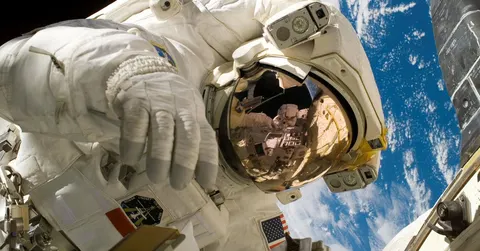
In a vacuum there is no matter to do the carrying. The same emptiness carries no sound either, which is why the Sun churns and roars without a whisper of it ever reaching us. The only way your body can lose heat is by radiating it as infrared light, and radiation is slow. So an astronaut who lost their suit would not flash-freeze. They would pass out from the lack of air in about fifteen seconds and die of decompression long before the cold ever finished the job.
The opposite trouble is often the real one. With no air to wick away warmth, spacecraft and spacewalking astronauts struggle to shed heat, especially on the side facing the Sun. Spacesuits run cooling water through tubes against the skin for exactly this reason. The void is cold, but it is a terrible refrigerator.
The same airless rock can be an oven and a freezer
Take away an atmosphere and a world stops sharing its heat around. The Moon is the clearest example. Stand at a sunlit spot and the ground climbs to over 120C. Step into the lunar night and the same ground plunges to about -130C. There is no air to even out the difference, so noon and midnight are separated by more than 250 degrees.
Worse, some craters near the Moon's poles have floors that sunlight has not touched in billions of years. NASA measures those permanently shadowed pockets at colder than -240C, among the chilliest spots in the entire solar system, and quite possibly holding ancient ice. Ice survives the deep cold all over the outer solar system, which is exactly what those bright bands around Saturn turn out to be made of.
The coldest places we know of
If 2.7 kelvin is the background hum of the universe, a few places have managed to dip below it. The Boomerang Nebula, a cloud of gas flung off a dying star about 5,000 light-years away, has cooled to roughly 1 kelvin. The gas is rushing outward so fast that it expands and chills, the same way the air from a spray can feels cold on your hand. For a while it is genuinely colder than deep space around it.
And the single coldest place anyone has ever found is not in deep space at all. It is in low Earth orbit, inside a box the size of a mini-fridge. NASA's Cold Atom Lab on the International Space Station chills clouds of atoms to about 100 nanokelvin, a hundred-billionth of a degree above absolute zero. That is more than ten million times colder than the void outside the station window. The emptiness of space, it turns out, is almost warm compared to what we can build.
So, how cold is space, really?
Pin it down and you get layers. The radiation filling space sits at 2.7 kelvin. A sunlit object can roast while its shaded side freezes. A dying nebula can dip to 1 kelvin, and a science freezer on the space station beats them all. The honest answer is that "the temperature of space" depends entirely on what you point the thermometer at, because the emptiness itself has almost nothing to measure.
What stays true is the strangeness. Space is one of the coldest environments imaginable and yet it cannot freeze you quickly, because cold needs something to touch you with, and out there, there is almost nothing to do the touching.
Keep wondering: find out what space actually smells like to the astronauts who come back from it, meet the tiny animal that shrugs off the vacuum entirely, see how astronauts sleep in a place with no up, no down, and no warm bed, and learn what gives a frigid, thin-aired neighbor its color in why Mars is red.



Join the conversation
Comments are reviewed before they appear. Be kind and stay curious.
Loading comments…