
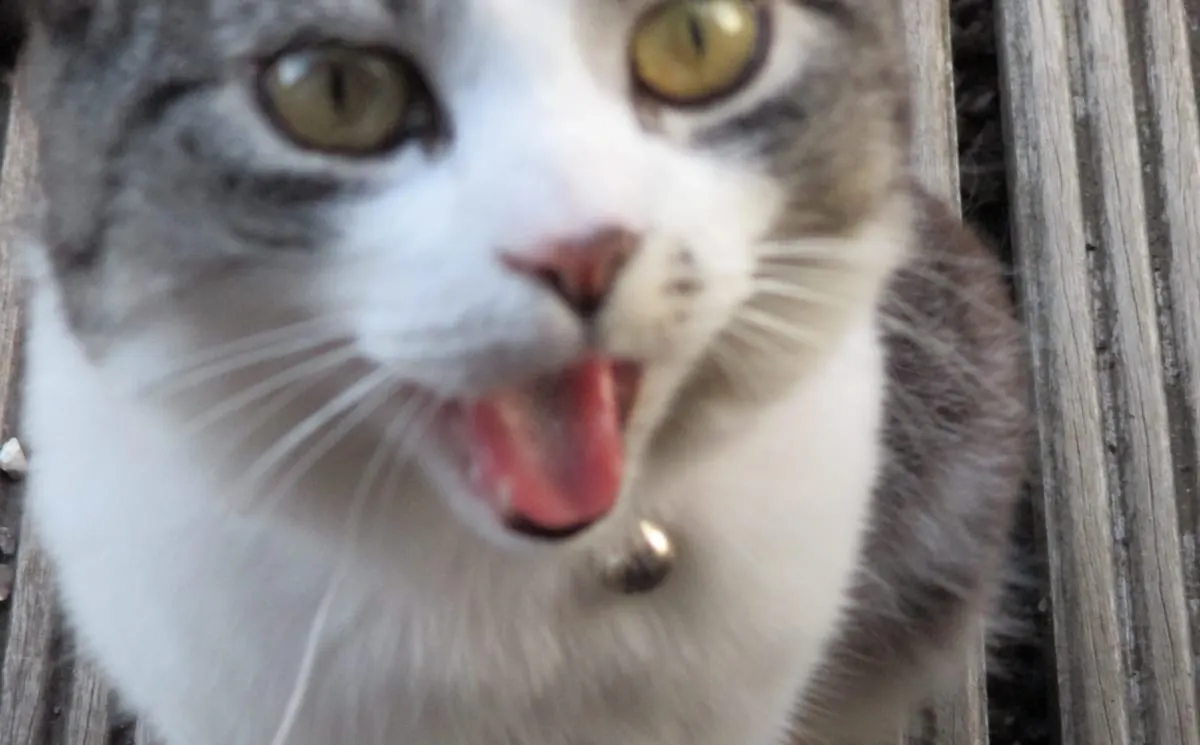
Your cat plants itself by the food bowl, looks straight at you, and meows. It feels like the simplest message in the world. Here is the strange part: your cat almost never makes that sound at another cat. Why do cats meow so much at people, then? Because the meow is barely a cat language at all. It is one your cat invented to talk to you.
The short answer: the meow is for humans
Among themselves, adult cats keep quiet, leaning on scent and body language. Meowing is mostly a kitten thing, and a human thing. "Outside of this relationship, cats rarely meow at each other," writes animal behaviour researcher Grace Carroll (The Conversation). The constant chatter you get is aimed squarely at the species that fills the bowl.
It starts with mom
Every kitten meows. It is how a kitten tells its mother it is hungry, cold, or lost. Feral cats mostly grow out of it, but house cats never do, because the habit keeps paying off. When your cat meows at you, it is treating you a little like its mother: the one who provides, comforts, and comes when called.
A sound tuned to your soft spot
Cats and humans have lived together for around 10,000 years, and cats largely domesticated themselves. The ones that could communicate with people did well, and over time the meow became a tool. Cornell researcher Nicholas Nicastro found that cats "have become very skilled at managing humans to get what they want -- basically food, shelter and a little human affection" (Cornell Chronicle).
The catch is that your cat does not actually know what its meow "means." "Cats do not know the meaning of their own meows," Nicastro explains; humans assign meaning to the sounds through long association. You and your cat slowly build a private dictionary, which is why your cat's owner can read it and a stranger cannot. Cats even sharpen the pitch of a pleading purr into something that resembles a baby's cry, slipping past our defenses the same way other animals exploit instincts we cannot switch off, like the contact-call instinct behind why dogs howl.
It is the same quiet inheritance from kittenhood that shows up when a grown cat settles on your lap and starts kneading: an infant behavior kept alive because you respond to it.
When the meowing is too much
A chatty cat is usually just being a cat. A sudden, sustained spike in meowing is different. Excess vocalizing can point to pain, an overactive thyroid or kidney disease in older cats, cognitive decline in senior cats, or a female in heat (ASPCA). If your normally quiet cat turns loud, or a talkative one gets louder, a vet visit is the safe move.
Keep wondering: the meow is a behavior cats bent to fit us, much like the comfort habit behind why cats knead, while dogs carry their own inherited voice in why dogs howl. For more on how animals work, explore Life on Earth.
Join the conversation
Comments are reviewed before they appear. Be kind and stay curious.
Loading comments…