
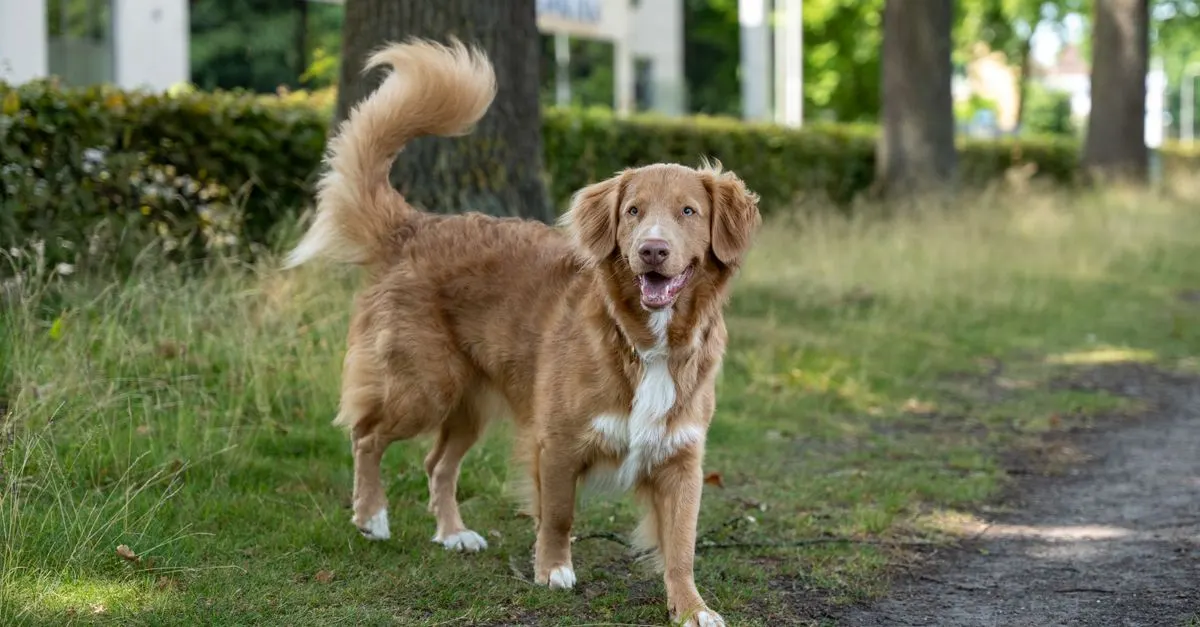
Wolves barely wag their tails. Dogs almost can't stop. Put a litter of wolf pups and a litter of dog pups side by side at a month old, and the dogs are already swishing away while the wolves stay still. That gap is the first clue that tail wagging isn't some leftover animal reflex. It's something dogs do, specifically, and far more than their wild cousins, and the reasons run deeper than the happy dog at the door.
A wag is a signal, not a smile
Here's the thing most people get wrong: a wagging tail doesn't simply mean a happy dog. Wagging tracks arousal, the intensity of what a dog is feeling, and that feeling can run either way (Biology Letters, 2024). A dog can wag while thrilled to see you, and a dog can wag while tense, uncertain, or working up to a bite. The tail is broadcasting how much the dog feels. The rest of its body fills in what. Read the wag alone and you're reading half a sentence.
That's why the speed and style matter more than the motion itself. A loose, low, whole-rear-end sweep is a different message from a high, stiff, fast flick at the very tip of the tail. The first is a relaxed greeting. The second is a dog on alert, keyed up and not yet decided. Both are "wagging." Only one is an invitation.
The secret in which way it swings
Now the part almost nobody can see with the naked eye. A dog's tail doesn't wag evenly. It leans.
In a 2007 study, researchers filmed dogs watching different things and measured the wag frame by frame. When a dog saw something it wanted to approach, like its owner, the tail swung wider to the right. When it saw something it wanted to back away from, like an unfamiliar, dominant dog, the wag pulled wider to the left (Current Biology, 2007). The split isn't random. The left half of the brain handles approach and positive feelings and controls the right side of the body; the right half handles withdrawal and controls the left. The direction of the wag is the dog's brain showing its hand.
Dogs can read it, even if we can't
Here's where it gets uncanny. A follow-up study showed the asymmetry isn't just a readout, it's a message other dogs pick up. Dogs watching a right-biased wag stayed calm. Dogs watching a left-biased wag grew anxious, their heart rates climbing (Current Biology, 2013). Neither dog is doing this on purpose. The wagging dog isn't choosing a direction, and the watching dog isn't consciously reading one. But the information passes anyway, a quiet channel running under the obvious one, invisible to the humans standing right there.
Why dogs wag and wolves don't
Which brings us back to that gap with the wolves. If wagging is such a useful signal, why do dogs do so much more of it? Two ideas are on the table, and they may both be partly true (Biology Letters, 2024).
The first is that wagging came along for the ride. When animals are bred for tameness, a cluster of traits tends to show up together: floppy ears, patchy coats, a more puppyish temperament. Famously, when Russian scientists bred silver foxes purely for friendliness, the tame foxes started wagging their tails like dogs, with nobody selecting for the tail at all. Wagging may simply be part of the package that comes with being calm enough to live alongside people.
The second idea is stranger, and a little flattering to us. Humans are wired to find rhythm rewarding: the steady beat of music, the pulse of repeated motion. As we bred dogs over thousands of years, we may have unconsciously favored the ones whose tails moved in that satisfying, metronome swing, because we liked watching it. If so, the famous happy wag has the story backwards. The wag didn't start as a sign the dog was happy. It stuck around because it made us happy. We may have built the wagging dog the same way we built the floppy-eared, soft-faced one: by choosing, over and over, the version that pulled at us. The tail at the door is real communication. It might also be a thing we taught the species to say.
Keep wondering: dogs have a whole vocabulary we're still decoding, from why they lick you to why they howl, and the cat across the room is running its own set of signals.

Join the conversation
Comments are reviewed before they appear. Be kind and stay curious.
Loading comments…