
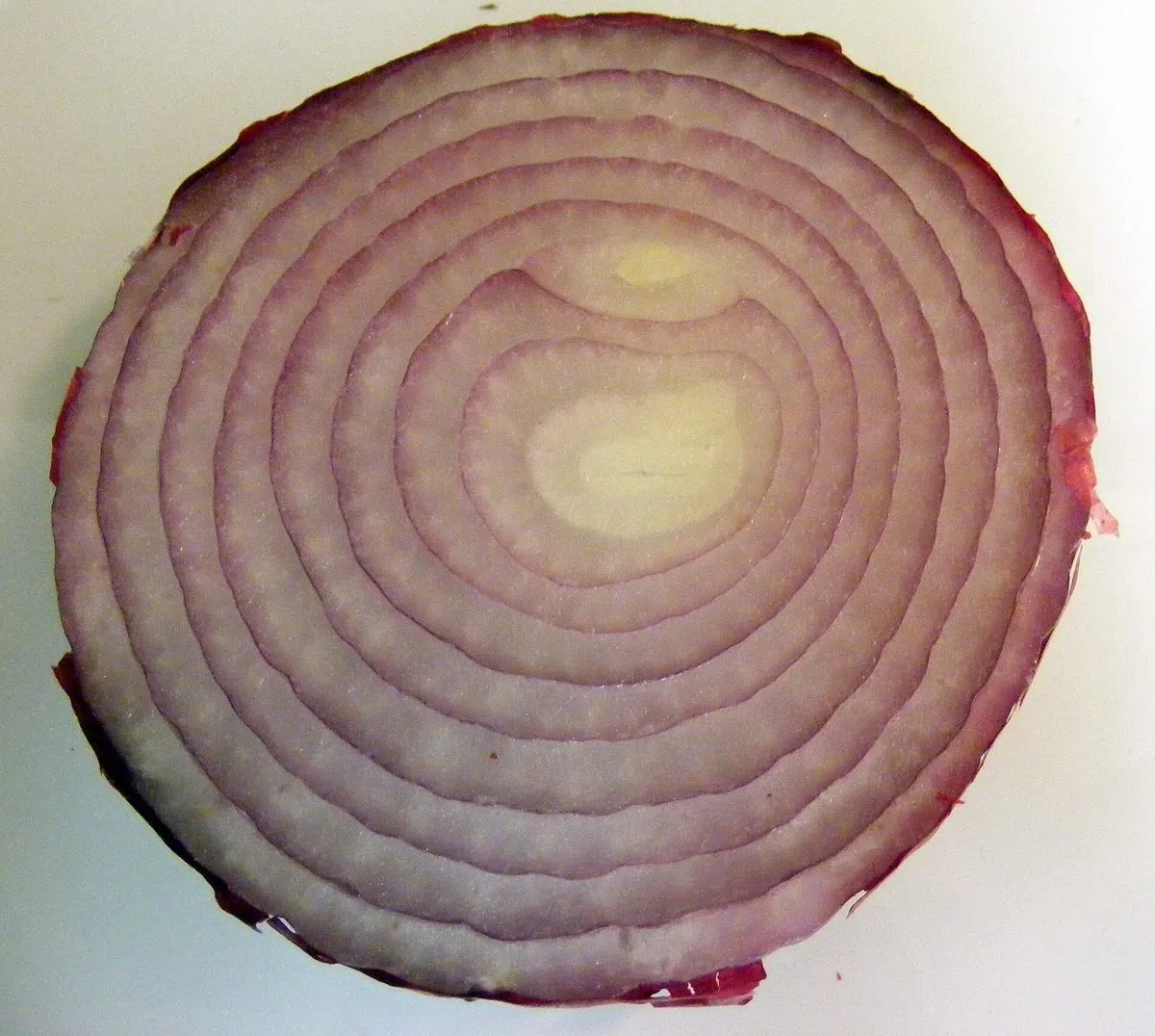
You are not sad. You are under chemical attack. The moment a knife breaks an onion open, the onion fights back, and your eyes are collateral damage. The tears are not emotional, they are a reflex flush, your body trying to rinse away a tiny cloud of homemade acid. Why do onions make you cry? Here is exactly how the onion pulls it off, and how to disarm it.
The short answer: a self-defense weapon, assembled on contact
An intact onion is harmless. It does not smell of much, and it will not make you cry sitting on the counter. The weapon only gets built when you damage it, which is the whole point. An onion cannot run from a hungry animal, so it stores the ingredients for an irritant separately and snaps them together the instant something bites or cuts into it (Library of Congress). Slicing one is, from the onion's point of view, an attack, and it responds to attacks.
The two-step chemical reaction
When the blade ruptures the cells, it mixes two things that were kept apart: stored sulfur compounds and the enzymes that act on them.
The first enzyme, alliinase, goes to work immediately, converting the onion's sulfur-bearing amino acids into unstable molecules called sulfenic acids. On their own, those would just smell oniony. But onions have a second enzyme that most of their relatives lack, lachrymatory-factor synthase, or LFS. It seizes the sulfenic acid and rearranges it into a small, volatile, airborne molecule: syn-propanethial-S-oxide, the actual tear gas (Poison Control).
That second enzyme is the real culprit, and that is a relatively recent discovery. For decades, chemists pinned the crying on alliinase alone. Then, in the early 2000s, Japanese researchers showed that LFS is the molecule that builds the lachrymator, work playful enough to earn an Ig Nobel Prize, and important enough that the enzyme's full crystal structure was later mapped (ACS Chemical Biology). Garlic, leeks, and chives carry the sulfur and the alliinase, but not LFS, which is why chopping them is pungent yet tear-free. Plants put this sulfur chemistry to all kinds of uses: the corpse flower loads its bloom with sulfur and amine compounds to reek of rotting flesh and pull in pollinators.
How a vegetable makes acid on your eyeball
The syn-propanethial-S-oxide is light and volatile, so it lifts off the cutting board and floats up toward the warmest, wettest target nearby: your eyes. When it lands on the thin film of tears coating your cornea, it reacts with the water and forms a trace amount of sulfuric acid (Chemistry World).
The quantity is minuscule and completely harmless, but your eye does not stop to measure it. Sensitive nerve endings detect the irritant and fire off an alarm, and your lacrimal glands respond the only way they know how, by producing a flood of tears to dilute and wash the offender away. The stinging and the watering are the same defensive reflex you would get from smoke or a speck of grit, just triggered by a molecule a vegetable manufactured on demand.
It is, like a lot of the body's protective machinery, automatic and impossible to override by willpower, in the same family as the reflexes behind why you cannot tickle yourself. You cannot decide not to react. You can only keep the gas away from your eyes.
How to actually stop the crying
Every effective trick targets one of three things: how much gas gets made, how fast it forms, or whether it reaches your eyes.
- Chill the onion first. Fifteen to thirty minutes in the fridge slows the enzyme reaction and cuts how much volatile gas escapes. This is the single most reliable fix.
- Use a genuinely sharp knife. A sharp blade slices cells cleanly; a dull one crushes and ruptures far more of them, releasing more enzyme and more gas. Sharper knife, fewer tears, almost literally.
- Add airflow. Cut near a running fan, an open window, or a range hood so the gas is carried away from your face instead of rising to your eyes.
- Save the root for last. The base of the onion, the hairy root end, holds the highest concentration of the sulfur compounds. Cut it last to delay the worst of the release.
The much-repeated tip about cutting onions under running water works for the same reason, it intercepts the gas, though it makes for awkward, slippery knife work. Plant breeders have even produced genuinely low-irritant onions by dialing down the LFS pathway, so a future of tear-free chopping is not science fiction. Until those are in every shop, a cold onion and a sharp knife will get you most of the way there.
Keep wondering: the onion reflex is involuntary in the same way you cannot tickle yourself; your brain runs plenty of other automatic responses you never chose, like the urge behind why we want to squeeze cute things; and for another everyday glitch in perception, see what causes deja vu.



Join the conversation
Comments are reviewed before they appear. Be kind and stay curious.
Loading comments…