
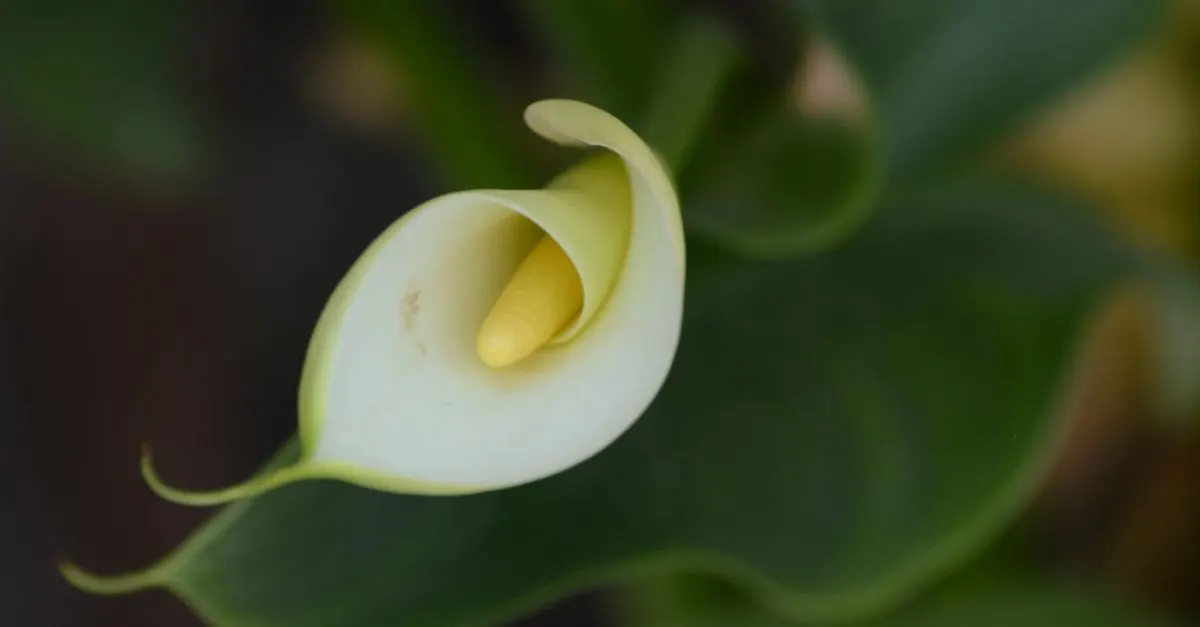
Most flowers spend their whole evolutionary career trying to smell nice. The corpse flower spent it trying to smell like something died. People line up for hours, pay for tickets, and crowd into greenhouses for the privilege of standing near a plant that reeks of roadkill. It is one of the few times a crowd gathers specifically to gag, and the reason it stinks turns out to be a piece of cold, clever strategy.
The corpse flower smells like death because death is what brings its pollinators
The corpse flower (Amorphophallus titanum) smells like a rotting body because that scent is exactly what its pollinators are hunting for. It does not want bees or butterflies. It wants the flies and beetles that lay their eggs in dead animals, and the fastest way to summon them is to pretend to be a fresh carcass (Chicago Botanic Garden). The smell is not a side effect or a flaw. It is the entire sales pitch.
Native to the rainforests of Sumatra, the plant produces the largest unbranched flowering structure in the world, a towering spike that can reach three meters tall (Kew). Inside the deep red, meat-colored chamber at its base sit the real flowers. The whole giant structure exists to stage one convincing performance of decay.
The chemistry of a fake corpse
The stink is not one smell but a recipe, and most of the ingredients are borrowed straight from actual rot. The two loudest notes are sulfur compounds: dimethyl trisulfide, which carries a rotting, fleshy odor, and dimethyl disulfide, which smells sharply of garlic (Compound Interest). Both have some of the lowest odor thresholds known, meaning the human nose can pick them out even diluted to parts per billion (Chemistry World).
Layered on top is a small cabinet of horrors. Trimethylamine adds the tang of rotting fish, and isovaleric acid the smell of sweaty feet (Compound Interest). And putrescine, a compound named for putrefaction itself, supplies the base note of decaying meat (Chemistry World). What makes this genuinely sly is the source material. Researchers at Dartmouth College traced the plant building its sulfur compounds from the amino acid methionine, and its putrescine from arginine, the same chemical pathways that drive real flesh as it breaks down. The flower is not imitating death from the outside. It is running a chemical version of the real process.
A flower that turns up the heat
Here is the part that pushes the corpse flower from gross to genuinely strange. Smelling like a carcass is useless if the smell stays trapped near the plant, so the flower does something almost no plant bothers to do. It heats itself up.
Just before and during the bloom, the central spike, called the spadix, warms by as much as 11 degrees Celsius through a process called thermogenesis, climbing to roughly the temperature of a living human body (Chemistry World). That warmth does two jobs at once. It vaporizes the heavy sulfur molecules so they lift into the air and travel, and it makes the whole spike feel convincingly like fresh, warm meat to an insect crawling across it. The payoff is range. With the heat doing the broadcasting, the stench can reach carrion insects from up to half a mile away (Kew).
The insects that answer the call are exactly the ones the plant is targeting: flesh flies and carrion beetles, the cleanup crew of the forest floor, programmed to find dead things and breed in them (Chicago Botanic Garden). They arrive expecting a meal and a nursery, blunder through the meat-colored chamber, and leave dusted with pollen, having been paid in a promise the flower never keeps.
The rarest bad smell in the world
For all that effort, the show almost never happens. A young corpse flower needs seven to ten years just to bank enough energy for its first bloom, and later blooms can be years apart (Chicago Botanic Garden). When the moment finally comes, the open flower lasts only 24 to 36 hours, and the famous stench peaks for a single evening before fading (Kew).
That is why botanical gardens make an event of it and why people will queue around the block to smell something awful. You are not just catching a bad odor. You are catching a once-in-a-decade burst of one of evolution's strangest gambles, lit up for a few hours and then gone. The corpse flower deceives its pollinators the way a Venus flytrap deceives its prey, by promising one thing and delivering another, and it works for the same reason every good trick works. It targets an instinct the audience cannot switch off, the same way a moth cannot stop steering toward a light.
There is a quiet kind of honesty in it, too. The flower never claims to be pretty. It just figured out, over millions of years, that in a forest full of plants competing for the same handful of polite pollinators, the open lane was the one nobody wanted. Smelling like death is not its problem. It is its whole solution.
Keep wondering: see how a Venus flytrap pulls off its own deadly trick, why moths can't stop flying toward light, and how bees turn flowers into honey.

Join the conversation
Comments are reviewed before they appear. Be kind and stay curious.
Loading comments…