
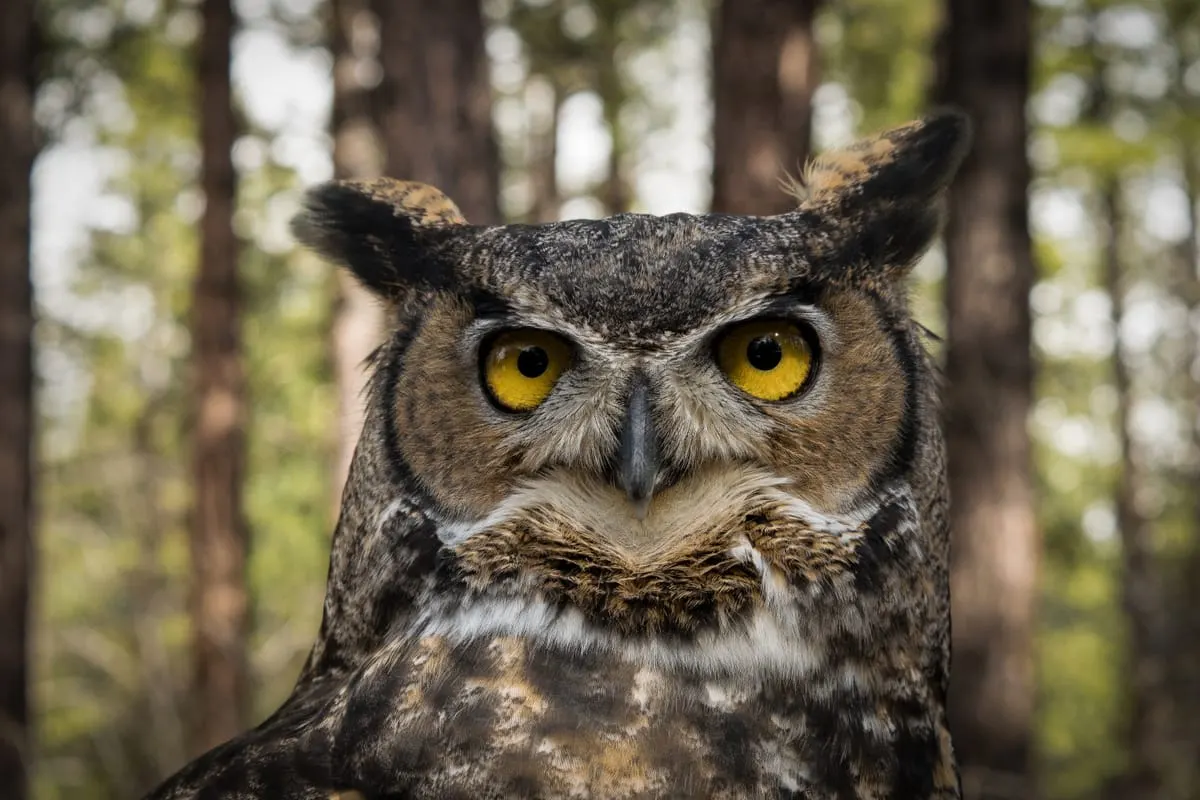
A low, round hoo drifts out of the dark trees, the noise every spooky film reaches for after sunset. We treat it as the voice of the night itself. To the owl, it is something far more practical, closer to a property line and a personal ad rolled into one.
A voice made for the night shift
So why do owls hoot? Because they live and hunt in the dark, and in the dark a far-carrying call does the job that bright feathers and display flights do for daytime birds. A hoot mainly stakes out territory, telling rival owls the patch is occupied, and helps a bird attract and keep a mate (Cornell Lab of Ornithology). It is communication tuned for a world where almost nobody can see you. Sound travels; a silhouette in a black wood does not.
Hooting is only a slice of what owls can say. Across the world's owls, researchers have recorded more than 200 distinct calls, from barks and hisses to screeches, whistles, and chuckles (Cornell Lab of Ornithology). As one Cornell Lab recordist put it, "people just don't realize owls make so many different sounds, or don't recognize what they're hearing." The deep hoot we all imitate is the famous one, but it is one word in a much larger vocabulary.
Not every owl hoots
Here is the first surprise. The bird most people picture making spooky screeches in a horror film, the pale, heart-faced Barn Owl, does not hoot at all. It hisses, grunts, and lets out a long, raw scream that sounds genuinely unsettling, and it uses those shrieks, not hoots, to communicate (Audubon). The classic hoot belongs to other species. North America's Great Horned Owl gives the textbook soft, stuttering hoots, and the Barred Owl is famous for a call that birders hear as "who cooks for you, who cooks for you-all."
So "owls hoot" is a bit like saying "birds sing." Some do, in their own dialects, and some make sounds you would never guess came from an owl at all.
The twit-twoo is two owls, not one
Now the detail that quietly rewrites a childhood memory. The classic "twit-twoo," the sound we all think of as one owl hooting, is not one owl. It is a duet between two Tawny Owls. The female makes a sharp, rising "ke-wick," and the male answers with the long, wavering "hoo" (Woodland Trust). Pairs often call back and forth like this through the night, the male hooting and the female dropping her note into the gaps (British Trust for Ornithology).
That means every cartoon owl going "twit-twoo" to itself is doing something no real owl can do alone. The sound you have carried in your head your whole life is a conversation, a male and a female in the dark, marking out their patch and keeping track of each other one call at a time. The night is not hooting at you. It is two birds, talking.
Keep wondering: another bird broadcasts on a schedule in why roosters crow, the wolfish version of a long-distance call is why dogs howl, and birds pull off quiet feats of physics like why a flamingo stands on one leg.
Join the conversation
Comments are reviewed before they appear. Be kind and stay curious.
Loading comments…