
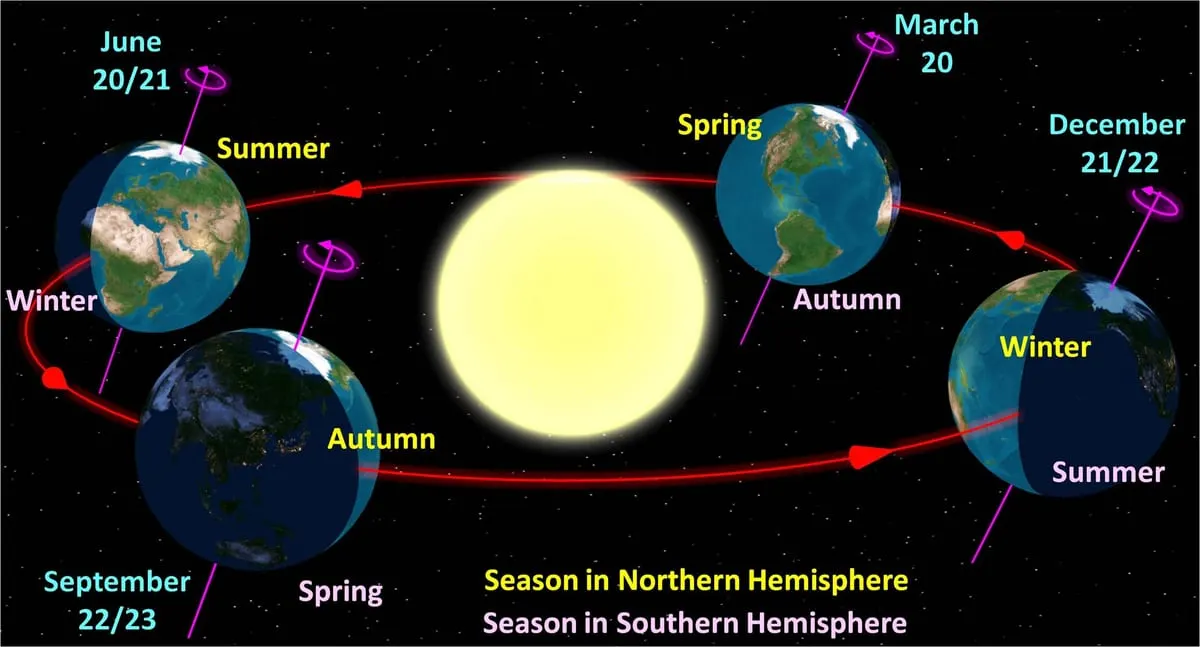
Plenty of people will tell you summer is when Earth swings closer to the Sun and winter is when it drifts away. It feels obvious, it's tidy, and it's flatly wrong. The calendar itself proves it.
It's the tilt, not the distance
So why do we have seasons? Because Earth spins on a tilted axis, leaning about 23.5 degrees off vertical, and that tilt, not our distance from the Sun, is what makes the year change (NOAA National Weather Service). Here's the fact that kills the distance myth on contact: Earth is actually at its closest to the Sun in early January, smack in the middle of Northern Hemisphere winter, and at its farthest in early July, during summer (NASA Space Place). If closeness made summer, the seasons would be backwards. On top of that, the distance only varies by about 3 percent over the year, nowhere near enough to flip warm to cold (NOAA NESDIS).
The real engine is the lean.
What the tilt actually does
Because Earth is tilted, the two halves of the planet don't get the Sun's light equally as we orbit. For half the year, your hemisphere leans toward the Sun. That does two things: the Sun climbs higher in your sky, so its light hits the ground more directly and concentrated, and your days get longer. More direct light plus more hours of it equals summer. Six months later, your hemisphere leans away. Now the sunlight arrives at a shallow slant, spread thin across the ground, and the days are short. That's winter (NASA Space Place).
It's the same Sun, the same Earth, the same rough distance. The only thing that changed is the angle the light is hitting you. Seasons are a story about geometry, not proximity.
Why your summer is someone else's winter
The tilt also explains a fact that should feel stranger than it does: when it's summer where you are, it's winter on the other side of the planet. That's because the axis points one fixed direction in space all year. So at any given moment, one hemisphere is leaning toward the Sun while the other leans away (Smithsonian Science Education Center). While the Northern Hemisphere bakes in July, the Southern Hemisphere is in the depths of winter, and in January it's the reverse. There's no single global "summer." There's only which way your half of the world happens to be leaning.
The solstices and equinoxes are just the signposts along that orbit. A solstice is the moment a hemisphere tilts most toward or away from the Sun, the longest or shortest day of the year. An equinox is when the tilt favors neither side, and day and night land at nearly equal length almost everywhere (NOAA National Weather Service).
So the next time someone says it's hot because Earth got closer to the Sun, you can gently break the news: in the Northern Hemisphere, we're actually nearest the Sun in the dead of winter. Summer isn't about closing the distance. It's about tipping your part of the world toward the light.
Keep wondering: a tilt-free runaway oven is the story of why Venus is the hottest planet, our nearest neighbor hides in plain sight in can you see the Moon during the day, and the same sunlight paints the daytime in why the sky is blue.



Join the conversation
Comments are reviewed before they appear. Be kind and stay curious.
Loading comments…