
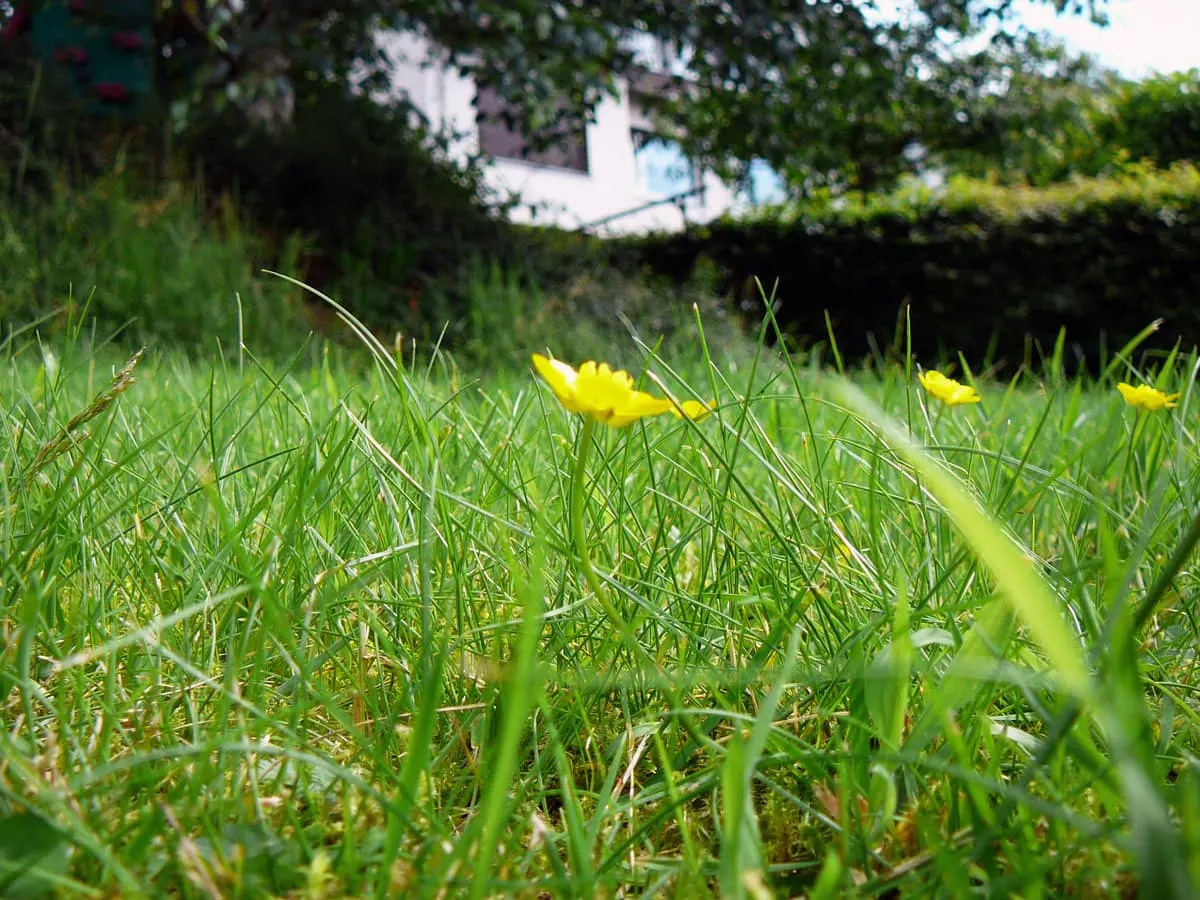
There are two questions hiding inside a green lawn. The easy one is what makes grass green. The hard one, the one that stumped scientists for decades, is why it settled on green and not some other color, or no color at all.
The pigment that eats red and blue
Why is grass green, really? Here's the easy half: chlorophyll, the pigment packed into its cells that drives photosynthesis, the process plants use to turn sunlight into food. Chlorophyll does not grab all of sunlight evenly. It absorbs light strongly at the blue and red ends of the spectrum and only weakly in the green (University of Minnesota). Those absorption peaks fall at roughly 430 nanometers in the blue and around 660 in the red. The red and blue go into running the plant. The green is mostly turned away.
That rejected green is what reaches your eyes. So the color we most associate with living, growing, healthy plant life is, in a sense, the one color the plant has the least use for. We see grass as green precisely because green is the part of the sunlight it bounced back.
The part that doesn't add up
Now the hard half, and it is genuinely strange once you notice it. Sunlight is brightest in the middle of the visible spectrum, right around green. If a plant wanted to harvest as much raw energy as possible, the obvious move would be to gobble up that abundant green light too, which would make plants look black. Instead, plants do the opposite and throw a big chunk of their richest available light away. For a long time nobody had a clean explanation for why (Quanta Magazine).
A 2020 study offered an elegant answer: it is not about grabbing the most energy, it is about grabbing it steadily. The researchers showed that photosynthetic machinery works best when its energy supply is smooth and predictable, and that the way to get a smooth supply is to absorb light at the steep edges of the solar spectrum, in the red and the blue, while skipping the bright but flat middle (University of California, Riverside). Drinking from the calm edges instead of the choppy peak keeps the plant from being jolted by every flicker of changing light. As the study's lead author, the physicist Nathaniel Gabor, put it, "by absorbing only very specific colors of light, photosynthetic organisms may automatically protect themselves against sudden changes, or 'noise,' in solar energy, resulting in remarkably efficient power conversion."
A color that means "no thanks"
Put the two halves together and the everyday green of a lawn turns into something deeper. The plant is not green because green is special to it. It is green because green is the light it deliberately leaves on the table, the cost of a system tuned for a steady, reliable trickle of energy rather than a greedy, unstable feast. One of the co-authors, the botanist Richard Cogdell, said the insight was so basic it embarrassed him: "How could I be so dumb not to think about this before?" (Quanta Magazine).
So the next time you look at a green field, you are looking at a rejection slip the size of a meadow, billions of plants all bouncing back the exact color they chose not to use. The world is green because life decided that steady beats greedy.
Keep wondering: the same physics of light and color answers why the sky is blue, plants pull off stranger tricks in how a Venus flytrap works, and another everyday substance defies expectations in why ice floats.


Join the conversation
Comments are reviewed before they appear. Be kind and stay curious.
Loading comments…