
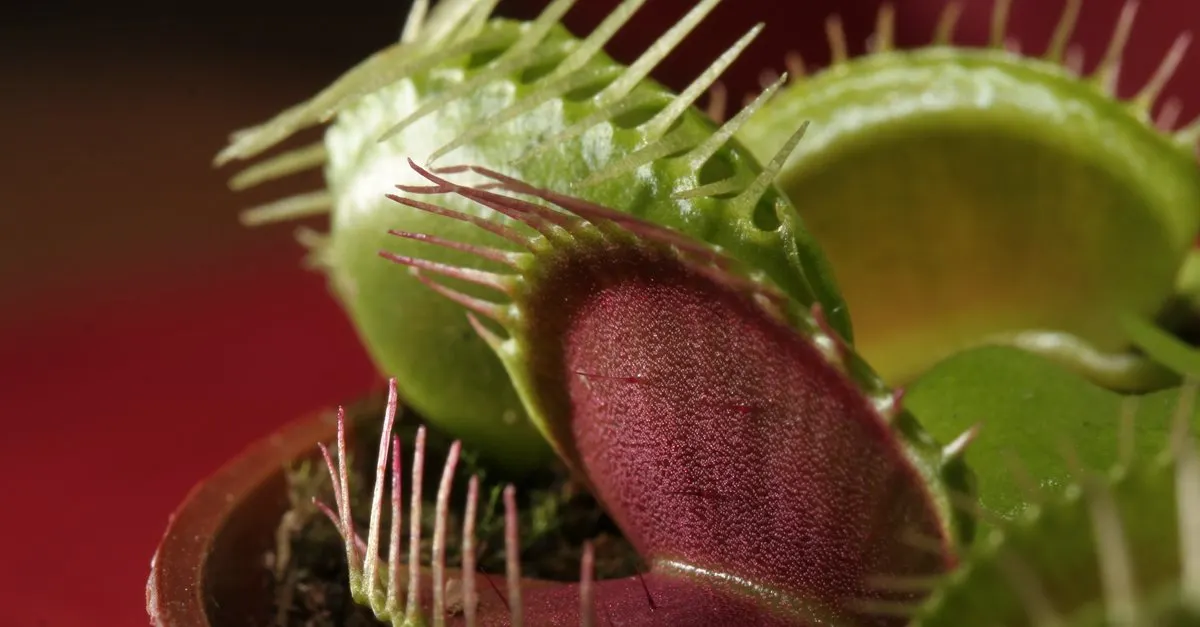
A fly lands on a leaf in a North Carolina bog. It brushes one of the tiny hairs sticking up from the pink interior. Nothing happens. It takes another step, grazes a second hair, and in about a tenth of a second the leaf folds over it like a closing hand. The plant just made a decision, and it made it by counting. How does a Venus flytrap work, and how does a plant with no brain know when to snap?
A Venus flytrap works by counting touches, not by feeling weight
Here is how a Venus flytrap works: each lobe of the trap carries a few stiff trigger hairs, and bending one fires a tiny electrical pulse called an action potential. A single ordinary touch does not normally close the trap. It usually snaps when a second action potential arrives within roughly 20 to 30 seconds of the first, so a raindrop or a gust of grit is less likely to spring it. A sufficiently strong single stimulus can sometimes generate the required pair of signals (plant electrophysiology study). In its own way the trap is filtering out touches that don't matter, a little like the way your brain tunes out your own movements, which is why you can't tickle yourself. Once shut, more touches from the struggling insect tell the plant to start digesting. The snap itself isn't a muscle clenching. It's stored elastic tension released all at once, like a contact lens flipping inside out.
Trigger hairs are the wiring, and they fire like nerves
Each trap lobe has three (sometimes more) sensory hairs on its inner face. They aren't sticky and they don't grab anything. They're levers. When an insect bends a hair, the deflection stretches mechanically sensitive cells at its base, and that opens ion channels. The result is an action potential, an electrical wave that spreads across the whole lobe in milliseconds, driven largely by a surge of calcium ions. Animal nerves and muscles run on the same basic trick. The flytrap has no neurons, yet it built a fast electrical signaling system out of ordinary plant cells.
That signal is also the plant's short-term memory. Each touch dumps calcium into the leaf cells, and the calcium slowly leaks back out. One touch raises the level partway. A second touch, arriving before the calcium drains, pushes it past a threshold and the trap fires. Wait too long and the memory fades. Researchers have tracked this rising and falling calcium directly, watching it glow in plants engineered to light up when calcium spikes.
How a leaf moves faster than most animals can react
The closing motion is one of the fastest in the plant kingdom, and there isn't a muscle anywhere in it. In the open state the lobes are curved inward, concave, held under tension like a bent ruler. When the action potential arrives, the leaf rapidly changes the water pressure (turgor) in specific layers of cells. That tiny shift in curvature trips the leaf past a tipping point, and the lobes snap from concave to convex in a buckling instability, the way a children's popper toy flips and jumps. The plant spends a little energy priming the trap and lets physics do the violent part.
Why a plant bothered to learn arithmetic
This is the detail I find genuinely strange: the flytrap doesn't just count to two, it keeps counting. In 2016, Rainer Hedrich, Jennifer Böhm and colleagues at the University of Würzburg published work in Current Biology showing the trap tallies each action potential and changes its behavior at specific counts. The second pulse closes the trap. The third is linked to switching on digestive-gland genes. By around five, the plant turns on the digestive enzymes and a sodium transporter, and full digestion, driven by the touch hormone jasmonic acid, only kicks in once the pulses climb past five. The more the prey thrashes, the more it brushes the hairs, and the harder the plant commits to digestion.
The counting is a budget. Closing the trap, flooding it with acid and enzymes, and absorbing the meal costs real energy, and a flytrap lives in nutrient-poor soil where it can't afford waste. A single touch is probably noise. Two touches mean something is moving. A steady stream of touches means the something is big and alive and worth digesting. The plant is reading prey size from the rhythm of its panic. As Hedrich put it, the count tells the plant about "the size and nutrient content of the struggling prey."
A green thing that decides
Strip away the romance and the flytrap is doing something we usually reserve for animals: sensing, remembering, counting, and acting on a threshold, all without a brain or a nerve cell. Nature keeps quietly breaking the rules we draw for it, from a plant that can count to an animal that may never grow old. It runs the whole computation on water pressure, calcium, and a leaf that's been pre-loaded like a mousetrap. The next time one closes on a fly, remember that it didn't react. It calculated.
Keep wondering: if a plant can count and remember, ask what other quiet machinery hides in living things, from how tardigrades survive the vacuum of space to why so many sea creatures make their own light and just how deep the ocean really goes.


Join the conversation
Comments are reviewed before they appear. Be kind and stay curious.
Loading comments…