
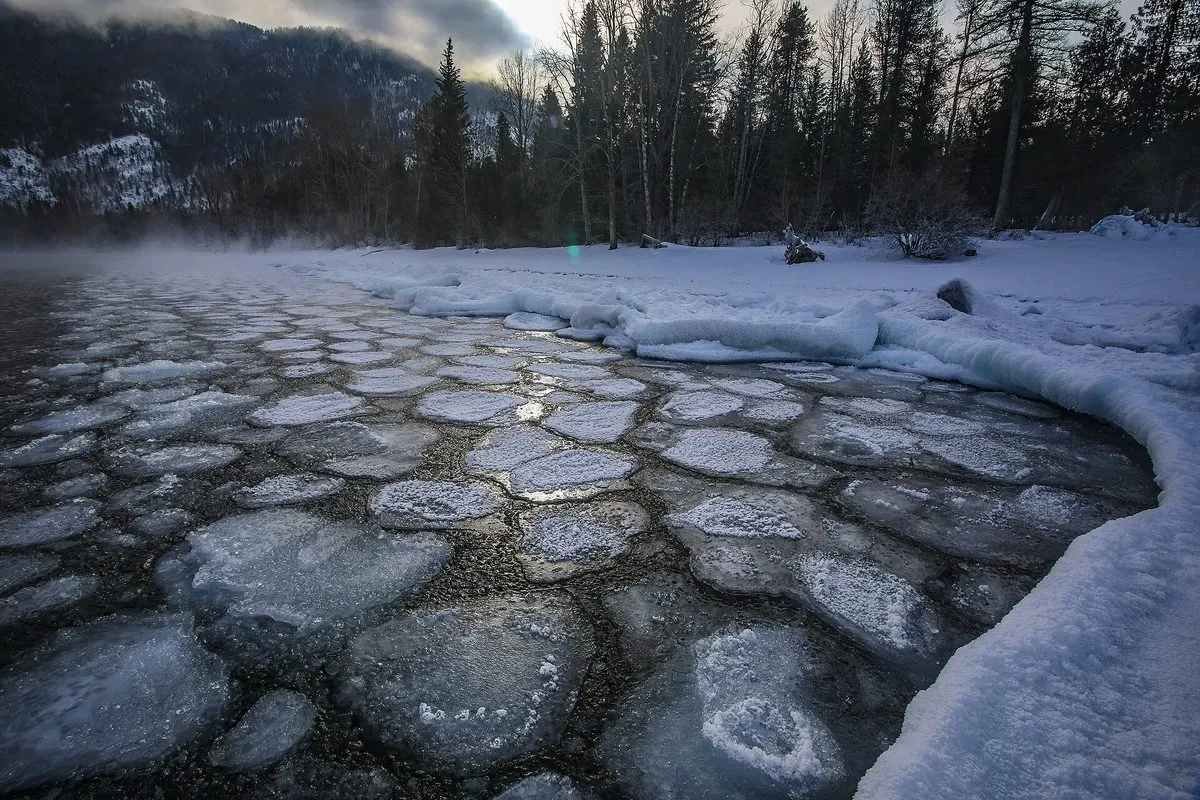
Almost everything in the universe gets denser when it freezes. Solid things sink in their own liquid. Water refuses. Why does ice float when almost nothing else does? Freeze it, and it gets lighter, floats to the top, and bobs there. That stubbornness looks like a minor curiosity in a glass of soda. It is actually one of the reasons there is life in a frozen lake at all.
The short answer: frozen water is full of holes
Liquid water is a chaotic crowd. The molecules tumble and slide past each other, packing in tight wherever they can fit. When water freezes, that chaos stops. The molecules lock into a rigid, repeating crystal, a hexagonal lattice held in shape by hydrogen bonds, and that lattice has deliberate empty space inside it (Chemistry LibreTexts).
So the same molecules, locked into a crystal, take up more room than they did jostling around as a liquid. A block of ice has about 9 percent more volume than the water it came from, which means it is about 9 percent less dense (USGS). That same outward push, as water locks into a crystal, is what makes an ice cube crack and snap when it hits a warm drink. Less dense things float on more dense things, so ice rides on top. This is also why a sealed bottle of water cracks in the freezer and why winter potholes appear: freezing water expands with real force, and there is no stopping it. Fighting that ice on a winter sidewalk is a different bit of chemistry, the trick behind how a scatter of salt melts ice.
The 4-degree twist
Here is the detail that makes water genuinely weird. As you cool water down, it behaves normally at first, shrinking and getting denser. But it hits maximum density at about 4 degrees Celsius, not at freezing. Cool it past 4 degrees and it starts expanding again, getting less dense as it approaches 0 degrees, because the molecules are already beginning to arrange themselves into that open, ice-like pattern (ZME Science).
That 4-degree quirk is the hinge the whole story turns on. It means the coldest water in a lake does not sink. The densest water, at 4 degrees, sinks to the bottom, and the colder, lighter water floats above it, ready to freeze at the surface.
Why this keeps fish alive
Now run the winter. As the air chills a pond, the surface water cools, drops to 4 degrees, and sinks. Eventually the surface water reaches 0 degrees and freezes into a sheet of ice on top. That ice floats, and it acts as a blanket. It insulates the water underneath, slowing any further heat loss, so the lake does not keep freezing downward at full speed. The water at the bottom stays around 4 degrees all season (Chemistry LibreTexts). Fish, frogs, insects, and plants ride out the cold in that liquid layer below the lid.
Now imagine the alternative. If ice were denser than water, like nearly every other frozen substance, it would form at the surface and immediately sink. Fresh water would keep freezing from the bottom up, and ponds, lakes, and shallow seas would turn into solid blocks of ice, killing almost everything in them. Whole ecosystems depend on the fact that ice is, against all the usual rules, a floater. The creatures down there breathe the whole time, pulling dissolved oxygen straight from that protected water.
It is a strange thought that the survival of life in cold water rests on the geometry of a crystal, on a few degrees of angle in how water molecules hold hands. But it does. The next time an ice cube clinks against the side of your glass and floats, you are watching the same physics that keeps a winter pond alive.
Keep wondering: the life that survives under the ice rides out winter in cold, dark water, much like the residents of the deep ocean; that depth raises its own puzzle, namely why deep-sea pressure doesn't crush fish; and some of those depth-dwellers even make their own light, which is why sea creatures glow.

Join the conversation
Comments are reviewed before they appear. Be kind and stay curious.
Loading comments…