
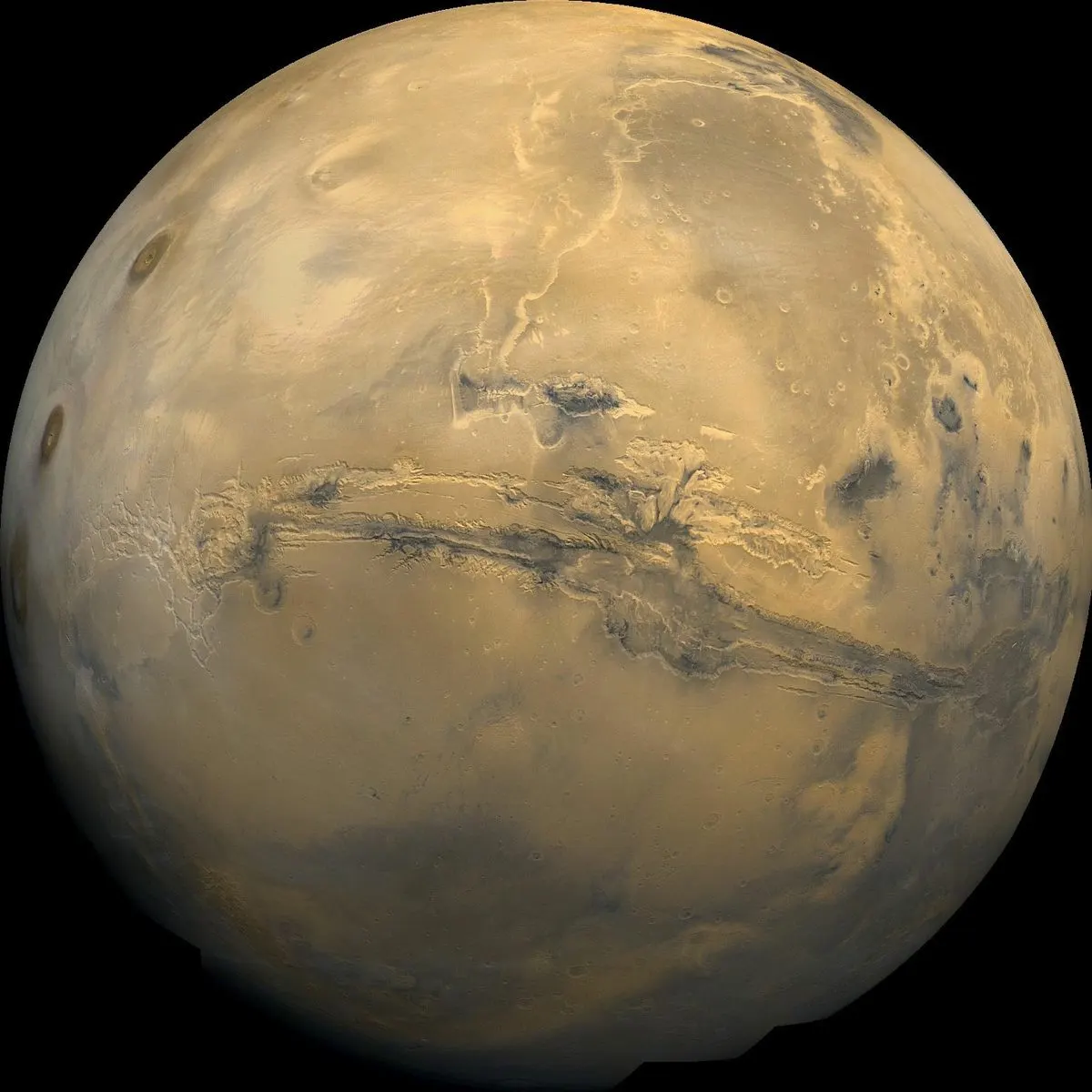
Why is Mars red? For the same reason an old bike left out in the rain is: it has rusted. The whole planet is dusted in iron oxide, the same compound that flakes off neglected metal here on Earth. The difference is scale. On Mars the rust is not a patch on a fender, it is a global coat of fine powder spread pole to pole, and it has been building up for billions of years.
The short answer: Mars is covered in rust
The rocks of Mars are loaded with iron. At some point that iron reacted with water, or with water and oxygen in the air, and oxidized, exactly the way iron does in a damp shed. The brittle, oxidized rock then broke down into dust, and Martian winds spread it everywhere (ESA). That dust is what your eye actually sees. Iron oxide scatters red light, so a planet wearing a thin film of it reads as a rusty dot in the sky.
It is worth saying what this is not. Mars is not red all the way down. The dust is a skin. Strip it away and the rock underneath is dark, grey-brown basalt, the cooled remains of ancient volcanoes. The famous color is a surface stain, not the planet's true complexion.
Up close it is more butterscotch than fire engine
Through a telescope, or in a processed NASA portrait, Mars glows a confident orange-red. Stand on it and the drama fades. Rover cameras show a landscape closer to butterscotch and rusty brown, under a sky tinted dusty tan by suspended particles. The vivid red is largely a distance effect: from far away you see the integrated glow of the whole dust layer, while a rover sees individual rocks, shadows, and a haze that mutes the color. Same planet, two very different reds.
The plot twist: the rust may be a fossil of water
For a long time the textbook story was that Mars rusted slowly and dryly, over billions of years, mostly through a mineral called hematite that forms under arid conditions. A 2025 study complicated that tidy picture.
A team led by Adomas Valantinas, then at Brown University, combined data from ESA and NASA spacecraft with laboratory experiments, grinding up replica Martian dust and measuring how it reflected light. The best match was not hematite. It was ferrihydrite, a different iron oxide, and a telling one. Ferrihydrite typically forms quickly in the presence of cool water, and it locks water into its very structure (Smithsonian Magazine). If the Martian dust is rich in ferrihydrite, then the rusting happened early, while liquid water was still sitting on the surface, not slowly over an arid eternity.
In other words, the color itself becomes a clue. The published work, in Nature Communications, suggests Mars had a wetter, possibly more habitable past than the dry-rust model implied (The Planetary Society). As Valantinas put it, "Mars is still the Red Planet. It's just that our understanding of why Mars is red has been transformed" (BBC Sky at Night Magazine).
Here is my one opinion: this is the most charming thing about the question. The feature that makes Mars look dead and dry, that single rusty color, may be physical evidence that it was once wet. The corpse is wearing the makeup of its livelier days.
A rust that is still happening
The Martian rust is not a finished event locked in the deep past. Wind keeps grinding oxidized rock into ever-finer dust, and dust storms, some of them large enough to swallow the entire planet, keep redistributing it (ESA). The red you see today is partly maintained in real time, an ongoing process rather than a single ancient accident. Mars, in a slow and quiet way, is still rusting.
Keep wondering: the same telescopes that catch Mars's color also explain why a small icy world got demoted from planet to dwarf planet; the iron in that Martian dust, like the iron in your blood, was forged in events tied to what happens when the sun dies; and if you are picturing how frigid a thin-aired, distant world gets, start with how cold is space.

Join the conversation
Comments are reviewed before they appear. Be kind and stay curious.
Loading comments…