
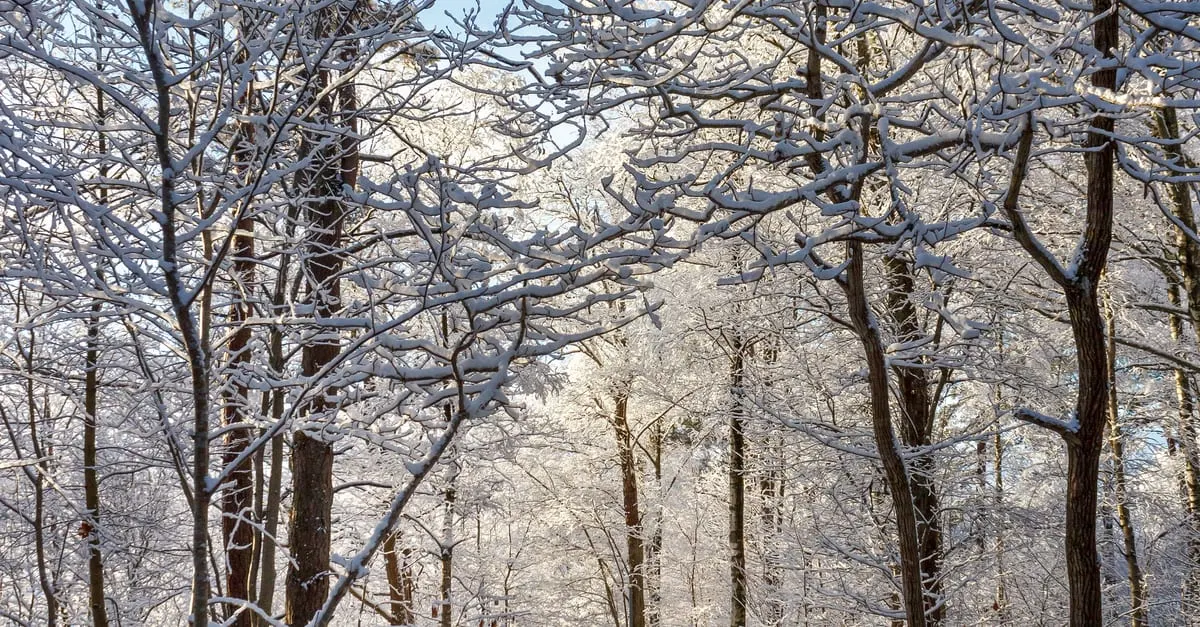
Snow is made of ice, and ice is clear. Hold up a single snow crystal and it's as colorless as a chip of glass. Liquid water, if you look through enough of it, is even faintly blue. So why is snow white, when nothing that built it was white to begin with? The color isn't in the snow at all. It's in what the snow does to light.
Snow scatters every color back at you equally
Snow is white because it bounces every color of sunlight back at you in roughly equal amounts, and a mix of all colors with none favored is what your eye calls white. This even, every-direction bounce is called diffuse reflection. As NSIDC puts it, "Most all the visible light striking the snow or ice surface is reflected back without any particular preference for a single color" (NSIDC). No pigment, no dye, no white material. Just clear ice rearranging light.
The clue is what happens when you break clear things into small pieces. A windowpane is transparent. Smash it and you get a white powder. The Caltech physicist Kenneth Libbrecht uses exactly that image for snow: take a piece of glass, "smashed into little bits of glass, now it's white" (Live Science). Snow is frozen water broken into millions of tiny crystals, each one clear, all of them stacked together with air in between.
Light scattering off thousands of surfaces
Send a ray of sunlight into that pile and it can't go straight. Every boundary between ice and air bends and reflects part of the light. A snowflake is "hundreds of teeny-tiny ice crystals varying in shape and structure," and when light hits those irregular surfaces it "reflects and scatters in all directions" (Live Science). The beam ricochets from one crystal face to the next, thousands of times, before it works its way back out the top.
What matters is that ice treats all the colors of sunlight almost the same. Red, green, blue, the whole spectrum scatters at nearly the same rate, and ice absorbs hardly any of it on a short trip. So the light that comes back out still carries every color, blended together, with none missing. That blend is white. It is the same reason a sheet of paper, a cloud, and beaten egg whites all look white despite being made of clear or pale stuff. A polar bear pulls the same trick: its fur looks white but is actually clear and hollow, scattering light the way snow does, which is why a polar bear's skin underneath is black.
The blue that hides in deep snow
There is a catch, and it is the best evidence the explanation is right. The scattering is only even when light makes a short trip. Push it through a meter of packed snow, or through dense glacier ice, and a small imbalance starts to show. Ice absorbs slightly more red light than blue. According to USGS, "Glacier ice is blue because the red (long wavelengths) part of white light is absorbed by ice and the blue (short wavelengths) light is transmitted and scattered," and "the longer the path light travels in ice, the more blue it appears" (USGS).
In fresh snow, light bounces back out after only a few hops, before that red-eating effect can add up, so it stays white. NSIDC notes that once the path runs about a meter, "mostly blue light makes it through" (NSIDC). Dig a deep hole in a snowdrift, peer into the bottom, and you'll sometimes catch that glow. Glaciers, compressed for centuries with the air squeezed out, show it plainly. It is a cousin of the reason veins look blue under your skin: in both cases the blue is a quirk of which wavelengths survive the trip, not a color anything actually has.
What you're actually seeing
A field of fresh snow is one of the brightest things you can stand in, and that brightness is not a property of the snow so much as a report from your eye. The snow hands back every color at once, evenly, and "white" is the word we have for that mix. Change the path the light takes and the same clear crystals turn blue. So the next time a snowfield blinds you on a sunny day, remember you are not looking at white stuff. You are looking at clear ice handing you the whole rainbow back, all at once.
Keep wondering: the same scattering trick in a different medium is why the sky is blue, the clear crystals in a snowbank follow a rule of their own when they freeze, which is why ice floats, and the sky that drops all that snow is heavier than it looks, as in how much a cloud weighs.


Join the conversation
Comments are reviewed before they appear. Be kind and stay curious.
Loading comments…