
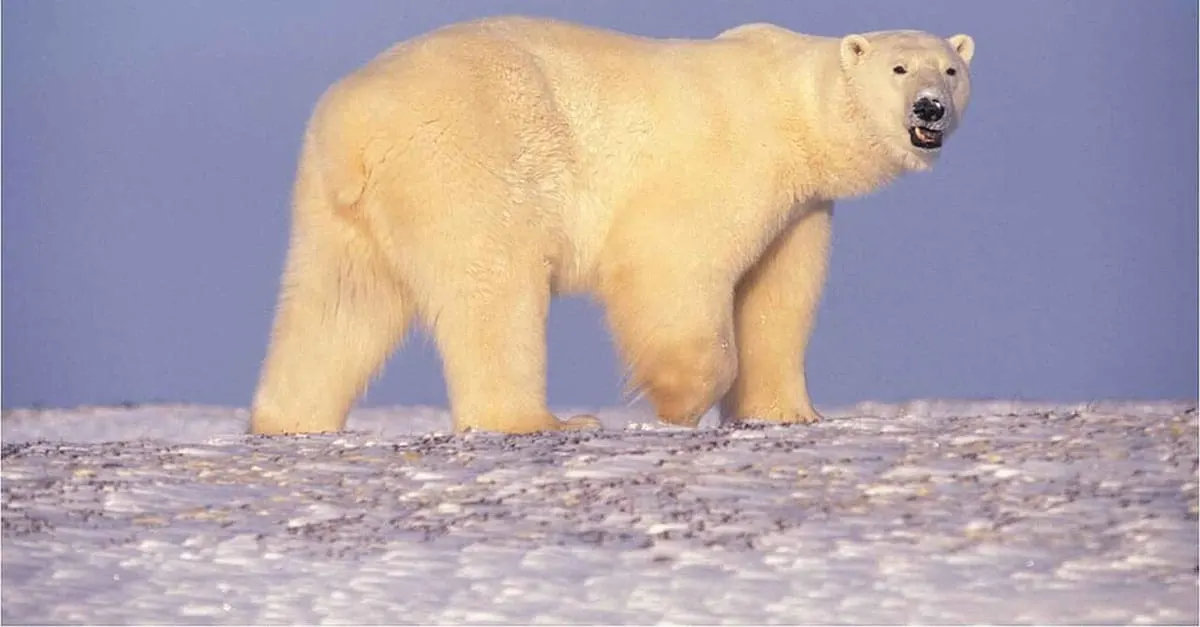
A polar bear looks like the whitest animal on Earth, a snowdrift with legs. So it comes as a small shock to learn that the bear under all that fur is not white at all. Peel back the coat and the skin is jet black, and the fur itself was never really white to begin with. The bear is hiding two surprises at once, though scientists understand the coat's insulation better than the skin's color.
Black skin may help, but its purpose is not settled
A polar bear's skin is black, but scientists do not know exactly why. Heat absorption and ultraviolet protection are leading hypotheses (Polar Bears International). Dark surfaces can absorb light and turn it into heat, which makes the warming idea plausible, but a plausible function is not the same as a demonstrated evolutionary explanation.
The black comes from melanin, the same pigment that colors human skin and hair. Polar bears carry a heavy dose of it, and that load may do double duty. Beyond the possible heat benefit, the dark pigment may shield the skin against ultraviolet radiation bouncing off the snow, which can be fierce in the Arctic. No albino polar bear has been reported in the cited wild or zoo records, but that observation is not proof that black skin evolved for either proposed function.
The fur is not white either
Here is the second twist, and it is the stranger of the two. A polar bear's fur is not white. Each hair is pigment-free and transparent, with a mostly hollow, air-filled core (Polar Bears International). There is no white dye anywhere in the coat. The bear only looks white because of what those clear hairs do to light.
When sunlight strikes the coat, it bounces around inside and between thousands of clear, hollow strands. The light scatters and reflects in every direction, and that even, colorless scatter is what your eye reads as white (San Diego Zoo Wildlife Alliance). It is the very same trick that makes a snowbank look white even though a single ice crystal is clear, which is also exactly why snow is white. Crush a pane of glass into powder and the heap turns white for the same reason. The polar bear, in effect, wears a coat of shattered light.
That clear coat also explains why polar bears are rarely a clean snow-white. The hollow hairs pick up tints from the world around them. Oils from a seal-fat meal can leave the coat cream or yellow, dirt can smudge it brown, and captive bears in warm, damp zoos sometimes go faintly green when algae grows inside the hollow hairs. The color you see is a property of the light and whatever clings to the fur, not of the fur itself, in much the same way that veins look blue without actually being blue.
The myth of the solar bear
For a long time, a tidy story tied all this together. The hollow, clear hairs, people said, worked like fiber-optic cables, piping sunlight and ultraviolet light straight down to the black skin to be turned into heat. It sounded perfect. A natural solar collector growing on a bear. The claim spread through newspapers, books, and classrooms for decades.
Then someone tested it. Daniel Koon, a physicist at St. Lawrence University, measured how much light actually traveled along a polar bear hair and found the answer was almost none: less than a thousandth of a percent of red light, and a far tinier fraction of violet, made it even an inch down a shaft. Far from guiding light to the skin, the keratin in the hair mostly absorbs it. The heat-absorption idea for black skin remains plausible, but it is not established by the failed fiber-optic explanation. The hairs are not light pipes funneling the sun down to the skin.
A coat built for the cold
Strip away the myth and what remains is still impressive. The bear has a clear, hollow, double-layered coat, with coarse guard hairs over a soft woolly undercoat. The fur insulates so well that polar bears barely lose any heat, which becomes a real problem in summer when they can overheat. Black skin sits underneath that insulation, but its evolutionary function remains unsettled.
So the next time you see a polar bear glowing white against the ice, remember you are not really looking at its color at all. You are seeing clear hair throwing sunlight back at you, the way the sky scatters blue, which is its own story in why the sky is blue. The real bear underneath has jet-black skin, whose evolutionary function remains unsettled.
Keep wondering: find out why snow is white when a single ice crystal is clear, learn how camels survive their own brutal climate, and discover just how cold space gets.



Join the conversation
Comments are reviewed before they appear. Be kind and stay curious.
Loading comments…