
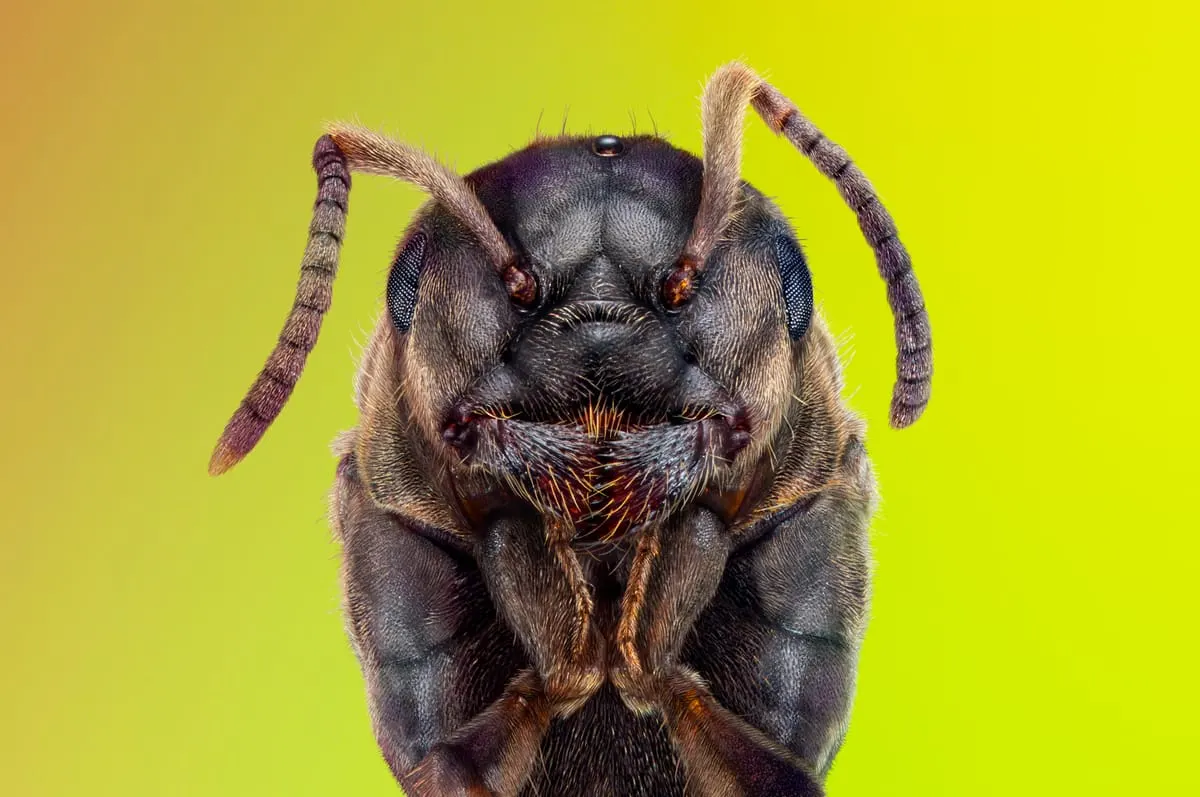
An ant is smaller than a grain of rice, and yet it can find its way home across rough ground, follow a scent trail, carry many times its own weight, and join thousands of others to build a city. It is fair to wonder whether something that tiny is really thinking at all. Do ants have brains? The short answer is a clear yes, but it leads somewhere much stranger than a simple yes or no.
Yes, and it is a real brain
An ant has a genuine brain, packed into its head and built from dense clusters of nerve cells (Myrmecological News Blog). It is small, but it is not trivial. Estimates put an ant brain at roughly 50,000 to 150,000 neurons, varying with species and body size, and a careful peer-reviewed study measured a desert ant's brain at about 90,000 cells (Proceedings of the Royal Society B). Your own brain runs on something like 86 billion neurons, so an ant manages its whole life on roughly a millionth of the wiring.
The ant brain even has specialized districts. Paired structures called mushroom bodies handle learning, memory, and pulling together the flood of incoming smells and signals. And the brain is not the whole story: an ant also has a string of smaller nerve clusters running down its body that manage things like leg movement, so a fair amount of its control is spread out rather than centralized in the head.
What a single ant can and cannot do
With that hardware, one ant does real cognitive work. It navigates, remembers routes, learns, and reads the chemical world, deciding what to do based on the pheromone trails its nestmates lay down and on how often it bumps into other ants.
But on its own, an ant is not impressive. It follows simple rules and reacts only to what is right in front of it. It has no plan for the colony, no map of the whole nest, no idea what the ants on the far side are doing. The cleverness everyone admires in ants is not really in any one ant.
The colony is the bigger brain
Watch a colony and you see something that looks designed: highways of foragers, nurseries, waste dumps, farms, armies, all running smoothly. Yet no one is in charge. The queen does not give orders. She only lays eggs.
Stanford biologist Deborah Gordon, who has studied ants for decades, puts it in a way that reframes the whole question: "An ant colony is like a brain in that there's no central control. So just as no neuron tells the other neurons what to do, so no ant tells the other ants what to do" (Stanford). The colony thinks the way a brain thinks, by letting huge numbers of simple units interact, with intelligence emerging from the network rather than sitting in any single part.
This is the same trick that makes a beehive feel like a single creature, the logic running through why bees die defending the colony and why bees make honey at all. The individual barely matters; the group is the organism.
Small brain, big results
So do ants have brains? Absolutely, one apiece, tiny but capable. The deeper answer is that the intelligence we marvel at, the part that builds and farms and conquers, is not stored in those tiny heads at all. It lives in the colony, in the pattern of millions of small interactions. As Gordon notes, in the aggregate "they get a lot of things done," even though, individually, the ants "don't look very competent." It is one of nature's best arguments that a mind does not have to live in one place.
Keep wondering: the colony-as-organism idea ties ants to bees, in why bees die after they sting and why bees make honey, and the question of animal smarts runs on into how an octopus rewrites its own skin. More at Life on Earth.
Join the conversation
Comments are reviewed before they appear. Be kind and stay curious.
Loading comments…