
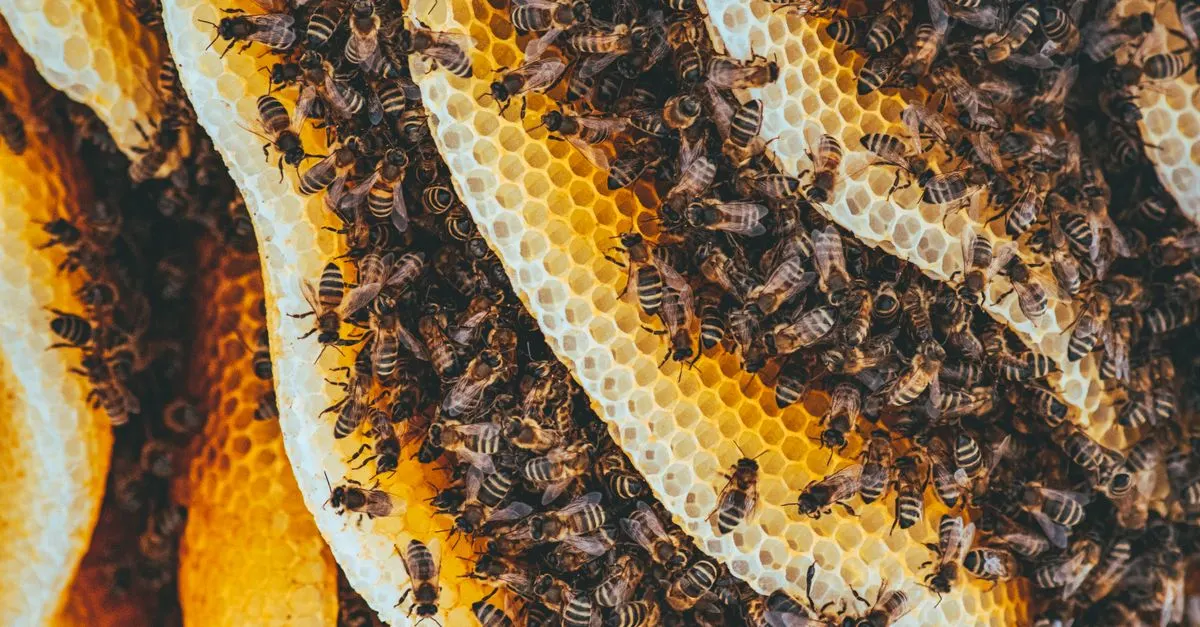
Why do bees make honey? Not for us, and not for fun. They make it because winter is coming and there will be nothing to eat. Honey is a pantry: a dense, sugary, nearly imperishable food store that a colony lives on through the months when no flower in sight is offering a single drop of nectar. That near-immortality in a jar is why honey never spoils.
That one fact explains almost everything else about honey, including why bees go to such absurd lengths to produce it.
The problem honey solves
Most insects deal with winter by dying off and leaving eggs behind, or by going dormant. Honey bees do neither. A colony stays awake and alive all winter as a single huddled mass, and that takes fuel. The bees cluster tightly together and shiver their flight muscles to generate heat, keeping the core of the cluster warm even when it is freezing outside. Shivering burns energy, and the energy comes from honey.
So the hive spends all summer doing something very deliberate: turning a flood of watery nectar, which would spoil in days, into a concentrated sugar that will keep for months. Honey is how a colony carries summer into winter.
From flower to jar: how nectar becomes honey
The transformation is part chemistry, part patience. Here is the actual process.
- A forager collects nectar. Out at the flowers, a worker drinks up nectar, which is mostly water, around 60 to 80 percent, with sugar dissolved in it. She stores it in a separate "honey stomach," a crop kept apart from her own digestion.
- Enzymes go to work. Even on the flight home, enzymes in that crop begin breaking the nectar's complex sugar into simpler ones, and adding glucose oxidase, an enzyme that will later help preserve the honey.
- The hive passes it around. Back inside, she brings it up and passes it mouth to mouth to other workers, who do the same again. Each handoff adds more enzymes and works moisture out of the mix.
- The water evaporates. The bees spread the thickening nectar into wax comb cells and then fan their wings over it in shifts, driving a current of air across the comb until the water content falls to roughly 17 to 18 percent.
- They seal it. Once a cell of honey is dry enough to last, the bees cap it with a lid of fresh wax. Sealed away, it will keep until the colony needs it.
Why honey never goes bad
The reason honey survives the winter, or a few thousand years in a sealed jar, comes down to that careful drying. With so little water left, and a naturally low, acidic pH between 3 and 4.5, there is almost nothing a microbe can do inside honey. On top of that, the glucose oxidase the bees added produces small amounts of hydrogen peroxide, a mild antiseptic. Together those defenses make honey one of the few foods that essentially does not spoil. Archaeologists have pulled pots of honey thousands of years old from ancient tombs and found it still preserved.
Why a hive makes far more than it needs
If honey is just winter rations, why does a colony stockpile so much that beekeepers can take jars of it without starving the bees? Because a colony has no way of knowing how long or harsh the coming winter will be, so it errs hugely on the side of caution. As long as flowers keep blooming and there is empty comb to fill, the bees keep gathering and storing. A strong hive in a cold climate may pack away 80 to 100 pounds of honey for a single winter.
That instinct to overstock is the whole basis of beekeeping. The beekeeper adds extra boxes above the nest, lets the bees fill them with surplus, and harvests only that overflow, leaving the colony's own stores intact.
The scale of the effort
It is worth sitting with how much work a jar of honey represents, because the numbers are almost hard to believe. According to the University of Missouri Extension, a single worker bee produces only about one-twelfth of a teaspoon of honey in her roughly six-week life. To make one pound of honey, the same source estimates, bees collectively visit around 2 million flowers and fly more than 55,000 miles, more than twice the distance around the Earth.
So the honey on your toast is not a byproduct or a happy accident. It is a survival ration, distilled drop by drop from millions of flowers by thousands of short-lived insects, and stored against a winter most of them will never live to see. A worker gives everything to the colony, right down to her sting, which is its own one-way sacrifice once you understand why a bee dies after it stings you. We just happen to make more than they need to.
Keep wondering: meet another plant-and-animal marvel in how a Venus flytrap counts and snaps, find out whether any animal is truly immortal, and see why so many sea creatures make their own light.


Join the conversation
Comments are reviewed before they appear. Be kind and stay curious.
Loading comments…