
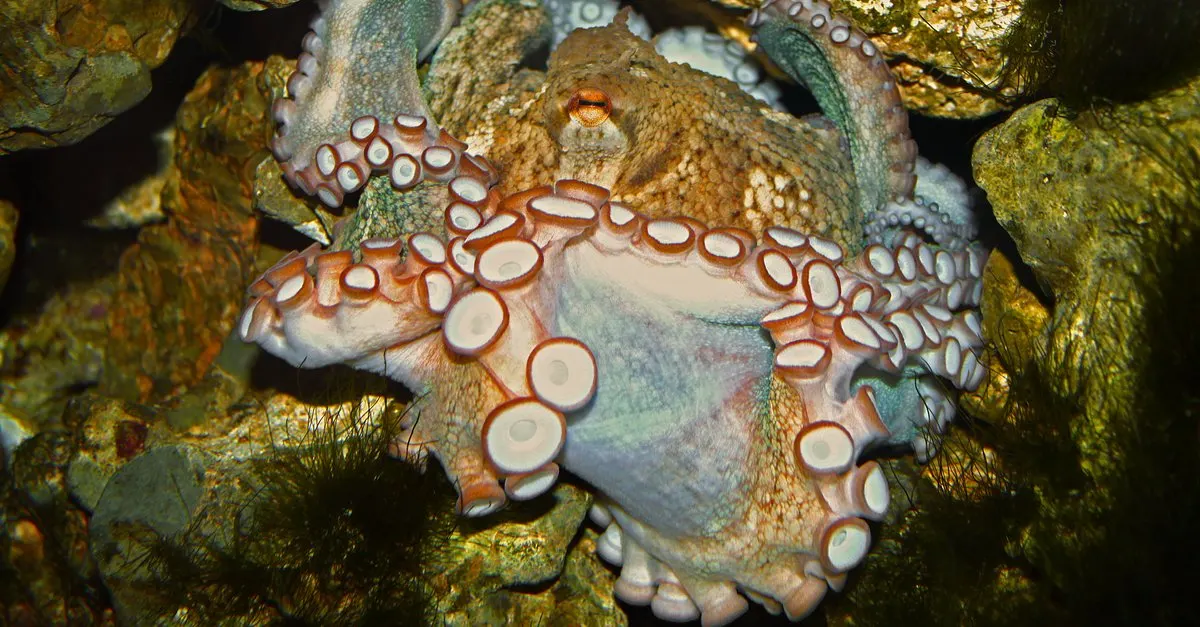
Drop a common octopus onto a checkerboard of coral, sand, and shadow, and within a heartbeat it vanishes. Not blends. Vanishes. How do octopuses change color that fast? The skin matches color, brightness, and even bumpiness so well that a diver can swim past the spot where the animal sat. The strangest part is that the octopus pulling off this trick is, by every measure we have, colorblind.
A million tiny muscles open and close the color
Here is how octopuses change color: their skin is packed with chromatophores, microscopic elastic sacs of pigment in yellow, red, and brown. Each sac is ringed by 15 to 25 tiny radial muscles wired straight to the brain. When those muscles contract, they yank the sac open into a flat disk up to 15 times wider, splashing color across the skin. When they relax, the sac snaps shut to a pinprick and the color disappears. Because the brain drives the muscles directly, the whole display flips in well under a third of a second, faster than you can blink (Marine Biological Laboratory).
That muscle-driven mechanism is why an octopus beats a chameleon for speed. A chameleon shuffles pigment around inside its cells, which takes seconds. An octopus just pulls a thousand drawstrings at once. Raw speed like this is something the ocean specializes in, the same obsession with springs and muscle that lets a mantis shrimp throw the fastest punch in the sea.
Mirrors and snow stacked under the paint
Pigment alone can't make blue, green, or silver, and it can't make a clean white. So octopuses layer two more kinds of cells underneath the chromatophores, and these don't hold pigment at all. They bend light.
The first are iridophores, stacks of a protein called reflectin arranged like microscopically thin mirrors. Light bounces between the layers and interferes with itself, producing blues, greens, and metallic sheens, the same physics that makes a soap bubble shimmer (Nature Education). Iridophores shift slowly, over seconds to minutes, so they set the background tone while the chromatophores do the fast work on top.
The second are leucophores, cells that scatter every wavelength equally and so look bright white, the way a polar bear's hair looks white. A leucophore layer gives the chromatophores a clean canvas and lets the animal throw a sharp white patch to break up its outline (Marine Biological Laboratory). Paint, mirrors, snow: three layers, working together.
The skin doesn't stay flat either
Color is only half the disguise. An octopus also rewrites the texture of its own skin using papillae, three-dimensional bumps it can raise and flatten in about a fifth of a second. The foundational map of how this muscle machinery works came from a study on cuttlefish (Sepia officinalis), a close cephalopod cousin, by Gonzalez-Bellido and colleagues, with Roger Hanlon as a coauthor; octopus papillae are inferred to work the same way (Cell iScience, Gonzalez-Bellido et al.). Papillae are muscular hydrostats, like your tongue: no bone at all, just muscle squeezing one part to push out another. Striated muscles, an erector set and a retractor set, drive the rapid expansion and retraction of each bump, while smooth muscles hold it erect through a sustained catch-like tension, powered by the protein twitchin, so the skin can stay raised with almost no energy. The papilla's final shape comes from the dermal connective architecture itself, not from a separate shaping muscle. A smooth-skinned octopus can sprout spiky weed-like fronds and erase them seconds later.
The colorblind animal that matches color anyway
Now the puzzle. Octopus eyes carry just one type of photoreceptor, one opsin tuned to a single band of light. By the textbook definition that makes them colorblind, locked to grayscale (Carnegie Museum of Natural History). And yet they routinely match the color of their surroundings, not just the brightness. How does an animal copy a hue it can't see?
Nobody has nailed it, and that honesty matters here. There are two leading ideas, and they may both be partly right. One, from a 2016 paper by Alexander and Christopher Stubbs, argues the off-center pupil and chromatic aberration, the way a lens focuses different colors at slightly different depths, could let a single-photoreceptor eye tease colors apart by hunting for the sharpest focus (PNAS). The lens itself becomes a crude color filter.
The second idea is wilder. The skin may sense light on its own.
Skin that sees without eyes
In 2015, M. Desmond Ramirez and Todd Oakley at UC Santa Barbara cut isolated patches of skin from the California two-spot octopus, with no connection to the eyes or brain, and shone light on them. The chromatophores opened on their own. They named the effect light-activated chromatophore expansion, or LACE (Journal of Experimental Biology).
The skin was responding because it carries the same light-sensitive opsin and rhodopsin proteins normally found only in eyes, sitting in sensory structures across the surface. The response was fastest under blue light, around 470 nanometers, the same band the octopus eye is tuned to (Phys.org). The skin isn't forming images, it can't, there's no lens. But it can read the brightness and likely the wavelength of light hitting it, locally, everywhere at once.
Think about what that means for camouflage. An octopus could be tasting the light of its background through its skin and tuning its display to match, no central color vision required. The body might be doing the seeing the brain can't.
That's the detail that stays with me. We picture sight as something that happens behind two eyes. An octopus may experience color as a full-body sensation, spread across a skin that paints, reflects, sprouts texture, and reads light all at the same time, in a brain so distributed that two-thirds of its neurons live in the arms. It isn't wearing a disguise. It is, in a real sense, becoming the reef. The sea keeps a long list of these quiet impossibilities, including an animal that may have sidestepped death itself.
Keep wondering: the same dark water that hides an octopus lights up with living color in why do sea creatures glow, and the deeper you go the stranger it gets, from how deep is the ocean to why deep-sea pressure doesn't crush fish.



Join the conversation
Comments are reviewed before they appear. Be kind and stay curious.
Loading comments…