
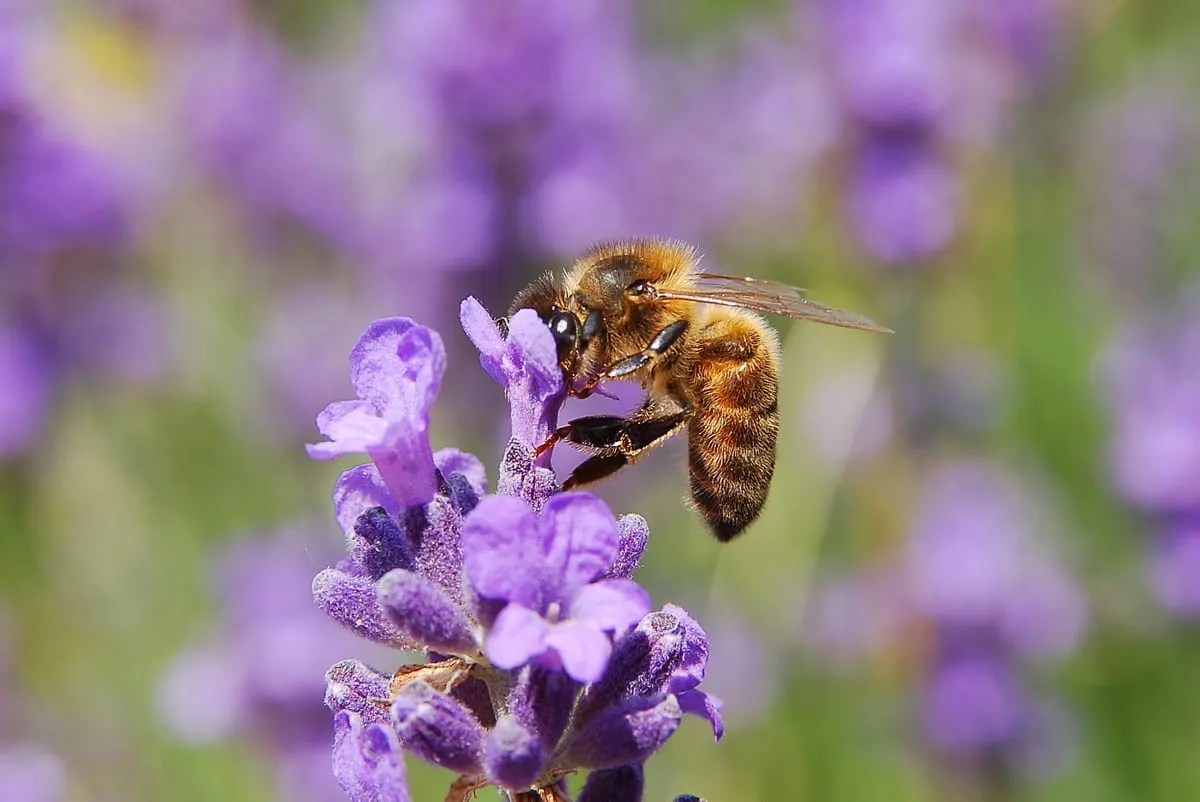
A wasp stings you and flies off, ready to do it again. A honey bee stings you and is dead within minutes. Same painful jab, completely different price. So why do bees die after they sting when a wasp simply flies off? It is part gruesome anatomy, part beautiful logic about family, and one of the strangest deals in nature.
The short answer: a one-way harpoon
A honey bee worker's stinger is not a smooth needle. It is lined with rows of tiny backward-pointing barbs, like a fish hook or a harpoon. Those barbs make the sting easy to push in and nearly impossible to pull back out of thick, stretchy skin. Retired UC Davis apiculturist Eric Mussen described what happens next bluntly: "When a bee stings, it cannot remove its barbed stinger without yanking out its abdominal tissue, aka 'guts'" (UC ANR).
When the bee pulls away, the entire sting apparatus, the stinger plus its venom sac, muscles, and a chunk of the abdomen, tears loose from its body. As the Texas A&M Honey Bee Lab puts it, that leaves "massive abdominal rupture and death" (Texas A&M). The bee has, in effect, left its weapon and part of itself behind.
The sting that keeps stinging
Here is the eerie part. The torn-off stinger does not stop. Because the venom sac and muscles come away with it, the detached sting keeps pumping on its own, driving venom deeper for up to a minute after the bee is gone. Mussen put a number on it: "the venom will continue to pump for 45 to 60 seconds following a sting."
That is the practical reason every beekeeper tells you the same thing: do not pinch a stinger out, which squeezes the sac like a syringe. Scrape it sideways with a fingernail or a card instead.
Why nature would build a suicidal weapon
A weapon that kills its user sounds like a terrible design. It makes sense only when you stop thinking about the single bee and start thinking about the hive.
A worker bee is a sterile female. She will never have offspring of her own. Everything she does, she does for her mother, the queen, and her thousands of sisters. In that setting, her own survival barely matters to evolution. What matters is the colony's. A worker who dies driving a bear or a person away from the nest protects the family that carries her genes forward. As bee researcher James Dorey describes it, "they will literally die to protect their mother, sisters and brothers" (University of Wollongong). The sting is not really a personal weapon. It is the colony's alarm system, and the worker is willing to be the fuse.
That logic of the group mattering more than the individual runs all through the social insects, the same way it shapes why bees make honey in the first place.
The myth hiding inside the fact
Now the twist: "bees die when they sting" is mostly wrong. It is true only for the honey bee worker, and only against thick-skinned animals.
- A honey bee stinging another insect does not die, because the barbs cannot grip an insect's hard shell. The sting pulls free and the bee flies off to fight again.
- The queen honey bee has a smooth stinger and can sting over and over (she mostly saves it for rival queens). Male drones have no stinger at all.
- Bumblebees, wasps, and hornets all have smooth stingers too. Bumblebee stings, as UW-Madison notes, "are smooth and un-barbed, allowing them to sting repeatedly," and the lab flatly calls the broad version "a common myth" (UW-Madison).
Add it up and the suicidal sting is the rare exception, not the rule. Of nearly 21,000 bee species, only about eight die when they sting. The honey bee just happens to be the one we meet most, so its strange sacrifice became the story we tell about all of them.
Keep wondering: the honey bee's sting is the colony putting the group first, the same instinct behind why bees make honey. For more on life, death, and animal weaponry, see whether any animal is truly immortal and how hard a mantis shrimp can punch. More at Life on Earth.
Join the conversation
Comments are reviewed before they appear. Be kind and stay curious.
Loading comments…