
Hanging in a dark sky, the Moon looks for all the world like a lamp, a glowing disc bright enough to read by on a clear night. It seems obvious that it must be shining. It isn't. The Moon is a dark, dead rock, and every bit of its glow is borrowed.
Moonlight is just sunlight, bounced
So does the Moon make its own light? No. The Moon generates no light at all; it only reflects the light of the Sun back toward us (NASA Space Place). As the NASA scientist Sarah Noble puts it, "unlike our Sun, the Moon doesn't create its own light. We can only see it because light from the Sun is reflecting off of its surface" (NASA). There's really just one lamp in the neighborhood, the Sun, and the Moon is a rock catching its glow. That's also why a lunar eclipse darkens the Moon: block the sunlight reaching it, and the Moon has nothing of its own to fall back on.
A surprisingly dark mirror
Here's the part that feels wrong given how bright it looks: the Moon is a terrible mirror. Its surface reflects only about 12 percent of the sunlight that lands on it, an albedo of roughly 0.12. The physicist Christopher Baird sums up the surprise neatly: "the moon has the same bond albedo as old asphalt, such as is found in roads and parking lots" (West Texas A&M University). The Moon is, in effect, a giant ball of dark grey rock about as reflective as a parking lot. It looks dazzling only because it is bathed in direct, intense sunlight and set against the perfect black of space. Contrast does the rest.
Phases are geometry, not a shadow
A common follow-up trips a lot of people up: if it's all reflected light, what makes the phases? The answer is pure geometry. The Sun always lights up one half of the Moon. What changes, night to night, is how much of that lit half is turned toward us as the Moon orbits Earth (NASA Space Place). A "crescent" is just a sliver of the sunlit side facing us; a "full" Moon is the whole lit side in view. Phases are not Earth's shadow falling on the Moon. That's a lunar eclipse, which is a different, rarer event that only happens at full Moon.
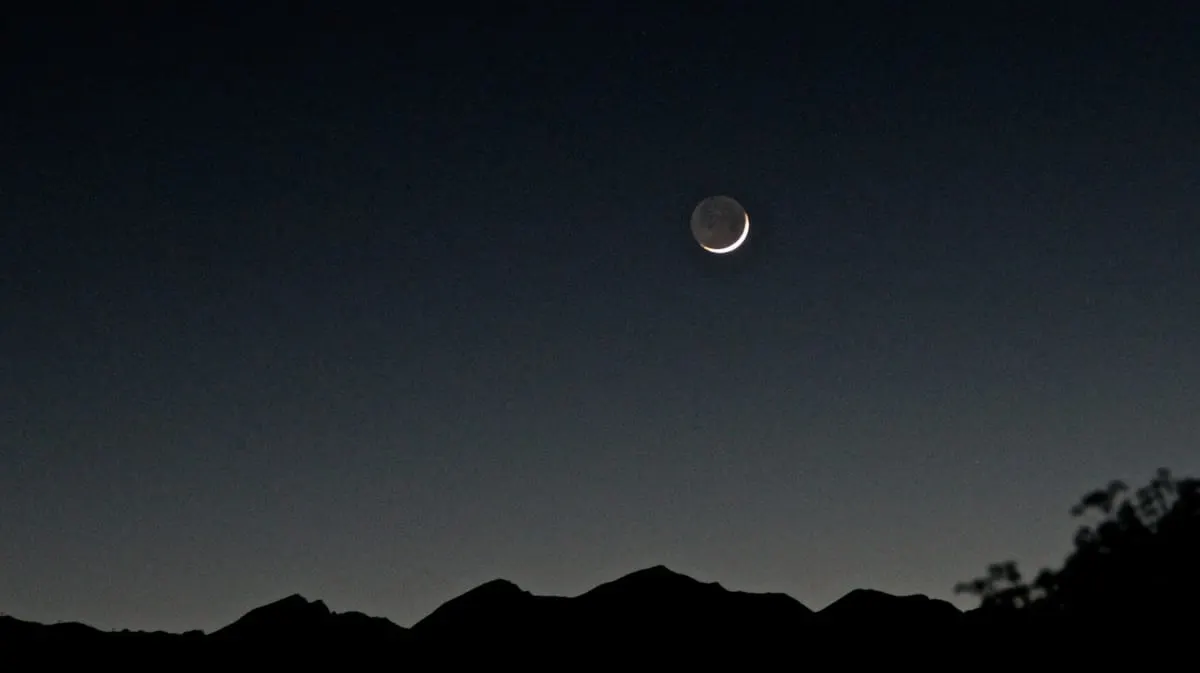
There's one lovely bonus that proves the whole "borrowed light" idea in a single image. Look at a thin crescent Moon and you can often faintly see the rest of the Moon's disc glowing a soft grey. That's earthshine: sunlight that struck Earth, reflected off our oceans and clouds, and bounced a second time onto the Moon (NASA Earth Observatory). It's light that has been reflected twice before it reaches your eye, Sun to Earth to Moon and back. The Moon isn't just borrowing the Sun's light. On a crescent night, it's borrowing some of ours.
So the lamp in the night sky is no lamp at all. It's a dark rock, dimmer than you'd ever guess, catching a bright star's light and tossing a little of it our way. Beautiful, but borrowed, every photon of it.
Keep wondering: that borrowed glow is visible more often than you'd think in can you see the Moon during the day, the atmosphere makes real stars shimmer in why stars twinkle, and another world wears a dusty disguise in why Mars is red.

Join the conversation
Comments are reviewed before they appear. Be kind and stay curious.
Loading comments…