
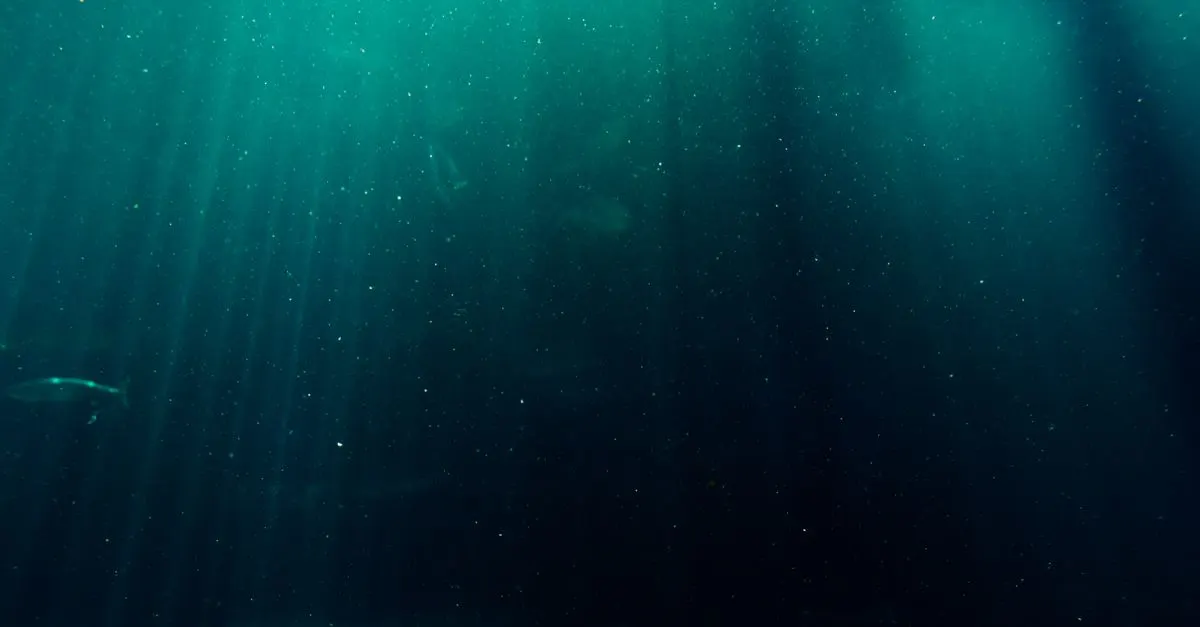
Switch off every light in a windowless room at midnight and you still have not seen real darkness. Your eyes adjust, a sliver leaks under the door, the clock glows. Now imagine a place where none of that exists, where no light has ever arrived and never will, stretching for thousands of meters in every direction. That place is not rare or far away. It is most of the ocean, and most of the room for life on this planet, sitting in the black right now.
Below about 1,000 meters, the ocean is completely dark
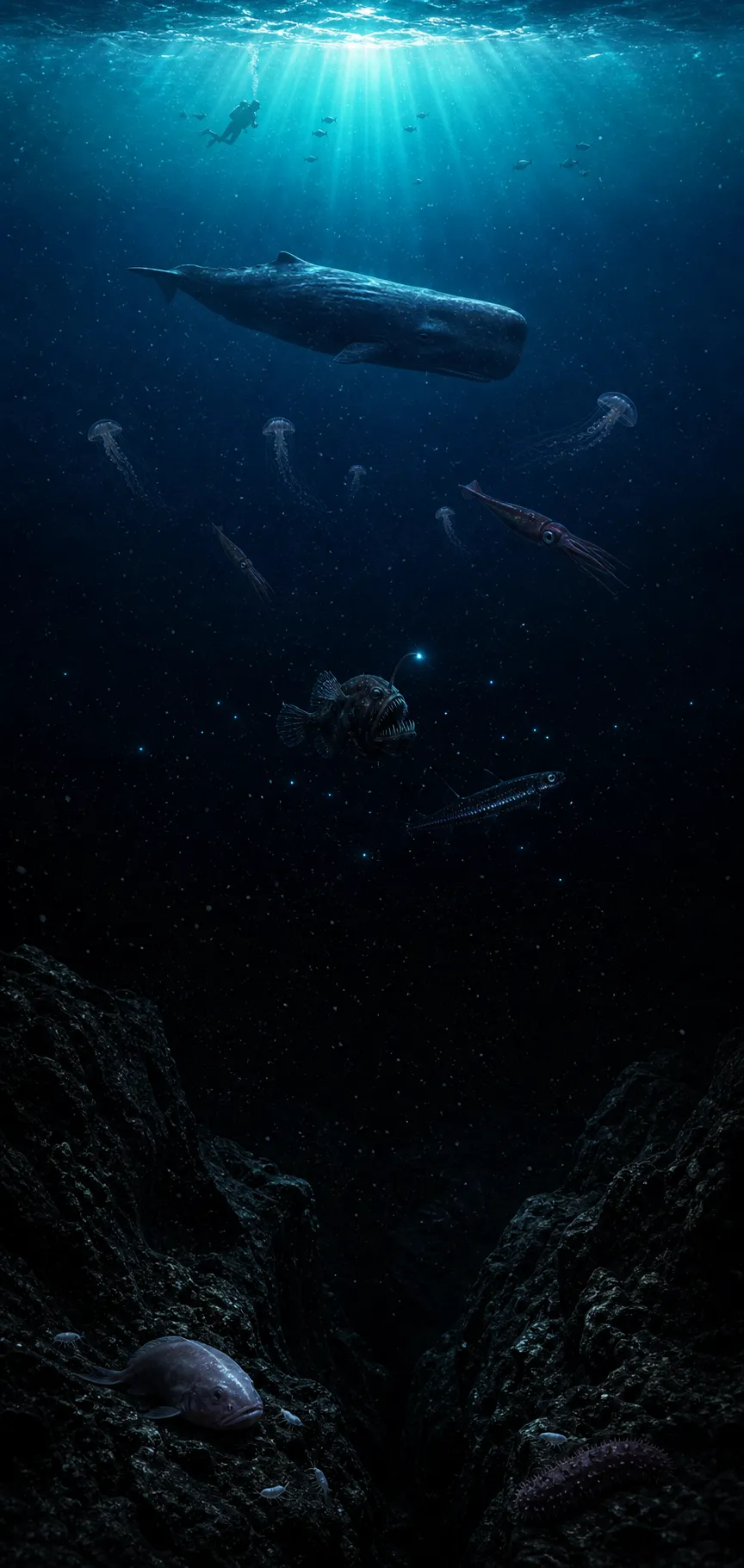
The bottom of the ocean is in total, permanent darkness: below roughly 1,000 meters (3,280 feet), no sunlight reaches at all, according to NOAA. That layer is called the aphotic zone, "aphotic" meaning simply "without light," and it runs from there all the way down to the seafloor, in the deepest trenches almost 11,000 meters below the waves. Down there, daylight is not a thing that ever happens.
Light does not vanish all at once, though. The ocean dims in stages, and walking down those stages is the only way to feel how strange the deep really is. Take the dive yourself.
The sunlit zone: the only bright slice
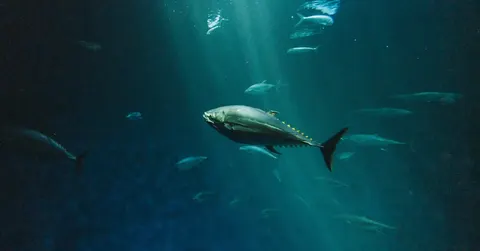
The top 200 meters (about 650 feet) is the euphotic, or sunlight, zone. This is the entire ocean most of us will ever experience, the layer with enough light to power photosynthesis, so it holds the plankton, the reefs, the tuna, the sharks. It feels like the whole sea. It is a film. As NOAA puts it, light "may be detected as far as 1,000 meters down in the ocean, but there is rarely any significant light beyond 200 meters."
Why blue is the last color standing
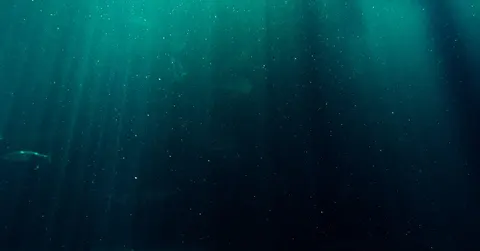
Color leaves long before brightness does. Sunlight looks white, but it is a bundle of wavelengths, and water picks them off one at a time. It absorbs the longest wavelengths first, so red is the first to go, fading out in the shallows. Orange follows, then yellow and green, until only blue, the shortest and most penetrating, is left sliding deeper. By around 100 meters a red fish looks black, because there is no red light left to bounce off it. Snorkel down with a cut and the blood looks dark green, not red.
This is the quiet secret of the deep ocean: it is not just getting darker as you descend, it is getting bluer, draining its palette one color at a time while it is still bright enough to read by. That single surviving color ends up shaping the eyes and the glow of nearly everything that lives below, as we will see.
The twilight zone: a faint blue glow, then nothing
From 200 to 1,000 meters lies the twilight zone, officially the dysphotic zone, the layer Woods Hole Oceanographic Institution describes as wrapping around the entire globe. The top of it is defined by light: it begins roughly where only about 1 percent of surface sunlight remains. That 1 percent is too little for plants to grow, so the food chain quietly flips from growers to hunters and scavengers.
Descend through it and that faint blue fades to gray, then to almost nothing. Your eyes would strain for shapes that are not there. By the bottom of this zone, the sun has been reduced to a memory of a memory. The next step down is the one with no light at all.
The midnight zone: the largest dark place on Earth
Cross 1,000 meters and you enter the midnight zone, the top of the aphotic black, and it never ends in brightness. The water sits a hair above freezing. The pressure is monstrous, though that pressure does not crush the fish that live there the way you would expect. And it is dark in a way nothing on the surface is, because there is no source of daylight anywhere, no dawn coming, no moon getting through.
Here is the part that resets the scale. This dark zone is not a remote corner of the ocean. It is most of it. The sunlit layer is only the top 200 meters of a sea that plunges to nearly 7 miles at its deepest point, so the lightless deep makes up the overwhelming majority of the ocean by volume. Since the ocean holds most of the livable space on the planet, the single biggest habitat on Earth, by a wide margin, is pitch black. Sunlit life is the exception. Darkness is the default condition for life here.
Eyes built for a world without light
You might expect animals in permanent black to go blind. Many do the opposite. Down where the last specks of sunlight meet the dark, deep-sea fish have evolved some of the most sensitive eyes in nature, often enormous relative to their bodies, all built to catch every stray photon. Some, the aptly named barreleyes, grow tubular eyes that point straight up to spot the faint silhouettes of prey against the dim glow above.
Inside those eyes, the design is tuned for darkness, not detail. Deep-sea fish rely almost entirely on rod cells, the photoreceptors built for dim light, while the cones that handle bright color vision are nearly gone. Most carry a single, blue-sensitive visual pigment, because blue is the only sunlight color left and most living light down there is blue too (NOAA). A few have gone further, evolving extra genes for rod proteins to squeeze vision out of almost nothing. In a place with so little to see, evolution spent a fortune on seeing.
The only light is alive
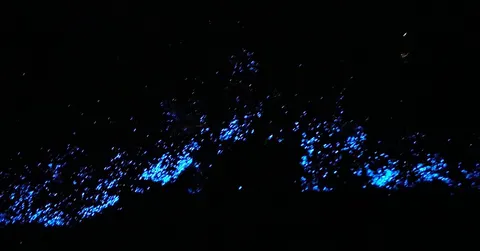
So is the deep truly without any light? Sunlight, yes. But the dark is not empty of light, it is just that every spark down there is made by something living. The only light at these depths is generated by organisms, a chemical glow called bioluminescence, and an astonishing share of deep-sea animals can do it.
Picture it. An anglerfish dangling a lit lure in front of its own teeth. A flash fired off to startle a predator. A constellation of tiny blue-green pinpricks drifting past, each one an animal advertising, hunting, or hiding. It is how creatures in the deep make their own light to find food and mates in a place the sun abandoned. In the largest, oldest darkness on the planet, life did not give up on light. It learned to bring its own.
That is the picture worth holding. We named ourselves the Blue Planet, but blue is just the lid. Underneath sits a world that is mostly cold, mostly crushing, and almost entirely black, lit here and there by living sparks, and it is far bigger than the bright sliver we call home.
Keep wondering: see how deep the ocean actually goes and what waits at the very bottom, why that crushing pressure doesn't flatten the fish, and what would happen to your own body at the bottom of the Mariana Trench.
Join the conversation
Comments are reviewed before they appear. Be kind and stay curious.
Loading comments…