
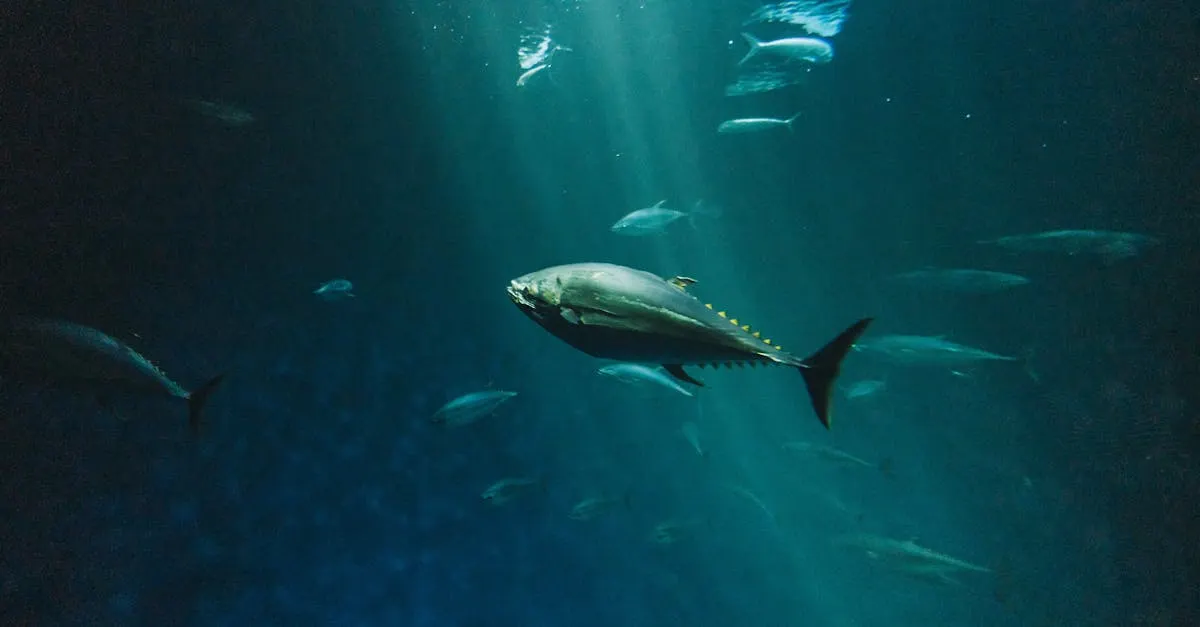
Eight kilometers down, the water presses in at over 800 times the pressure at the surface. You'd expect nothing large to survive there, which is exactly the puzzle of why deep sea pressure doesn't crush fish. And yet, on a depth camera in the Izu-Ogasawara Trench in August 2022, a small pale fish, a snailfish, barely the length of a ruler, glided past at 8,336 meters, apparently unbothered.
Fish are mostly water, and water doesn't compress
The reason deep-sea pressure doesn't crush fish is simpler than it sounds: most of what makes up a fish is water, and water is nearly incompressible. Pressure acts on the fish from every direction simultaneously, and because the fish's tissues push back with the same force, there is no net squeeze. As NOAA's Ocean Exploration program puts it, "most things living in the deep ocean are largely water and water is incompressible." The pressure is immense, but it has nothing to act against.
For humans, this arithmetic breaks down because we carry air. Our lungs, sinuses, and middle ears are gas-filled spaces, and gas compresses. A diver's lungs can be crushed to the size of a fist as pressure rises. Put a sealed can in a submarine at depth and the metal buckles. A deep-sea fish has no such vulnerability. Its body is continuous fluid and tissue; there is no cavity that can collapse.
The shallow-water swim bladder is the giveaway
Shallow-water bony fish solved the buoyancy problem with an ingenious internal air sac called the swim bladder. By adjusting the gas inside, a fish can hover at any depth without swimming. It works beautifully until the pressure gets serious. Bring a gas-bladder fish up from 200 meters too quickly and the sac expands violently, fishermen see them hauled up with their stomachs pushed out of their mouths.
Deep-sea fish have largely abandoned the gas bladder altogether. Snailfish, the family that holds every depth record, have no swim bladder. Their skeleton is mostly soft cartilage rather than dense bone. Their bodies run gelatinous, with far more fluid than structural tissue. All of this means they stay in pressure equilibrium with the water around them. According to IFLScience's review of deep-sea physiology, deep-sea fish bodies are "composed mostly of water and jelly-like material," which lets them maintain a balanced pressure gradient with the surrounding ocean.
Pressure still does something, even to a fish: it warps proteins
No gas bladder and a water-rich body gets a fish a long way. But water itself is not immune to pressure. At extreme depth, the hydrogen bonds between water molecules are stressed in ways that subtly change how the molecules are arranged. That shift is enough to distort how proteins fold.
Proteins are not rigid structures. They fold into precise three-dimensional shapes, and those shapes are what make them functional, enzymes catalyze reactions, ion channels open and close, muscle fibers contract. Pressure-induced distortion threatens all of this. A muscle protein that can't flex means a fish that can't swim.
This is where a molecule called trimethylamine N-oxide, or TMAO, comes in. TMAO is a small organic compound that fish accumulate in their tissues, and it works by reinforcing the hydrogen bond network in water around proteins, encouraging them to hold their correct shape under conditions that would otherwise cause misfolding. Protective chemistry like this is a favorite trick of extreme survivors, it's also part of how tardigrades survive being dried out and even shot into space. Research by Paul Yancey and Joseph Siebenaller, published in the Journal of Experimental Biology in 1999, showed that TMAO prevented denaturation of the enzyme lactate dehydrogenase at pressures up to 101.3 MPa in deep-sea fish, where glycine, a common osmolyte, offered no protection at all.
TMAO builds up with depth in a remarkably consistent pattern. Shallow bony fish carry around 40 mmol/kg of it. That concentration climbs linearly: fish living at 4,850 meters carry roughly 261 mmol/kg. When a team led by Paul Yancey captured five hadal snailfish (Notoliparis kermadecensis) from 7,000 meters in the Kermadec Trench and analyzed their tissue, the TMAO reading was 386 mmol/kg, as reported in PNAS in 2014, the highest ever recorded in fish muscle at that time.
The molecule that sets a hard floor for fish life
Here is where the story gets unexpected. TMAO protects proteins from pressure, but it can also be too much of a good thing. At high concentrations, TMAO starts to over-stabilize proteins, locking them so rigidly that they cannot move through the conformational changes that make them useful. A muscle protein needs to flex to do its job. Too much TMAO and it can't. The fish would be chemically paralyzed.
The 2014 PNAS study, by Yancey and co-authors including Mackenzie Gerringer, Jeffrey Drazen, Ashley Rowden, and Alan Jamieson, worked through the math. If TMAO must keep rising to keep pace with increasing pressure, and if there is a concentration ceiling beyond which it causes more harm than good, then there is a depth at which fish chemistry simply runs out of road. Their calculations pointed to approximately 8,200 meters, the depth at which TMAO would reach an isosmotic state and osmotic gradients would need to reverse direction to continue. Beyond that point, the biochemistry doesn't work.
That number matters because it matches the fossil record of living fish almost exactly. No fish have been reliably found below about 8,400 meters. The deepest 25% of the ocean, from roughly 8,400 to 11,000 meters, appears to be fishless. Not because the pressure itself would physically crush a fish, but because a molecule the fish needs to survive the pressure would, at that concentration, destroy it.
A fish at 8,336 meters
The snailfish filmed in August 2022 lived right at the edge of what chemistry allows. The expedition, led by Prof. Alan Jamieson of the Minderoo-UWA Deep Sea Research Centre at the University of Western Australia, placed cameras in the Izu-Ogasawara Trench south of Japan. The footage, documented in detail by the Natural History Museum and later published in Deep-Sea Research, showed a Pseudoliparis snailfish at 8,336 meters, 158 meters deeper than the previous sighting record. The same expedition also retrieved two specimens of P. belyaevi from 8,022 meters in the nearby Japan Trench, making them the deepest fish ever physically caught. They were small, pale, and soft, gelatinous where a salmon is firm. Their skulls had visible gaps; their skeleton yielded rather than resisted. Everything about them had been redesigned by pressure over millions of years of evolution. Pressure is only one of the deep's demands, the permanent darkness is another, which is why so many deep-sea creatures make their own light.
Jamieson, who had predicted a decade earlier that fish would eventually be found between 8,200 and 8,400 meters, found the confirmation difficult to argue with. The depth prediction that came from biochemical extrapolation, from TMAO chemistry alone, had turned out to be accurate to within 200 meters.
What the snailfish shows is that the deep ocean doesn't have a single physical barrier that life smashes against. It has a chemical one. Protein stability sets the ceiling, and the fish alive today sit almost exactly at it.
Keep wondering: if you want a sense of how far down 8,336 meters actually is, the ocean is far deeper and stranger than most people imagine, and if you're curious what that pressure would actually do to a human body, the answer is specific and not for the faint-hearted.
Join the conversation
Comments are reviewed before they appear. Be kind and stay curious.
Loading comments…