
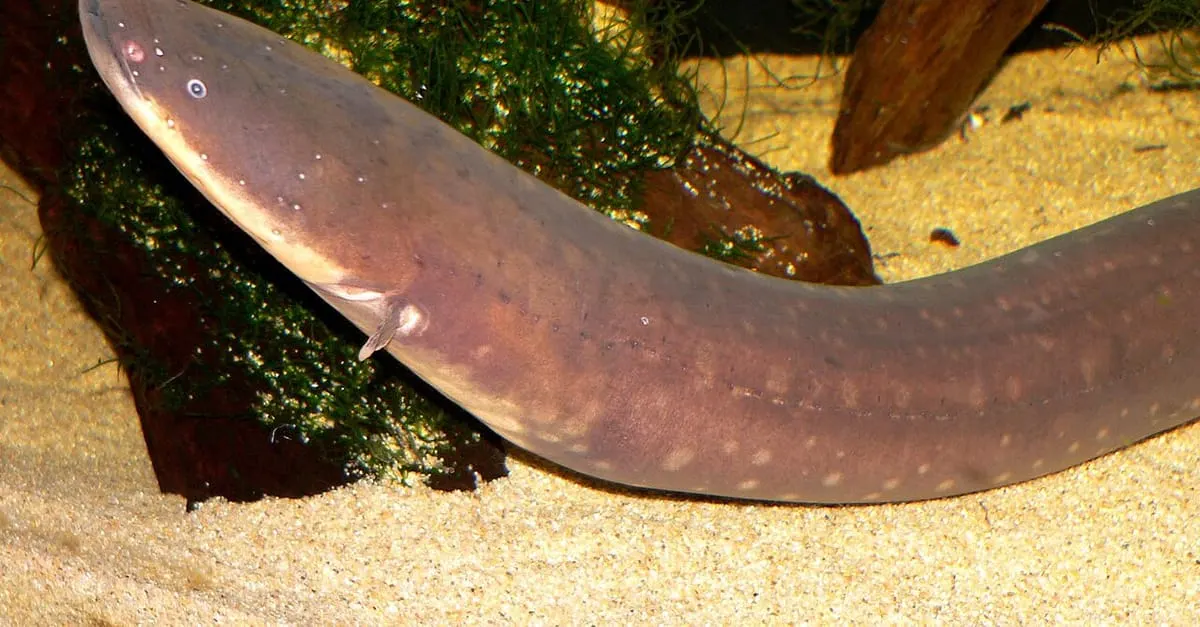
There is an animal in the rivers of South America that can stun prey without biting or touching it. The electric eel does not need claws or teeth to deliver its main defense. It turns on specialized electric organs and floods the water around it with a jolt that can disrupt a fish's nervous system. The strange part is that it runs on the same basic ion-flow principle your own nerves use, just scaled up to a powerful discharge.
An electric eel makes electricity with thousands of stacked living batteries
An electric eel makes electricity with specialized cells called electrocytes, packed into three electric organs that fill most of its long body, where each cell builds a tiny voltage and thousands of them fire in sync to add up like batteries in a series (Wikipedia). National Geographic puts the count at around 6,000 of these battery-like cells in the main organ, all discharging at the same instant. A single electrocyte is feeble on its own, worth only about a tenth of a volt. The power comes from numbers and timing.
Here is the part worth slowing down on, because it is the whole secret. Each electrocyte is a flat, modified muscle cell, and at rest it spends energy keeping its two sides electrically lopsided. It does this with an ion pump, the same sodium-potassium pump that hums away inside your own cells, shoving charged sodium and potassium ions across the membrane so that one face of the cell carries a different charge than the other. That difference is small, but it is real stored energy, like a tiny charged battery sitting in the dark.
The shock is a wave of cells firing in order
When the eel decides to strike, its brain sends a nerve signal down to the organ, and the nerve endings release a chemical messenger called acetylcholine (Wikipedia). That message throws open ion channels on one side of every electrocyte at almost the same moment. Sodium ions rush in, the cell's polarity flips for an instant, and that flip is the discharge. A heartbeat later, potassium ions flow out through a separate set of channels and reset the cell, ready to fire again.
Because the cells are wired in series, like the AA batteries in a flashlight lined up end to end, their little voltages stack. One cell gives a tenth of a volt. Six thousand cells, firing as one, give you hundreds. The eel actually stacks thousands of electrocytes lengthwise and runs many such stacks side by side, which lets it pile up high voltage and still push a meaningful current. The whole event is astonishingly quick. The eel can fire its strong discharge at a rate of up to 500 a second, so each individual shock lasts only about two thousandths of a second.
Just how strong is the jolt?
Electric eel voltage is species-dependent. In a 2019 study, researchers found that Electrophorus electricus produced about 480 volts, E. varii 151 to 572 volts, and E. voltai up to 860 volts (Nature Communications). The record belongs to E. voltai, not to every electric eel. The study also showed that what had long been treated as one species was really three.
One of the newcomers, named Electrophorus voltai, set a record. Researchers recorded it discharging up to 860 volts, the strongest electric shock ever measured from a living thing. The work, published in Nature Communications after the team examined 107 specimens and sequenced their DNA, suggested the extra punch may be an adaptation to the highland waters where this eel lives. Those waters carry fewer dissolved salts and conduct electricity poorly, so a stronger jolt helps the signal reach prey through resistant water.
More than a weapon
It is tempting to think of all this as just a stun gun, but the eel does subtler things with it too. Alongside the high-voltage organ, it carries a low-voltage one, Sachs' organ, that puts out gentle pulses of around ten volts. The eel reads how those weak fields bend around objects in the murky water, a sense called electrolocation, and uses it to navigate and find prey when eyesight fails. In that sense the eel is feeling its surroundings the way you might wave a hand in a dark room, except its hand is an electric field. It is a different way of working with charge than the static cling on a balloon or the spark you get touching a doorknob, but the underlying push and pull of ions is the same physics.
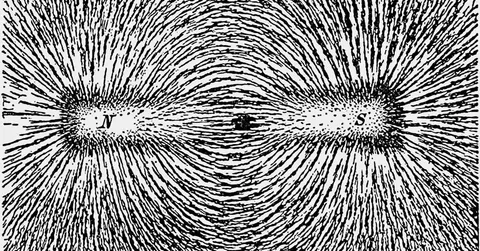
The hunt itself can get clever. An eel will sometimes curl its body to bring its head and tail close together, sandwiching prey between the two ends of its electric organ to roughly double the field, the way pinching a magnet's poles together concentrates the force in how a magnet works. It can also fire short bursts that make a hidden fish twitch, revealing its location, before delivering the full shock.
One last thing the eel is not: an eel. For all its slithering looks, it is a kind of knifefish in the order Gymnotiformes, more closely related to catfish than to the river eels in how do eels reproduce. The resemblance is a coincidence of body shape, not family.
There is a tidy historical footnote to all of this. When Alessandro Volta built the first true battery in 1800, stacking metal discs to make a steady electric current, he was working in the long shadow of these fish. The eel's stacked, voltage-summing organ was the original proof that animals could generate electricity at all, and it helped inspire the device that now powers nearly everything you own. Nature filed the patent first.
Keep wondering: trace the same hidden physics into how magnets work, feel it crackle in how static electricity works, and meet the eel's stranger river cousins in how do eels reproduce.

Join the conversation
Comments are reviewed before they appear. Be kind and stay curious.
Loading comments…