
Richard Feynman got asked, on camera in 1983, how magnets work. He refused to answer it the easy way. "I can't explain that attraction in terms of anything else that's familiar to you," he said. "For example, if I said the magnets attract like as if they were connected by rubber bands, I would be cheating you" (ScienceAlert). He wasn't dodging. He was being honest about a genuinely deep fact. So how do magnets work, if even Feynman wouldn't hand you a tidy picture? You can get remarkably far before you hit the part that gets strange.
Magnets work because moving electric charge makes a magnetic field
Every magnet you have ever touched comes down to one fact: magnetism is made by electric charge in motion (Lumen Learning / SUNY). A current running through a wire makes a magnetic field around it. So does an electron moving inside an atom. There is no separate "magnetic stuff" hiding in iron. There is only charge, and charge that moves makes a field.
Each electron in an atom contributes in two ways. One is its motion around the nucleus, a tiny loop of current. The bigger one is a built-in property called spin. An electron behaves like a minuscule spinning charge, which makes it act as a tiny bar magnet with its own north and south (Britannica). Spin is a misleading word, because nothing is actually whirling around like a top, but the magnetic effect is real and it is the main source of the magnetism in everyday magnets.
In almost every material, those tiny electron magnets point in random directions and cancel each other out. The atom as a whole, and the lump of material as a whole, ends up magnetically blank. That is the normal case. Magnets are the exception. Electrons are restless in other ways too, which is the same reason static electricity builds up when surfaces rub.
Why iron is special: domains
A handful of metals break the rule. In iron, cobalt, nickel, and the rare element gadolinium, the electron magnets in a neighborhood of atoms don't cancel. They prefer to line up parallel to each other. That cooperative alignment is called ferromagnetism, and it is the only kind of magnetism strong enough for you to feel with your hand.
The lining-up happens in patches. Inside a piece of iron, groups of atoms band together into regions called domains, and within each domain the atomic magnets all point the same way (National MagLab). In a plain, unmagnetized nail, the domains themselves point in scattered directions, so the nail has no overall pole. Bring a magnet near it, though, and the domains rotate and grow until they mostly agree, and the nail turns into a weak magnet of its own. That is why a magnet can pick up a paperclip, and why the paperclip can then pick up a second one.
A permanent magnet is just a piece of ferromagnetic material whose domains have been locked into alignment and stay that way. An electromagnet skips the domains and the iron entirely: run a current through a coil of wire and you get a field for exactly as long as the current flows, then nothing (Lumen Learning / SUNY). Both are the same physics, charge in motion, packaged two different ways. And both can be undone. Heat a permanent magnet past its Curie temperature, 1043 kelvin for iron, and the thermal jostling scrambles the domains and the magnetism dies (Lumen Learning / SUNY).
Field lines, and why poles do what they do
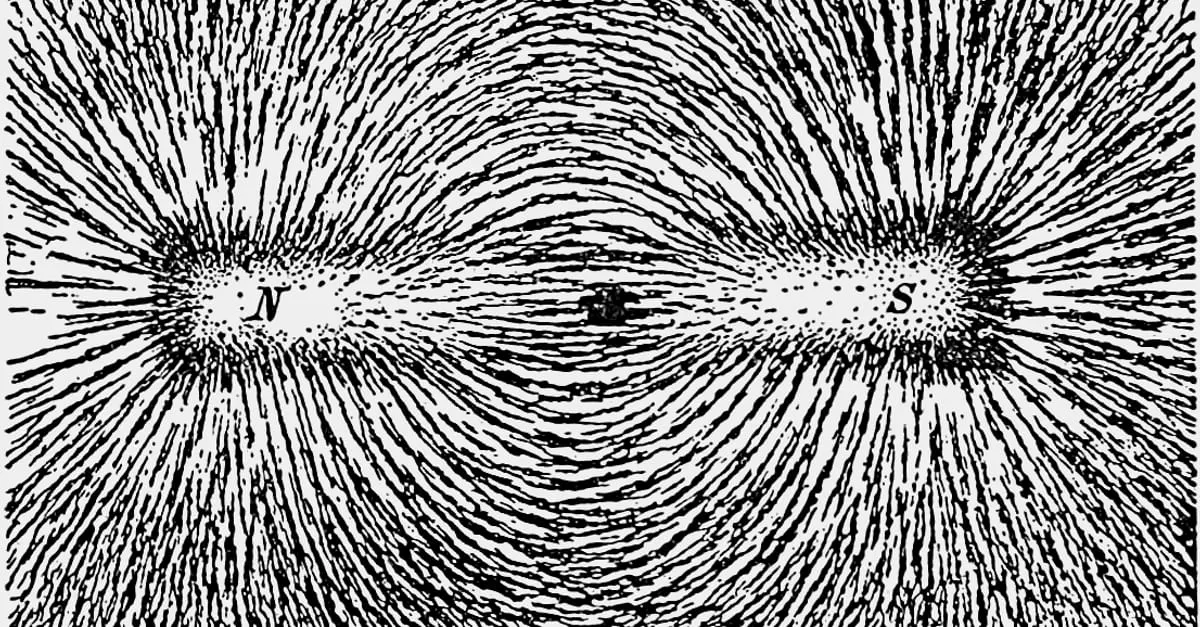
Sprinkle iron filings on paper over a bar magnet and they snap into looping arcs running from one end to the other. Those arcs trace the magnetic field, and they always run out of the north pole and back into the south. When two magnets meet, the field lines do the talking. Opposite poles let the lines flow together smoothly and the magnets pull close. Like poles force the lines to bunch up and shove apart, which you feel as that springy refusal when you press two norths together.
One detail trips people up. You cannot get a lone north pole. Snap a bar magnet in half and you don't get a separate north and a separate south; each half instantly has its own north and south. Keep cutting, all the way down to a single atom, and it is still a tiny two-poled magnet. Poles come in pairs, always.
The planet under your feet is a magnet too
The same idea, scaled up enormously, is why a compass works. Earth's magnetic field is generated in the molten iron of the outer core, roughly 1,800 miles down, where the churning metal acts like a giant electrical generator that physicists call the geodynamo (NASA). Moving charge again, just on a planetary scale. Living things run the same trick at a smaller size, which is how electric eels make electricity. The field it throws out, the magnetosphere, reaches far into space and deflects the solar wind and cosmic radiation that would otherwise strip away our atmosphere (NASA). The same force that holds a note to your fridge is, in a bigger version, part of what keeps the planet habitable.
The part Feynman wouldn't fake
Now the honest catch, the thing Feynman wouldn't paper over. You can chase magnetism down to electron spin and feel like you've reached bottom. You haven't. It turns out classical physics, the physics of billiard balls and ordinary forces, cannot produce magnetism in matter at all. There's a result called the Bohr-van Leeuwen theorem, worked out by Niels Bohr in 1911 and again by Hendrika van Leeuwen in 1919, showing that if you ran the numbers with no quantum mechanics, the magnetism of any material would average out to exactly zero (Wikipedia). Permanent magnets are flat-out impossible in a purely classical world.
So magnetism in solids is a quantum effect through and through, and electron spin is itself a quantum and relativistic property with no everyday counterpart. That is the wall Feynman ran into on camera. He could tell you magnets attract, and he could tell you the rules they follow, but he couldn't translate the cause into rubber bands or gears or anything you could hold, because at the bottom there is nothing more familiar to translate it into. The honest answer to how magnets work is that lined-up electron spins make a field, and that the spins exist because the universe is quantum mechanical underneath, and there the explanation stops, not because we're ignorant, but because we've hit the floor.
That is a strange place to land for something stuck to your refrigerator. A fridge magnet is a little window onto the fact that the world, at its base, does not run on the rules your hands learned. The pull is real, the rules are clean, and the reason underneath is genuinely not like anything else.
Keep wondering: the metals that make the best magnets are also the ones that feel coldest to the touch, which is why metal feels colder than wood; the same restless electrons that line up in iron are what scatter sunlight into why the sky is blue; and the way iron atoms lock into a rigid pattern is its own crystal quirk, much like why ice floats.




Join the conversation
Comments are reviewed before they appear. Be kind and stay curious.
Loading comments…