
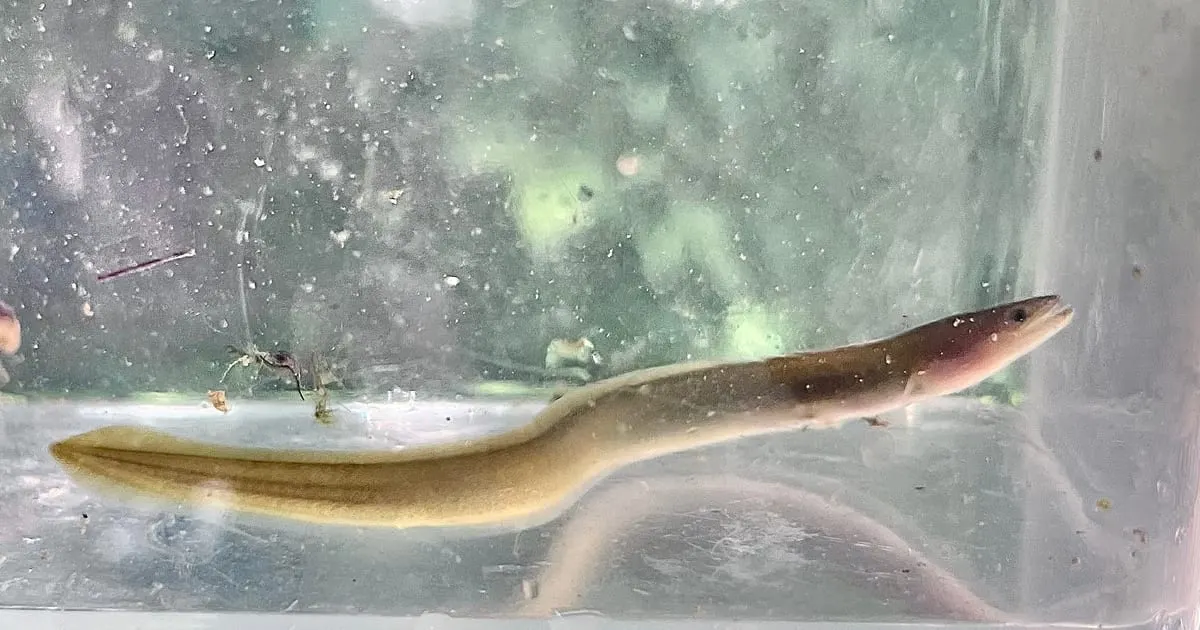
Every freshwater eel in Europe began life in the same stretch of open ocean: the Sargasso Sea, a borderless patch of the Atlantic with no coastline of its own. Eels reproduce there once, then die. In all of recorded history, no human has ever seen it happen.
That last part is not a figure of speech. We have split the atom, mapped the human genome, and landed machines on other worlds, but the moment an eel releases its eggs has never been filmed, photographed, or witnessed by anyone. Other fish wear their reproduction on the outside, like the male seahorse that carries the young and gives birth. "How do eels reproduce" is one of the oldest questions in biology, and the honest answer is that we have only recently confirmed half of it.
The question that outlived Aristotle
For most of human history, eels seemed to come from nowhere. Slit one open and you find no obvious eggs and no testes, none of the equipment other fish wear plainly inside them. Faced with that blank, Aristotle studied eels closely around 350 BC and reached a conclusion that was reasonable for its time: eels are not born in the ordinary way at all. They arise, he wrote, from the "so-called 'earth's guts' that grow spontaneously in mud", springing from the ground itself rather than from eggs or mating.
It is easy to laugh at that now, but the eels were genuinely hiding something. Generation after generation of naturalists looked for the missing pieces and failed. Some decided eels grew from horsehairs dropped in water, or from the morning dew, or budded off the bodies of other fish. The puzzle even earned a name, the "eel question," and it stayed open for more than two thousand years.
The young Freud, hunting for something he could not find
By the 1870s the mystery had narrowed to a single stubborn gap: no one could reliably point to a male eel and prove it. The reproductive organs that should settle the matter had never been pinned down. In 1876 the problem landed on the desk of a nineteen-year-old medical student named Sigmund Freud, years before he would invent psychoanalysis.
Sent to a zoological research station in Trieste, Freud spent about four weeks dissecting hundreds of eels, searching for the testes that would explain how they bred. He did find the lobed organ an earlier naturalist had flagged as a possible testis, but his specimens were immature, so he could not confirm it actually was one, and the question stayed open. One of the sharpest minds of the coming century met the eel and came away without his proof.
One man chased the answer across an ocean
The breakthrough, when it came, arrived not from a dissecting tray but from the deck of a ship. Starting in 1904, a Danish biologist named Johannes Schmidt began hauling up tiny, transparent, leaf-shaped creatures from the Atlantic. They were eel larvae, called leptocephali, and they looked nothing like the adults. Schmidt noticed something that would take him the better part of two decades to chase down: the farther west he sailed, the smaller the larvae he caught.
Smaller meant younger, and younger meant closer to home. So Schmidt followed the trail of ever-tinier larvae across an ocean, expedition after expedition, through interruptions and a world war. In 1922 he reached a quiet expanse of warm water south of Bermuda, the Sargasso Sea, and there he netted the smallest, freshest eel larvae anyone had ever seen. He had walked the breadcrumbs back to the bakery. In his 1923 report he laid out the answer that had escaped Aristotle: Europe's eels are born here, in the middle of the Atlantic, thousands of kilometers from the nearest river they will ever call home.
A body that remakes itself for one last trip
Knowing where eels go only made how they get there stranger. Eels are catadromous, a word that means they grow up in fresh water but breed in the sea, the reverse of a salmon. A European eel can spend ten, fifteen, even twenty years in a river or pond as a drab "yellow eel." Then something switches on.
In a change called silvering, the eel rebuilds its own body for a journey it will make exactly once. Its flanks turn metallic silver, its eyes swell to take in the dim blue of the open ocean, and its digestive system begins to shut down. By the time it slips out to sea, the eel has stopped eating for good. Everything left in the trip, the muscle power for thousands of kilometers and the eggs or milt waiting at the end, runs on fat it banked years earlier. An animal that quietly dismantles its own stomach to make one final swim is a reminder of how odd life's solutions can be, and the ocean is full of them, including a jellyfish that may never truly die.
The round trip, mapped
Stitched together, an eel's whole life is a single enormous loop out into the Atlantic and back.
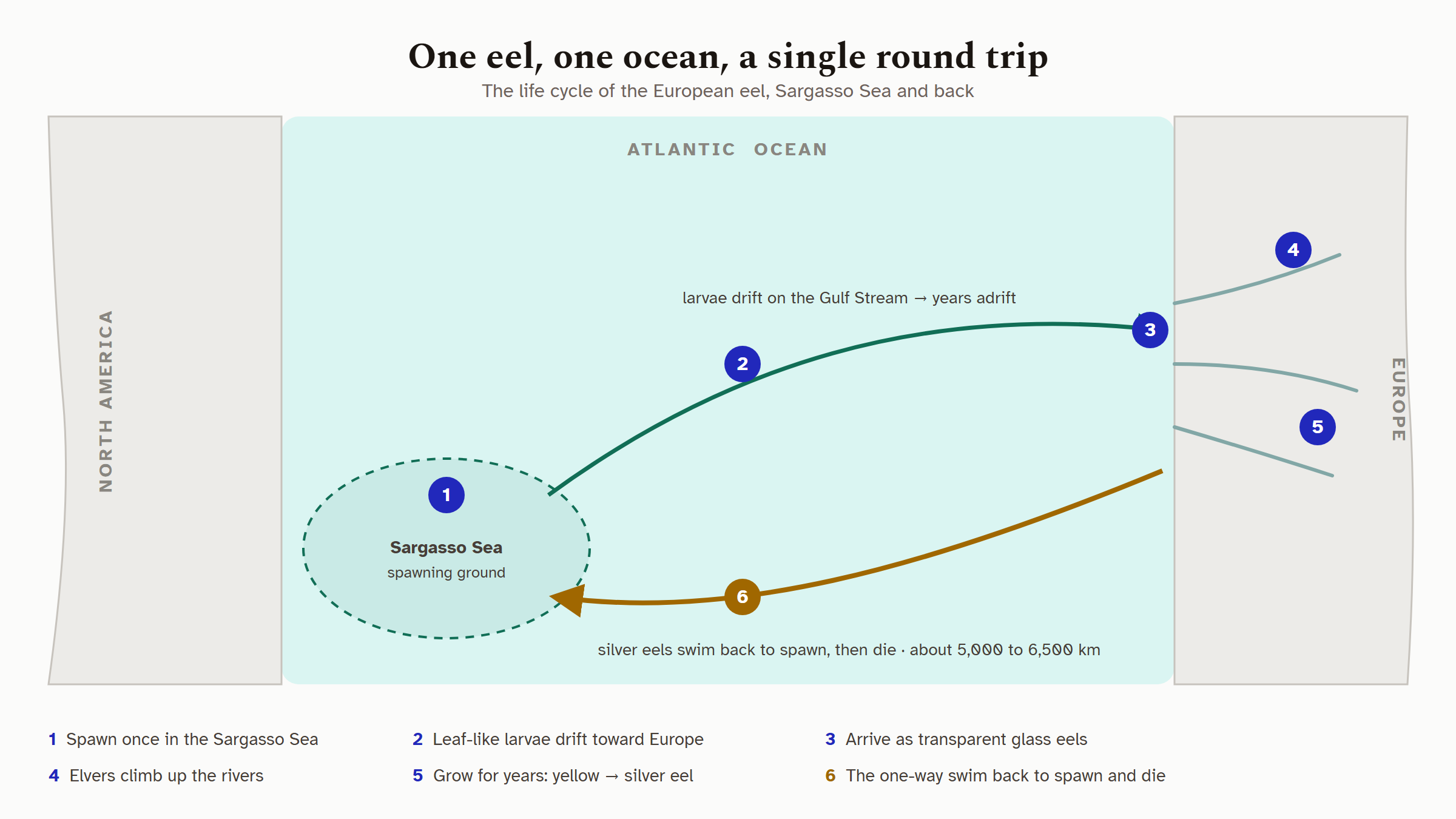
The larvae that Schmidt traced ride the Gulf Stream northeast for a year or more, drifting toward Europe like leaves on a current. Near the coast they shrink and clarify into "glass eels," see-through slivers the length of a finger, then darken into "elvers" that wriggle up rivers, sometimes climbing wet walls and weirs to reach the still water inland. There they stay and grow, for years, until the silver change calls them back the way they came.
Europe's eels are not even the only ones drawn to that water. The American eel runs its own version of the same loop, swimming out from the rivers of North America, and it too heads for the Sargasso Sea to breed, its birthplace overlapping with the European eel's. Two separate species, kept an ocean apart for almost their entire lives, somehow end up spawning in the same hidden stretch of the Atlantic.
2022: the first time we followed them out there
For a century, Schmidt's Sargasso answer rested on an inference. He had found the youngest larvae there, so the adults must spawn nearby, but no one had ever tracked a grown eel the whole way out to prove it. The adults vanished into the Atlantic and were not seen again.
Then in 2022, researchers reported the first direct evidence of adult European eels reaching the area. They fitted satellite tags to twenty-six eels and tracked them out from the Azores, already far into the mid-Atlantic. Several tags surfaced inside the bounds of the Sargasso Sea, and one eel reached the very region long presumed to be the breeding ground. It was the closest anyone had come to confirming the old answer by following living adults across the ocean.
And still, even then, no one saw a thing. The tags logged positions, not behavior. As the scientists are careful to point out, no eggs and no spawning adults have ever been collected from the Sargasso Sea to confirm what happens there. We now know where eels go to reproduce. We have never once watched them do it.
Why a 2,000-year-old mystery still matters
This is no longer a leisurely puzzle. The European eel is now listed as Critically Endangered, the same tier as some of the rarest animals on the planet. The number of glass eels returning to Europe's rivers has fallen to a tiny fraction of what it once was, hit by dams, pollution, disease, and a changing ocean. We may be racing to finish reading the eel's last secret at the very moment the eel is slipping away.
And the hardest part of the riddle is not the where but the how. No one can yet explain how an eel that has spent fifteen years in a single pond, and has never made the trip before, finds an unmarked patch of open ocean a continent away, in the dark, with no parent and no map to follow. Whatever sense it steers by, it carries the route inside itself from birth.
There is something humbling in that. A creature common enough to end up in pies and smokehouses for centuries turns out to guard one of the most stubborn riddles in natural history, and it has kept the final page to itself. We can map its loop, tag its body, and name the sea where it ends. The eel still gets to spawn in the dark, unwatched, exactly as it has since long before anyone thought to ask how.
Keep wondering: the sea hides stranger lives the deeper you go, so meet a jellyfish that may be biologically immortal, find out how deep the ocean really goes, and learn why so many sea creatures make their own light down where the eels disappear.
Join the conversation
Comments are reviewed before they appear. Be kind and stay curious.
Loading comments…