
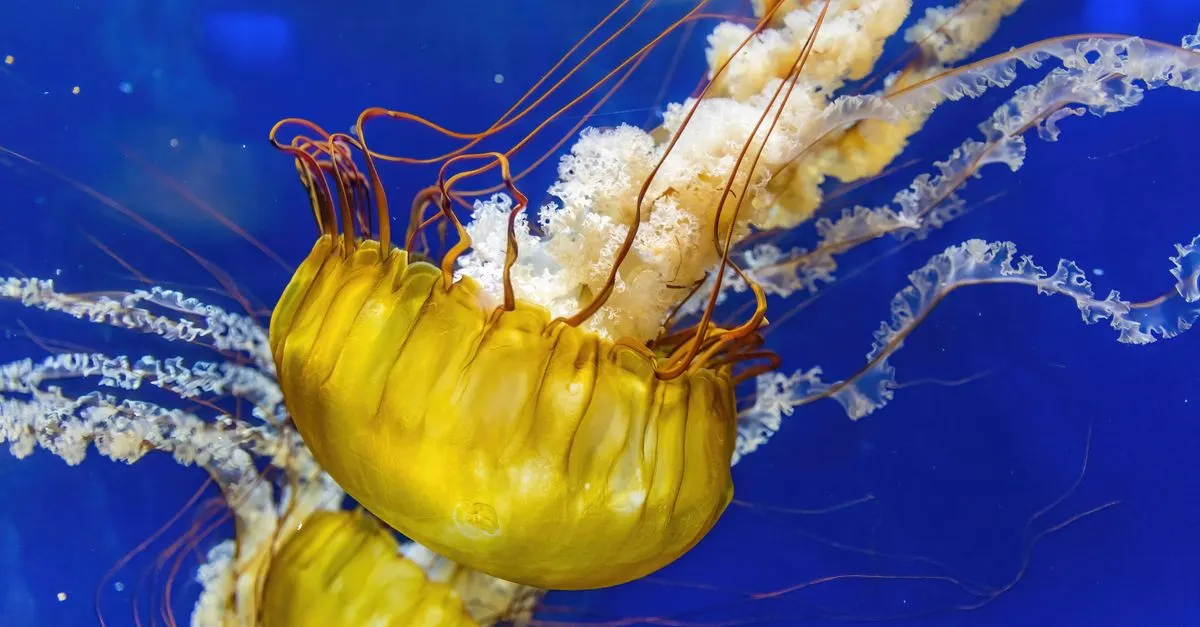
Here's the unsettling part about a jellyfish sting: it does not require a jellyfish to make a conscious decision. Jellyfish have nerve nets rather than brains, and the cells that sting can respond locally when the right physical and chemical cues arrive. That is why even a detached tentacle can remain dangerous. Its surface is covered in microscopic loaded capsules, and brushing them can be enough to start the sequence.
Millions of tiny harpoons, waiting
Here's how jellyfish sting. Their tentacles are studded with specialized stinging cells called cnidocytes, and inside each one sits a nematocyst, a minuscule capsule holding a tightly coiled, barbed, venom-tipped thread, like a harpoon wound up under enormous tension (Ocean Conservancy). A single tentacle can carry thousands or even millions of them. When the trigger is tripped, the capsule fires: the coiled thread shoots out, spears whatever touched it, and pumps venom straight through the skin. Multiply that by the number that go off at once, and you have a sting.
What pulls the trigger
The trigger belongs to the cnidocyte, the living cell around the capsule. Mechanical contact works together with chemical information from the potential target, which helps prevent every passing water movement from wasting a sting (A molecular filter for the cnidarian stinging response). Once discharge begins, stored pressure and elastic energy drive the thread outward. The thread everts, meaning it turns inside out as it travels, and its barbed end can pierce or wrap around the target depending on the capsule type (The architecture and operating mechanism of a cnidarian stinging organelle).
One of the fastest things in all of biology
The most famous speed figures come from a particular capsule in a different cnidarian. In 2006, researchers filmed stenotele nematocysts from the freshwater polyp Hydra at more than a million frames per second. Those capsules completed the first launch phase in as little as 700 nanoseconds and reached acceleration above 5.4 million times gravity (Nüchter et al., Current Biology). The same experiment estimated capsule pressure near 150 bar and tested penetration against crustacean cuticle.
Those are real measurements, but they are not a universal speed limit for every jellyfish sting. Cnidarians carry many kinds of nematocysts, built for piercing, entangling, or sticking, and their dimensions and mechanics vary (A view to kill). The Hydra result is best understood as a benchmark for what one specialized cnidarian capsule can do.
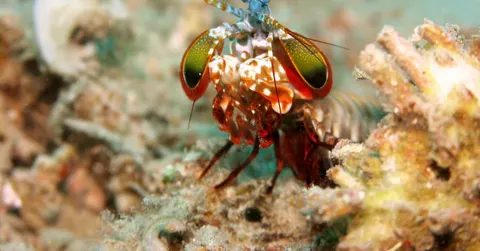
The energy is stored in the pressurized capsule and its tightly packed thread. Trigger it and that energy is released in a rapid sequence, first launching the shaft and then everting the rest of the tubule. It is one of the fastest cellular events scientists have measured, and the ocean is full of speed records like it, from the mantis shrimp's bullet-fast punch to this.
A local trigger with biological safeguards
The cnidocyte can execute the discharge locally, but calling it a completely self-contained hair trigger goes too far. Experiments across cnidarians show that mechanical and chemical cues are filtered before discharge, and some species add neural or synaptic control to that decision (Regulation of cnidocyte discharge). The exact control system differs among species and body parts.
That distinction does not make loose tentacles safe. A detached piece of tissue can retain cnidocytes that are still intact and responsive. It only means the animal's biology does more than wait for any random touch.
Both the capsule and its chemical cargo vary. Cnidarians have evolved different nematocyst shapes and threads for different jobs, while venom composition changes among species. Many jellyfish stings cause limited skin irritation in people. Some box jellyfish species can cause life-threatening envenomation. The shared idea is a microscopic capsule delivering its contents with startling speed, not one identical harpoon used by every jellyfish.
So give a stranded jellyfish room. The animal may not be choosing a target, but intact stinging cells can still recognize the right cues and fire. That is more interesting than a simple hair trigger, and a better reason not to test one with your hand.
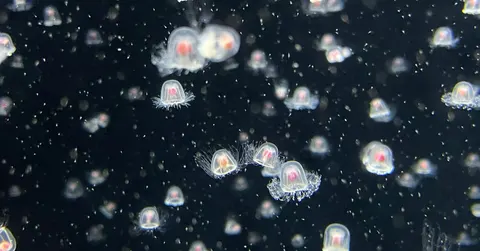
Keep wondering: the ocean keeps setting speed and survival records, from the fastest punch in the sea to the jellyfish that may have beaten death itself and the starfish that digests its prey outside its body.

Join the conversation
Comments are reviewed before they appear. Be kind and stay curious.
Loading comments…