
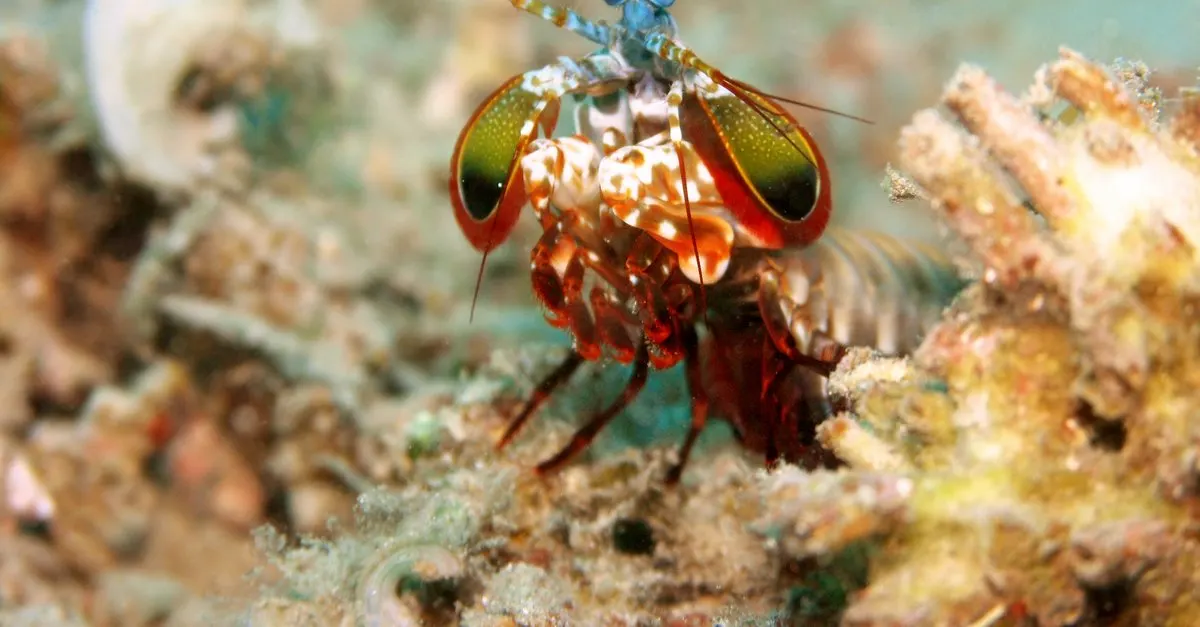
A creature the size of your finger throws a punch that boils the water in front of it. The peacock mantis shrimp hits so fast and so hard that the strike happens twice: once with its club, and once with the bubble its club leaves behind.
A finger-sized animal hits with up to 1,500 newtons
So how hard does a mantis shrimp punch? The peacock mantis shrimp (Odontodactylus scyllarus) swings its club-shaped forelimb at over 20 meters per second and lands peak impact forces between 400 and 1,501 newtons, thousands of times its own body weight. Biologists Sheila Patek and Roy Caldwell measured those numbers in a 2005 study in the Journal of Experimental Biology. To put 1,500 newtons in human terms, that's roughly the force of a 150-kilogram weight pressing down, delivered by an animal you could hold in your palm. And it does this underwater, where drag should make fast movement nearly impossible.
The strike is a crossbow, not a muscle
A muscle alone can't move that fast. Patek's earlier work, published with Korff and Caldwell in Nature in 2004, clocked the strike accelerating at around 10,400 g, comparable to the acceleration of a .22 caliber bullet leaving a barrel. Muscle contraction tops out far below that. The trick is that the mantis shrimp doesn't punch with muscle. It punches with a spring.
The limb works like a crossbow. Muscles in the arm contract slowly, bending a saddle-shaped piece of exoskeleton, a curved, mineralized strut that compresses like a bow being drawn. A pair of latch structures hold everything cocked while the muscle keeps loading energy into the spring. When the latch releases, all that stored energy unloads at once into the club. Research on the spring shows the bulk of the elastic energy actually sits in mineralized bars in the arm segment, with the saddle acting as part of a coupled spring system. The point is the same: load slowly, release instantly. The same trick of storing elastic energy and letting it go all at once is how a Venus flytrap snaps shut on a fly. That decoupling of loading from firing is what lets a small animal beat the speed limit of its own muscle. Pound for pound it hits harder than almost anything, a different kind of record from the raw muscle behind how strong a gorilla is.
The bubble that punches back
Here's where it gets strange. The club moves so fast that the water can't keep up. Pressure behind the moving club drops low enough that the water vaporizes into tiny bubbles, a process called cavitation. Those vapor bubbles are unstable, and a fraction of a millisecond later they collapse.
The collapse is its own weapon. Patek and Caldwell recorded two separate force peaks in every strike, 390 to 480 microseconds apart. The first peak is the club hitting the shell. The second is the cavitation bubbles imploding against it, with forces reaching up to 504 newtons on their own. So a snail's shell takes two blows from a single swing, and the mantis shrimp can damage prey even when its club doesn't land cleanly, because the bubble does the follow-up.
A flash of light, hotter than you'd believe
When a cavitation bubble collapses, it concentrates energy into a vanishingly small point, and that point glows. The phenomenon is called sonoluminescence: a brief flash of light born from collapsing bubbles. The interior of a collapsing cavitation bubble can spike to thousands of degrees for an instant. In principle a collapse like this can emit a faint flash of light, and high-speed imaging has directly captured that glow in the snapping (pistol) shrimp, a closely studied case of biological sonoluminescence. For the mantis shrimp the same flash is hypothesized from the cavitation physics but has not been directly imaged. If it does happen, each punch briefly lights a spark hotter than most flames, then snuffs it out before you could ever see it with the naked eye. The shrimp is making tiny, short-lived stars to break dinner open.
Why the club doesn't shatter itself
A hammer that hits 1,500 newtons thousands of times should crack apart. The mantis shrimp's club doesn't, and the reason is its architecture. In a 2012 Science study, James Weaver and colleagues found the club is built in layers. The outer impact surface is packed with hardened mineral (hydroxyapatite) to take the blow. Beneath it sits a region of chitin fibers stacked in a slowly rotating spiral, each layer twisted a few degrees from the one below. Materials scientists call this a Bouligand structure, a twisted-plywood pattern.
That twist is the secret. When a crack tries to travel through the club, it can't run straight. The rotating fiber layers force the crack to corkscrew, spreading its energy across a much larger area instead of letting it split the club in one clean line. The crack exhausts itself before it can do real damage. Engineers are now copying this layout into carbon-fiber composites and body armor, because nature solved impact resistance long before we did.
The mantis shrimp doesn't know any of this. It just needs to eat a snail. The sea is full of animals that shrug off limits we assume are fixed, from this fist that boils water to a jellyfish that may never truly die. But to do that, it built a crossbow into its arm, learned to boil water with a fist, and armored itself against its own violence, all in something smaller than your thumb.
Keep wondering: the same cavitation flashes that arm this shrimp hint at why other animals make their own light, so read why sea creatures glow, then go down where these hammers really live in how deep the ocean goes and find out why deep-sea pressure doesn't crush the fish that live there.

Join the conversation
Comments are reviewed before they appear. Be kind and stay curious.
Loading comments…