
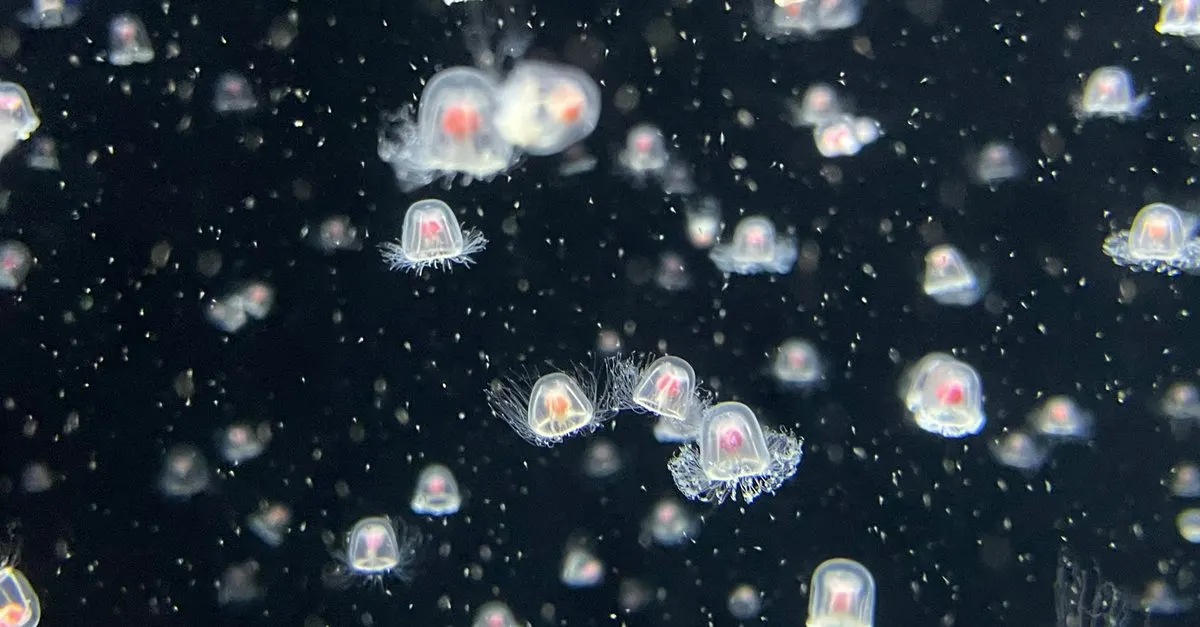
A jellyfish the width of a pencil eraser has done something only a very few known complex animals can do: it grew old, then grew young again, then did it once more. Drop a stressed adult of this species into a dish and watch over three days. The bell collapses, the tentacles pull in, and the whole animal melts into a blob that crawls back to the seafloor and starts life over as a baby.
What "biological immortality" actually means for the immortal jellyfish
The immortal jellyfish, Turritopsis dohrnii, is biologically immortal because it can reverse its own life cycle. When injured, starved, or simply aging, the adult medusa transforms back into its juvenile polyp stage instead of dying, then matures into an adult again, potentially repeating the loop without limit (Wikipedia). It's one of the very few known cases of a complex animal that can reverse aging after reaching sexual maturity. A 2024 PNAS study by Soto-Angel and Burkhardt reported a similar feat, finding reverse development after sexual maturity in the comb jelly Mnemiopsis leidyi (Soto-Angel and Burkhardt, PNAS 2024). Biological immortality doesn't mean nothing can kill it. It means the animal shows no built-in clock forcing death by old age. A few other creatures flirt with the same trick, which is part of how long lobsters can live.
A normal jellyfish life runs one direction. A larva settles, becomes a polyp anchored to the seafloor, and the polyp buds off free-swimming medusae, the umbrella-shaped adults we recognize. The medusa reproduces and dies. Turritopsis breaks the arrow. Its adult can run the tape backward.
How an adult body rewinds into a baby
The trick is a cellular process called transdifferentiation: a fully specialized cell changes directly into a different specialized cell, skipping the usual rule that mature cells stay what they are. A muscle cell can become a nerve cell. Under stress, the medusa's cells abandon their adult jobs and reorganize into the tissue of a polyp (American Museum of Natural History).
The full reset takes 24 to 72 hours. The bell deteriorates, the animal sinks, and within days it has rebuilt itself as a polyp colony that will later release new, genetically identical medusae. Italian researchers Stefano Piraino and colleagues documented this in a 1996 study, showing medusae could revert to polyps when stressed (Piraino et al., 1996). That paper described the species as Turritopsis nutricula, the name then used for what is now considered synonymous with today's T. dohrnii. Most accounts trace the first observation to a German biology student, Christian Sommer, who in the late 1980s noticed his jar of Turritopsis refused to leave behind any corpses.
The medusa itself is tiny, about 4.5 millimeters across at its widest (Wikipedia). It started in the Mediterranean and now turns up in oceans worldwide, hitchhiking in the ballast water that ships pump in and out, a quiet global spread.
Why it is not the same as being unkillable
Here's the part the headlines skip. A fish eats most of these jellyfish long before old age becomes a problem, and the deep ocean is full of fish thriving under conditions that would seem impossible, like the crushing pressure that somehow doesn't flatten them. In the wild, the great majority of individuals die from predation or disease in the medusa stage and never get the chance to revert (Wikipedia). The reversal also works only at certain points in the life cycle and not after the animal has been mortally damaged.
So "immortal" is a statement about aging, not about invincibility. The jellyfish escapes senescence, the slow bodily decline that makes a mouse or a person more likely to die each passing year. It does not escape getting swallowed. That distinction matters, and it's the single most-mangled fact about this animal.
What its genome hinted at, and why scientists argued about it
In 2022, a team led by Maria Pascual-Torner and Carlos Lopez-Otin at the University of Oviedo published the first whole-genome assembly of T. dohrnii in PNAS. They compared it to a close cousin, Turritopsis rubra, which they described as unable to rejuvenate after reproducing. T. dohrnii carried roughly twice as many copies of some genes tied to DNA repair and damage protection, plus variants linked to telomere maintenance and stem-cell upkeep (Pascual-Torner et al., PNAS 2022).
Then science did what science should. In 2023, Maria Pia Miglietta of Texas A&M argued in a formal PNAS letter that the study's premise was shaky, because T. rubra may in fact be able to rejuvenate too, which would undercut the whole mortal-versus-immortal comparison (Miglietta, PNAS 2023). The genetics of immortality, in other words, are still being fought over.
The jellyfish has company, sort of
Turritopsis is the showpiece, but it isn't alone in cheating the aging clock. The freshwater hydra, a tentacled relative barely a centimeter long, seems to dodge senescence entirely. Biologist Daniel Martinez tracked hydra for four years and found no rise in death rate and no drop in fertility as they aged, results he reported in 1998 and that later work extended over much longer spans (Martinez, 1998). Hydra pulls this off differently, by constantly renewing its body from three lines of stem cells rather than rewinding its life cycle.
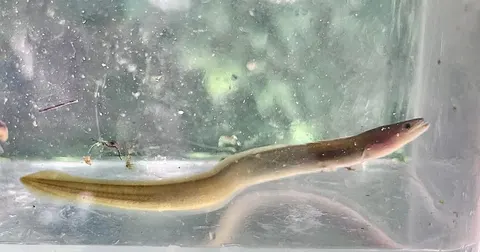
Some corals and other colonial animals blur the line further, since a colony can lose and regrow parts indefinitely. But hydra and Turritopsis are the two clearest cases biologists point to when they say an animal doesn't have to grow old. The ocean guards other life-cycle puzzles just as stubbornly, like how eels reproduce, a question naturalists chased from Aristotle onward.
A creature smaller than your fingernail has been quietly solving the problem we've chased for all of recorded history, and it has no idea it's doing anything remarkable at all.
Keep wondering: the same ocean that hides this ageless drifter also holds creatures that survive the vacuum of space, animals that make their own light, and trenches so deep we still ask how far down the ocean goes.

Join the conversation
Comments are reviewed before they appear. Be kind and stay curious.
Loading comments…