
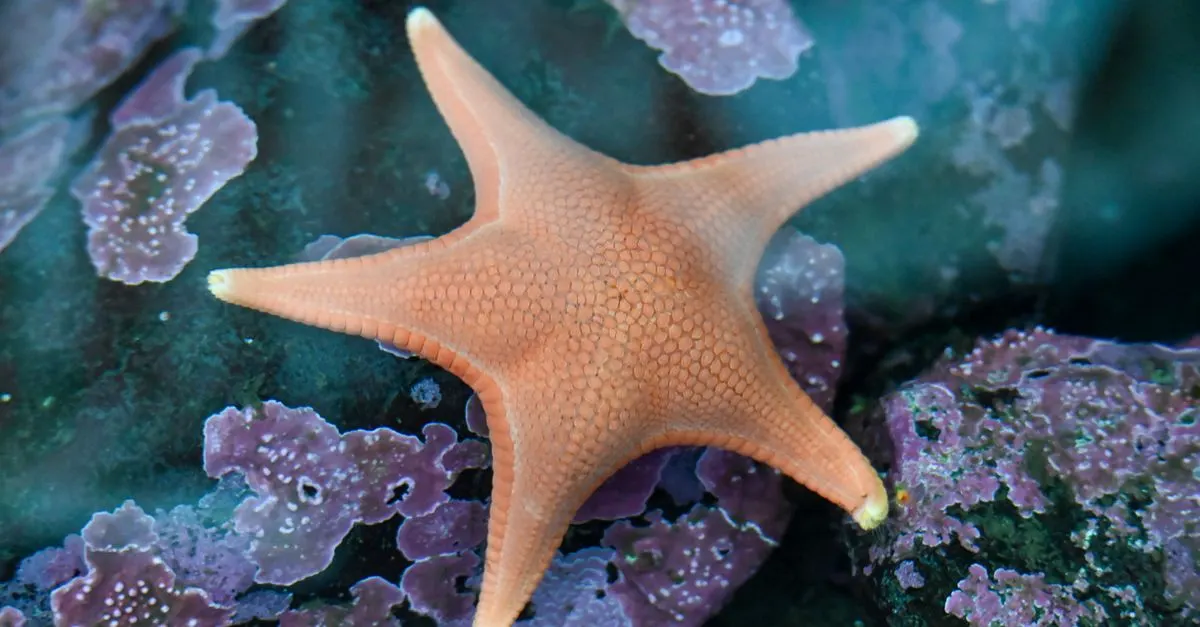
A starfish looks like the gentlest thing in the sea: slow, soft, five tidy arms, the kind of creature you'd pick up in a tide pool without a second thought. To a mussel, it's a slow-motion horror. Because when a starfish sits down to dinner, it does something no gentle creature should be able to do. It turns its stomach inside out and digests its prey alive, outside its own body.
It eats by pushing its stomach out of its mouth
Here's how starfish eat: the mouth sits in the center of the underside, and through it the starfish can push its stomach clean out of its body. Most sea stars have two stomachs. The larger one, the cardiac stomach, is soft and flexible and can be everted, turned inside out and extended through the mouth, onto or into a meal (National Aquarium). It floods the prey with digestive enzymes, melts the soft tissue into a slurry right where it lies, and then the stomach is hauled back in, carrying the liquefied meal to the second, internal pyloric stomach to finish digesting. The starfish never has to swallow anything whole. It brings the stomach to the food.
First it has to win a very slow fight
The famous victims are clams, mussels, and oysters, animals sealed inside two tightly clamped shells. Cracking that open looks impossible for a soft, boneless predator. The starfish doesn't crack it. It outlasts it.
A starfish moves and grips using hundreds of tube feet on the underside of its arms, and those feet don't run on muscle. They run on water. Seawater enters through a little valve on top called the madreporite and flows into an internal plumbing network, the water vascular system, that drives each tube foot by pressure, like a thousand tiny hydraulic pistons with suction cups on the ends (Washington State University, Ask Dr. Universe). The starfish humps over the shell, grips both halves, and pulls. Not hard. Just steadily, and forever. The mussel holds itself shut with a single strong muscle, but a muscle held tight tires out. After minutes, even hours, of that relentless, patient tension, the bivalve's muscle fatigues and gives, and the shell sags open.
A gap of a millimeter is all it needs
And the shell barely has to open at all. A gap of a millimeter or two is enough, because the everted stomach is astonishingly thin and can flow through a slit no wider than a coin's edge (Ocean Conservancy). Once that thin sheet of stomach is inside, the enzymes go to work, and the mussel is digested in its own shell, in its own home, without ever fully opening. By the time the starfish moves on, there's a clean, empty shell and not much else.
A predator running on seawater, with no brain
Step back and the strangest part isn't the table manners, it's the animal pulling them off. A starfish has no brain. It has no blood, either; the same seawater that works its feet also carries oxygen and nutrients around its body. A simple ring of nerves, with branches running down each arm, is all the coordination it gets (National Aquarium). And yet this brainless, bloodless thing tracks down prey, lays an hours-long siege, and performs a feat of external digestion that would be the envy of any horror movie.
We tend to file intelligence and menace together: the clever predator, the cunning hunter. The starfish quietly ignores all that. It out-patients and out-engineers its prey with no central thoughts at all, just water pressure, time, and a stomach that goes where the food is. The next time one sits motionless in a tide pool, pretty and harmless under your fingers, remember it might simply be mid-meal, its stomach somewhere out of sight, doing the worst thing in the rock pool to something that never saw it coming.
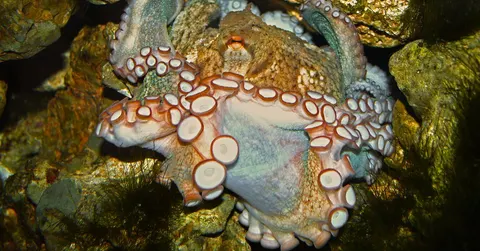
Keep wondering: the ocean is full of these quiet impossibilities, from how an octopus rewrites its own skin to whether sharks ever truly sleep, all the way down into how deep the ocean really goes.



Join the conversation
Comments are reviewed before they appear. Be kind and stay curious.
Loading comments…