
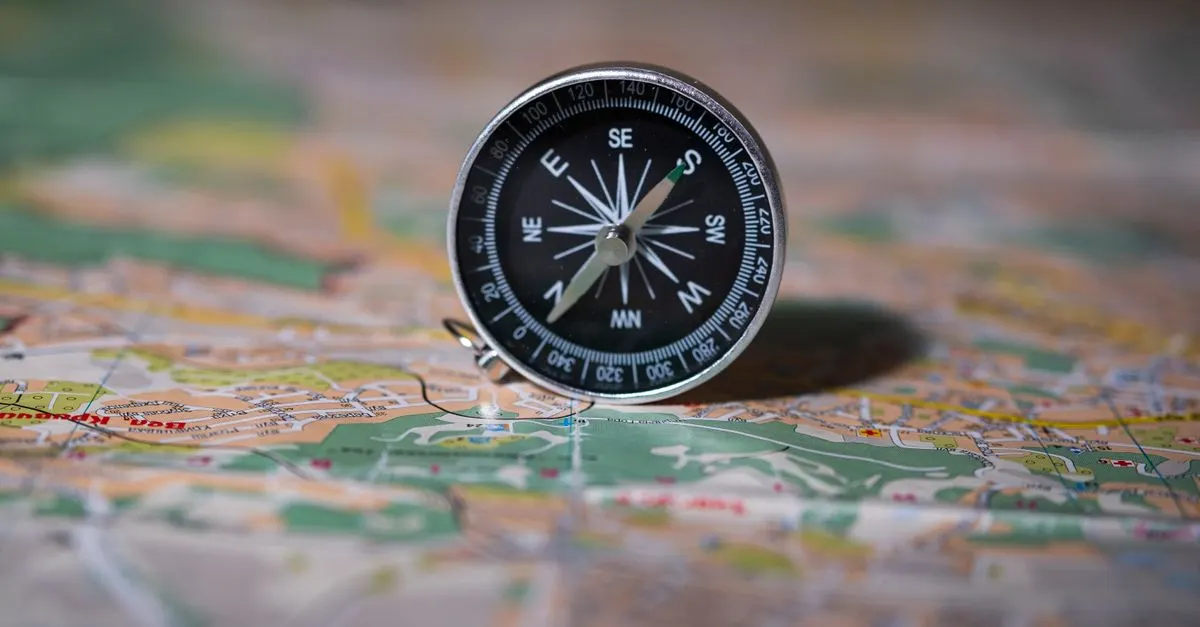
Point a compass north and it lies to you, just a little. The needle doesn't aim at the North Pole, that fixed point at the top of every map. It aims at a different spot entirely, a magnetic pole that's sliding across the Arctic toward Siberia at this very moment. The wonder of a compass isn't only that a sliver of metal knows which way to turn. It's that it's tracking a target that won't hold still.
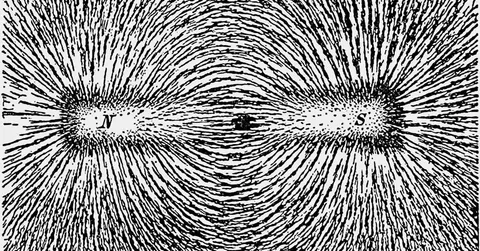
A free-floating magnet lining up with a much bigger one
Here's how a compass works: the needle is a thin, lightweight magnet, balanced on a near-frictionless point so it can pivot with almost no effort. Earth, it turns out, is also a magnet, with a magnetic field that wraps the whole planet. The field grabs the needle and twists it until it lies along the field's direction, so the marked end swings to point toward magnetic north and settles (NOAA Science On a Sphere). No battery, no signal, no satellites. Just one magnet falling into line with another. That simplicity is why the compass worked for Chinese navigators a thousand years ago and still works in your hand today.
The whole planet is the magnet
The field the needle answers to comes from deep underground. Earth's outer core is an ocean of molten iron and nickel, and as that metal churns and flows it works like a giant dynamo, generating electric currents that throw off a magnetic field. More than 95 percent of the magnetism you can measure at the surface is made down there (NOAA NCEI). The same restless heat that drives volcanoes also runs the planet's compass. So a hiker reading a needle in the woods is, in a real sense, feeling the motion of liquid metal two thousand miles beneath their boots.
There's a quirk worth knowing. Opposite magnetic poles attract, and the north end of your needle is pulled toward Earth's north. Which means the thing we call Earth's "north magnetic pole" is, in the language of magnets, actually a south pole. The label is a historical convenience. The physics underneath it runs the other way.
North, but not true north
This is where the needle's small lie comes in. The magnetic north it finds isn't the geographic North Pole, the point the Earth spins around. The two sit hundreds of miles apart, and the angle between where your compass points and true north has a name: magnetic declination (NOAA NCEI). Declination is different in different places. Stand in one part of the world and your compass is nearly honest; stand in another and it's off by a wide margin. Anyone navigating seriously, a pilot, a sailor, a backcountry hiker, looks up the local declination and corrects for it, because a few degrees of error stretched over many miles will leave you somewhere you didn't mean to go.
The pole that keeps walking
Now the strangest part. Because the molten core never stops moving, the magnetic pole doesn't either. Over the last two centuries the north magnetic pole has wandered more than 2,000 kilometers out of the Canadian Arctic, and it's now closer to Siberia than to Canada. In recent decades it picked up speed, racing along at around 50 kilometers a year, before braking hard to roughly 35 (NOAA NCEI World Magnetic Model). Nobody fully understands the sudden change of pace.
This is why the World Magnetic Model, the master map that phones, ships, and aircraft use to turn a compass reading into a true heading, gets re-issued every few years. The compass in your hand is reliable. The pole it points at is the moving part. And that's the thing to sit with: the oldest, simplest navigation tool we have isn't pointing to a place on the map at all. It's pointing at a slow current in the Earth's belly, and it has been quietly following that current, mile by mile, the whole time.
Keep wondering: the same forces turn up across the planet, from how magnets work up close to how the molten Earth drives volcanoes, and how airplanes fly the headings a compass helps set.


Join the conversation
Comments are reviewed before they appear. Be kind and stay curious.
Loading comments…