
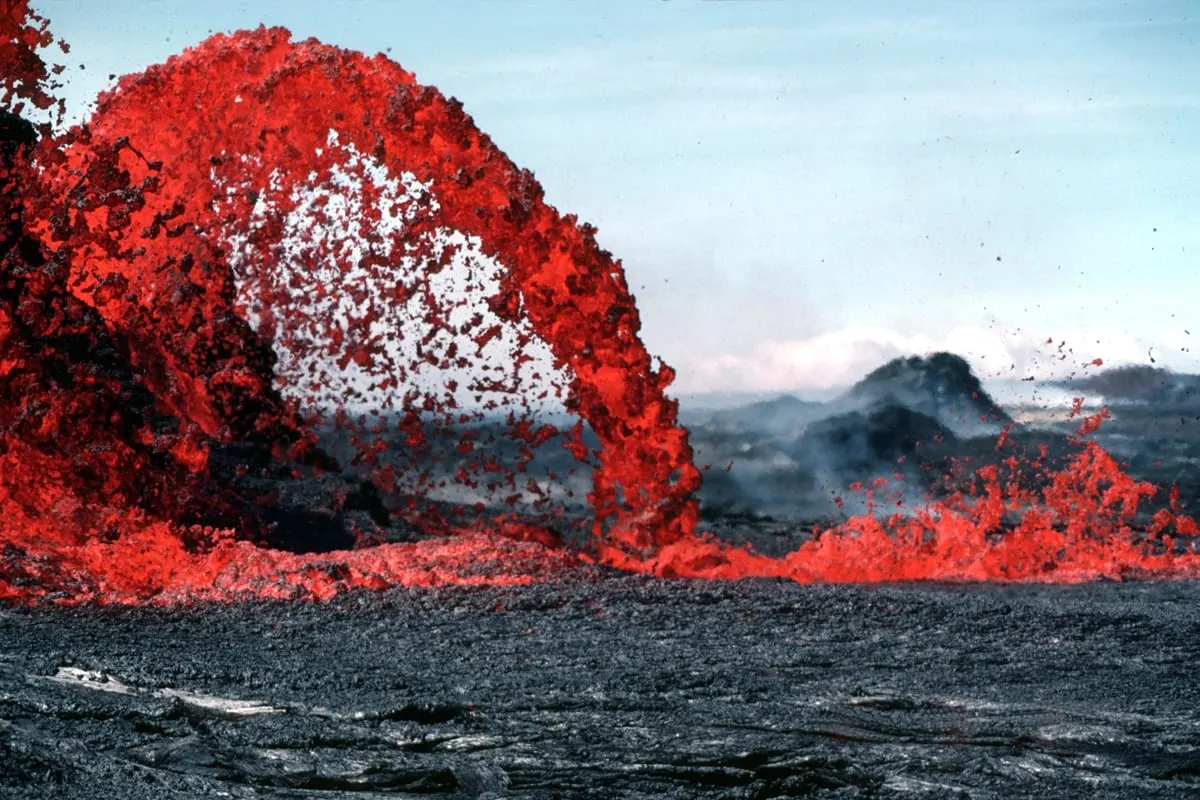
A volcano looks like a mountain losing its temper, blowing its top in a fit of fire. The truth is calmer and stranger. An eruption is mostly about gas escaping from melted rock, the same physics as opening a fizzy drink, just scaled up to move mountains. Rock shapes the ground gently too, over ages, which is how most caves form. How do volcanoes erupt, exactly? Once you see how the pieces fit, it becomes one of the most satisfying stories in earth science.
The short answer: light rock and trapped gas
Deep inside the Earth, intense heat melts solid rock into magma, often many tens of miles down (U.S. Geological Survey). That magma is lighter, less dense, than the rock around it, so it floats upward and gathers in pockets called magma chambers. Rising melted rock is the first half of the story. The second half is what is dissolved inside it.
The secret ingredient is gas
Magma is not just liquid rock. It carries dissolved gases, mainly water and carbon dioxide. As long as the magma is deep, the crushing weight of the rock above keeps those gases locked in solution (National Park Service).
Then the magma rises, the pressure on it falls, and the gases escape from the liquid and swell into bubbles. The Park Service puts the analogy plainly: this is "like the expansion and exsolution of gases" you see when you crack open a soda can and the dissolved carbon dioxide rushes out. That expanding gas is the engine. It shoves the magma up the conduit and out of the vent. An eruption is gas getting free.
Why some volcanoes ooze and others explode
Not all eruptions look alike, and the difference comes down to how runny the magma is. That texture is set mostly by silica content, which thickens magma the way flour thickens gravy (National Park Service).
- Thin, runny magma (low in silica, like the basalt under Hawaii) lets gas bubble out gently. The result is an effusive eruption, with lava flowing out and running downhill, sometimes at several miles per hour.
- Thick, sticky magma (high in silica) traps the gas. Pressure climbs with nowhere to go until it escapes all at once, shattering the magma into fragments and hurling them skyward. That is what Mount St. Helens did in 1980.
Two other things crank up the violence: more dissolved gas, and a faster rise. A magma that races to the surface has no time to let its gas leak out gradually, so it all comes out together, the way a shaken can sprays instead of fizzes.
This is the same buried-pressure drama that plays out across the planet, from the deep ocean floor to the elements forged in collapsing stars, like the story behind where gold comes from.
Where eruptions happen
Volcanoes are not scattered at random. Most line up along the edges of Earth's tectonic plates (U.S. Geological Survey). Where one plate dives beneath another, at a subduction zone, water dragged down helps melt rock and feeds the explosive, cone-shaped volcanoes of places like the Pacific Ring of Fire. Where plates pull apart along the mid-ocean ridges, magma rises into the gap and quietly builds new seafloor, the hidden rock that paves most of the planet beneath the deep ocean.
A few volcanoes break the rule. Hawaii sits over a hotspot, a plume of heat thousands of kilometers from the nearest plate boundary, which is why a chain of islands rises in the middle of the Pacific. Different address, same machinery: light rock rising, trapped gas breaking free.
Keep wondering: the Earth is full of pressure stories, from a volcano's trapped gas to the deep sea that does not crush its fish, and one strange quirk of water that keeps lakes from freezing solid. More at Life on Earth.
Join the conversation
Comments are reviewed before they appear. Be kind and stay curious.
Loading comments…