
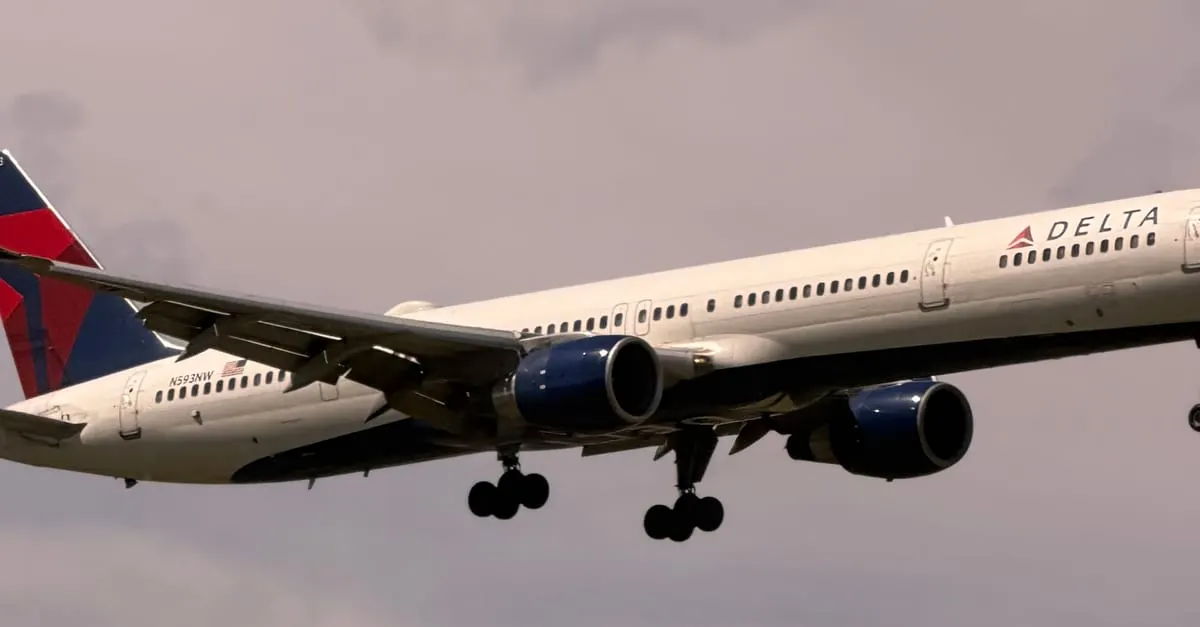
On a cold December morning in 1903, a machine that weighed more than 600 pounds left the sand at Kitty Hawk, North Carolina, and stayed in the air for twelve seconds. Orville Wright flew about 120 feet on that first hop, and by the fourth flight of the day Wilbur covered 852 feet in 59 seconds (Britannica). People had watched birds do this for all of history and called it impossible for anything heavier than air. So how do airplanes fly, and why did it take us until 1903 to work it out? The honest answer is that the popular explanation most of us learned is wrong, and the real one is simpler.
A wing throws air down, and the air shoves it back up
Here is the whole trick in one sentence. A wing pushes a large amount of air downward, and by Newton's third law of motion, that air pushes the wing upward with equal force. That upward force is lift, and lift is what holds a plane up (Let's Talk Science). The faster the wing moves and the more air it turns down, the harder the air pushes back. A jet engine or a propeller supplies the thrust that drags the wing through the air fast enough for this to work.
You can feel a tiny version of it from a car window. Hold a flat hand out at a slight upward tilt and the wind slams it up and back. Your hand is deflecting air down, and the air is pushing your hand up. A wing does the same thing far more efficiently, across its whole surface, all the time. A bird's wing does it too, which is why a hummingbird beats its wings so fast to hover in one spot.
The story you were probably told, and why it's wrong
Most textbooks explain lift like this: a wing is curved on top and flat on the bottom, so air going over the top has farther to travel, and since it has to meet its partner at the back edge at the same time, it speeds up, and faster air means lower pressure, which sucks the wing upward. It sounds tidy. It is also, in the words of NASA's Glenn Research Center, the "Incorrect Lift Theory" (NASA Glenn).
The problem is the part where the two air parcels have to reunite. Nothing makes them. NASA measured it: the air going over the top arrives at the trailing edge before the air going underneath, not at the same moment (NASA Glenn). And there is a cleaner proof. A symmetric wing, with a top and bottom of exactly equal length, still makes plenty of lift. So does a flat sheet of metal tilted into the wind. If the curved-top, longer-path idea were the real cause, neither of those should fly at all.
Bernoulli and Newton are the same story, told twice
So is the pressure explanation just garbage? No. Air really does move faster over the top of a wing, and faster air really does have lower pressure. That is Bernoulli's principle, and it holds. The mistake was only in why the air speeds up. The wing's shape and its tilt bend the airflow, and bending the flow is what speeds it up and drops the pressure on top.
This is the part that confuses people, so NASA spells it out plainly: "both 'Bernoulli' and 'Newton' are correct" (NASA Glenn). You can add up the pressure pushing on every patch of the wing and get the lift. Or you can measure how much the wing turned the air downward and get the lift from Newton. Same airflow, same number, two ways of accounting for it. As NASA puts it, the turning of the flow "will result in a re-action" on the wing (NASA Glenn). The low pressure on top and the air thrown off the back are not two separate causes. They are one event, described from two angles.
Why tilting the wing matters more than its curve
If the curve is not the secret, what is? Angle. The angle between the wing and the oncoming air is called the angle of attack, and it is the main dial a pilot turns. Tip the leading edge up a little and the wing turns more air downward, so lift rises. This is why a plane points its nose up to climb, and why it lifts off only once it is moving fast enough for the wings to bite.
There is a hard limit, though. Push the angle too far and the smooth sheet of air peels away from the top of the wing into a churning mess. Lift falls off a cliff, and the wing stalls. The Wright brothers crashed and rebuilt for years partly because they were learning, by hand, where that edge was. Their 1903 machine could warp its own wings to change the angle on each side, which is how Orville kept it balanced for those first twelve seconds (Britannica).
The four forces holding the whole thing in balance
Step back and a plane in cruise is a tug of war between four forces. Lift pulls up, weight pulls down, thrust pushes forward, drag pushes back (Let's Talk Science). When a jet levels off at altitude, those forces settle into balance: lift equals weight, thrust equals drag, and the plane holds its height and speed without climbing or slowing. Open the throttle and thrust beats drag, so it accelerates. Ease back and it slows. Pitch the nose up and lift beats weight, so it climbs. Drag is the one nobody wants, which is also why geese fly in a V: each bird rides the easier air behind the one ahead and saves energy on the trip.
What gets me is how ordinary the core of it is. There is no suction trick and no magic curve doing the work. A wing is just a clever way to throw a river of air at the ground, and the ground, through the air, throws a 400-ton jet right back into the sky. The Wrights did not beat physics. They found the one honest deal it was offering all along.
Keep wondering: that wing is shoving aside air made of the same drifting droplets that make a cloud weigh a million pounds; the air it flies through is the same stuff that scatters light and makes the sky blue; and the next time the plane lands somewhere freezing, you can think about why ice floats on the puddles outside.


Join the conversation
Comments are reviewed before they appear. Be kind and stay curious.
Loading comments…