
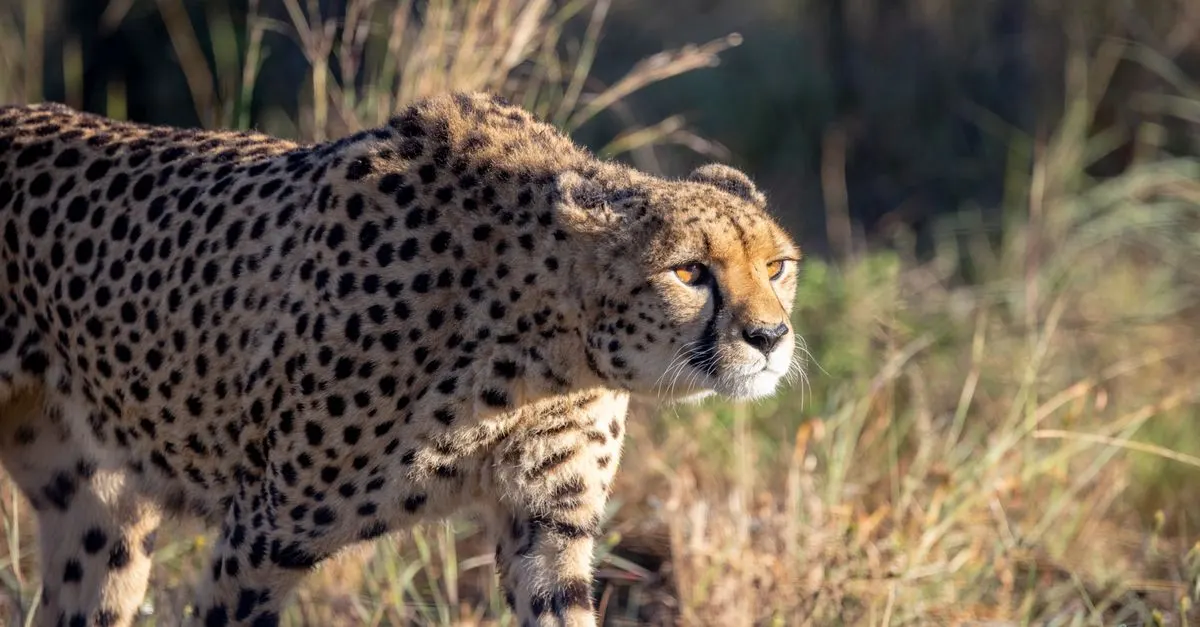
Forty-five miles an hour in two and a half seconds, from a dead stop. That is faster off the line than most sports cars, and a cheetah does it on four legs across open grass. Push the cat to its limit and it tops out somewhere between 60 and 70 miles per hour. So the headline number is real, but it hides the strange part: the fastest land animal on the planet can only run flat-out for about twenty seconds before it has to quit.
A cheetah runs 60 to 70 mph, the fastest of any land animal
A cheetah can run between 60 and 70 miles per hour (96 to 112 km/h), faster than any other animal on land (Smithsonian's National Zoo). Getting there is the showy part. From a standstill it hits about 45 mph in just 2.5 seconds, and the Cheetah Conservation Fund puts the launch at over 70 mph reached in just over three seconds. For comparison, a racehorse or a greyhound tops out in the mid-40s. The cheetah is not just a little quicker than its rivals. It is in a different class.
But that top speed comes with an expiry date. A full sprint lasts only about 20 seconds, and the cat can hold its fastest pace for roughly 300 yards before the run falls apart. Everything about the cheetah is built for that single burst and nothing else.
What the body does at full speed
Watch a cheetah run in slow motion and it stops looking like a cat. The spine flexes like a drawn bow, then snaps straight, flinging the back legs forward past the front ones. Each stride covers about 23 feet, nearly the length of a parking space, and the cat fires off four of those strides every second. For long stretches of each stride, all four feet are off the ground at once. It is closer to a series of leaps than a run.
The hardware matches. A cheetah's shoulder blades aren't anchored to a collarbone, so the front legs swing freely and reach far ahead. Semi-retractable claws stay partly out like cleats, biting into the dirt for grip. The long tail swings as a counterweight and a rudder, letting the cat lean into a turn at speed without tumbling. Inside, oversized nostrils, lungs, and a big heart move oxygen fast enough to feed muscles that are burning through fuel at a frightening rate.
The trade-off is that almost none of this is built for stamina. The cheetah is light, between 75 and 140 pounds, with thin legs and lean muscle (Smithsonian). It gave up the bulk and power that let a lion wrestle down big prey in exchange for raw acceleration. A cheetah is a sprinter wearing a sprinter's body, and sprinters can't run marathons.
Why the sprint ends in about twenty seconds
So why does the fastest animal on Earth give up after twenty seconds? For a long time the textbook answer was overheating. The story went that a sprinting cheetah's body temperature climbed so fast it had to stop before it cooked itself, a number often quoted as a 40.5 C ceiling measured on captive cats running on treadmills in the 1970s.
Field research has since taken that apart. When physiologist Robyn Hetem's team implanted temperature sensors in wild cheetahs and tracked them through real hunts, the cats did not overheat during the chase at all. Body temperature when a chase ended averaged about 38.4 C, in line with a normal resting day. The temperature did climb later, mostly in the hour after a kill, by around 1.3 C following a successful hunt. The researchers tied that rise to the stress of the hunt and the kill itself, a stress hyperthermia, rather than to the run. Overheating, it turns out, was a myth.
The likelier reason a cheetah stops is energy. A sprint that hard is anaerobic, meaning the muscles burn fuel faster than the lungs can supply oxygen, and the cat racks up an oxygen debt within seconds. Run out of usable energy and the legs simply can't keep firing. After a chase a cheetah stands there panting heavily for several minutes, paying back that debt, the same way you gasp at the top of a flight of stairs. It isn't too hot. It's spent.
The hunt is won by turning, not by top speed
Here is the part that rewrites the whole picture. In 2013, Alan Wilson's team at the Royal Veterinary College fitted wild cheetahs with custom GPS collars that logged their position and speed many times a second, then recorded 367 real hunting runs over the next 17 months. The cats almost never used their famous top speed. The fastest run the collars caught was about 58 mph, and plenty were far slower than that.
What actually caught the prey was agility. The collars recorded some of the most extreme acceleration, braking, and turning forces ever measured in any land mammal. Pound for pound, the cheetah's acceleration power came out at roughly four times Usain Bolt's at his world-record best. A gazelle can't outrun a cheetah in a straight line, so it jukes and cuts, and the chase is won by the cat that can brake hardest and corner tightest while staying on its feet. The study's blunt conclusion was that grip and maneuverability, not outright speed, decide who eats. The top-speed number is the headline. The footwork is the story.
That said, the headline number can be astonishing under the right conditions. The fastest cheetah ever reliably timed was Sarah, an 11-year-old at the Cincinnati Zoo, who ran a measured 100 meters in 5.95 seconds in 2012 and was radar-clocked at up to 61 mph along the way. Usain Bolt's record for the same distance is 9.58 seconds. The cheetah finished while the fastest human alive was barely past halfway.
The whole animal reads like a bet. Nature took a cat, stripped out everything heavy and slow, and spent the savings on one perfect burst of speed, knowing the burst would last only seconds. It pays off on the open plains of Africa often enough to keep the species running. But it leaves the cheetah with no second gear and no reserve, a specialist so committed to going fast that it can't afford to go far.
Keep wondering: if speed in extreme bodies grabs you, see how fast a hummingbird beats its wings, find out why dogs pant the way a winded cheetah does, and meet the animal whose punch is faster than a bullet.



Join the conversation
Comments are reviewed before they appear. Be kind and stay curious.
Loading comments…