
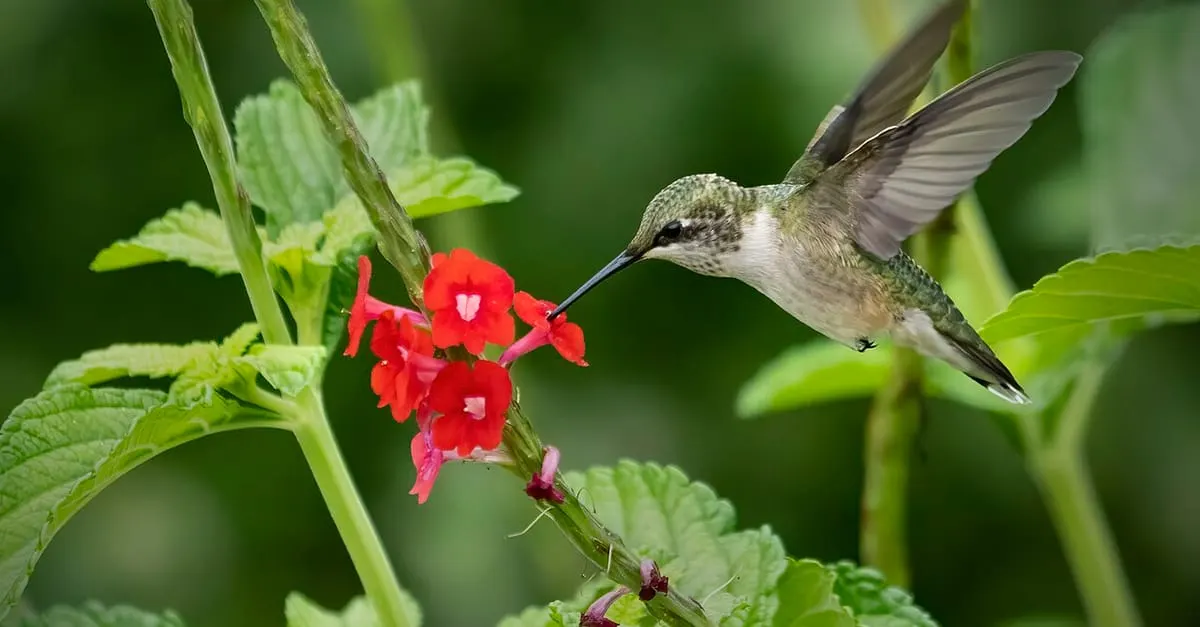
Stand near a hummingbird feeder and the bird arrives as a sound before it is a shape. A dry, electric hum, and then a body the size of your thumb hanging in the air on wings you cannot quite see. The wings are not invisible. They are simply moving too fast for your eyes to freeze them, the same blur of speed that trails a cheetah at a full sprint. So how fast do hummingbirds flap their wings, and how do they manage the one trick almost no other bird can do, holding perfectly still in midair?
The answer ranges from dozens to more than 100 beats a second
There is no single hummingbird wingbeat speed. Many species hover at roughly 40 to 80 beats every second, while smaller birds generally beat faster than larger ones. A broad study of 92 species found that a few tiny woodstars hover near or above 100 beats a second, and males can raise the rate again during aerial courtship displays (Behavioral Ecology). That is faster than your eyes can separate one stroke from the next.
That speed is why you hear a hummingbird before you understand what you are looking at. The hum is not a voice call. It comes from the wing forces pulsing through each stroke, creating a fundamental pitch and a stack of higher harmonics (eLife). The same engine pushes the whole bird along at close to 30 miles per hour in level flight, and past 45 in a dive (Smithsonian's National Zoo).
The wings don't flap, they row
Here is the part that makes hovering possible. Most birds get their lift from the downstroke and treat the upstroke as a recovery, a quick reset before the next push. A hummingbird does something stranger. Its wings rotate at the shoulder and sweep through a figure-eight, pushing air forward, backward, and down, so they make lift on both the forward and the back stroke (Science World).
Think of it less as flapping and more as rowing, or treading water in the air. Because the upstroke also contributes lift, the bird can hold its position through sustained feeding bouts. By adjusting the angle of its wings and tail it can hover, slide backward, pivot to either side, even tip briefly upside down (Science World). Hummingbirds are the only birds specialized for sustained still-air hovering. Nectar-feeding bats can hover too, but they use a different wing design (Science Advances). A hummingbird solves the same lift problem that keeps an airplane up, just by moving the wing instead of the whole aircraft.
The engine behind the blur
A motion that fast burns a frightening amount of fuel. A hummingbird's heart runs from around 225 beats a minute at rest to more than 1,200 beats a minute when it is flying (Smithsonian's National Zoo). To keep that furnace lit, hummingbirds feed frequently and can consume a large fraction of their body mass in nectar over a day. The exact amount varies with species, temperature, activity, and the sugar concentration of the nectar.
That is why a hummingbird never seems to rest at a flower for long. It is on a relentless circuit, and as it drinks it carries pollen from bloom to bloom, doing the same quiet work bees do when they collect nectar. The wing speed and the appetite are two sides of one bargain: an animal that lives this fast has to eat almost constantly to pay for it.
Some nights call for torpor
The bargain has a catch. A body that burns this hard faces a steep energy bill overnight, especially when it is cold or food has been scarce. Hummingbirds can answer by entering torpor, lowering body temperature and metabolism so sharply that their hourly energy cost can fall by up to 95 percent (Smithsonian Magazine). But torpor is a choice shaped by food, body condition, and the night ahead, not a switch every hummingbird flips every night (Proceedings of the Royal Society B).
So the blur you cannot quite see at the feeder is a body living at the edge of what a warm-blooded animal can do, a heart near 1,200 beats a minute, wings beating dozens of times a second, and an engine that can idle down into torpor when the energy budget demands it. The hummingbird is one of those animals that seems to break the rules of its own size, the way an animal that may never die of old age does. The next time one hangs in front of you, remember that you are watching one of the most expensive ways there is to be a bird.
Keep wondering: those beating wings solve the same puzzle that keeps an airplane in the air; the nectar a hummingbird chases is the start of why bees make honey; and for another animal whose body does something physically absurd, see how hard a mantis shrimp punches.

Join the conversation
Comments are reviewed before they appear. Be kind and stay curious.
Loading comments…