
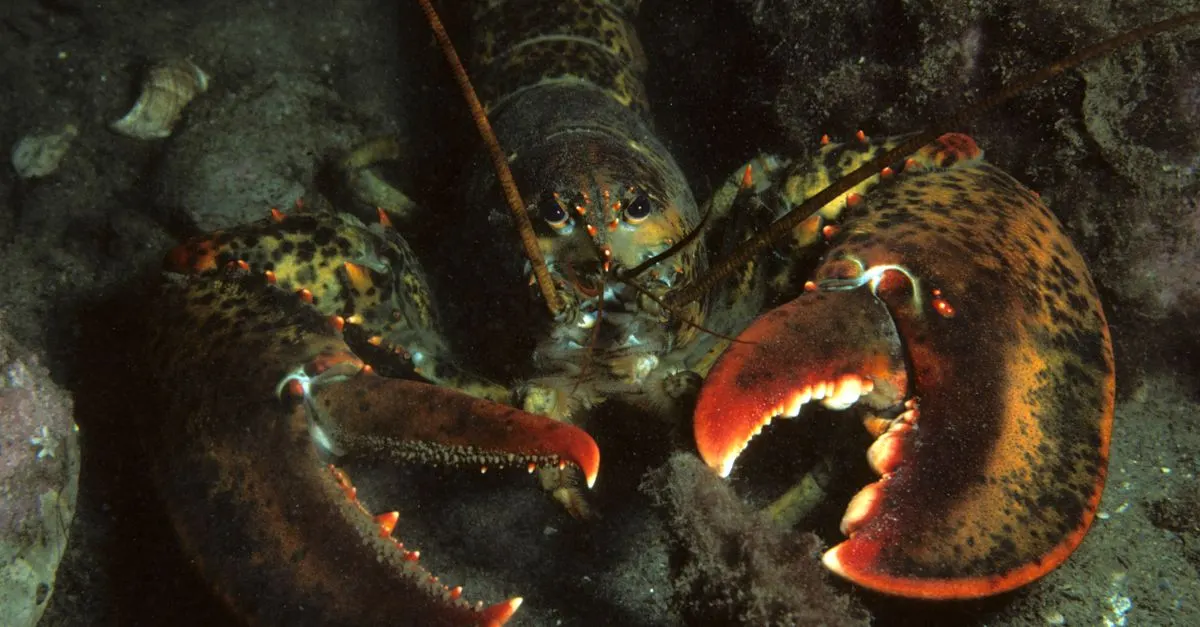
Ask the internet how long a lobster lives and you will get a confident, wrong answer: forever. The meme has been kicking around for years, and it is the rare piece of viral science that is both genuinely surprising and genuinely false. Lobsters do age slowly. They keep growing their whole lives. But pull on the actual numbers and you hit a strange wall: nobody can tell you for sure how old any wild lobster is, because the animal throws away the evidence every time it grows.
Probably decades, possibly near a century, definitely not endless
The honest answer is that lobsters likely live for many decades, with some large individuals approaching 100 years, but no one has ever proven a single lobster's exact age. The figures you see quoted, 50 years, 100 years, sometimes more, are estimates built from a lobster's size and weight, not from any clock inside the animal. The Natural History Museum in London is blunt about the difficulty: working out how old lobsters are "can be very tricky," and despite the memes, "we know they can't actually live forever" (Natural History Museum).
So the real story has two halves. Lobsters genuinely are slow agers, slow enough that scientists use a special term for it. And lobsters genuinely do die. Both things are true, and the gap between them is where the immortality myth grew.
Why you can't just count the rings
Here is the problem that makes lobster age such a headache. For most animals, age leaves a paper trail. A tree has rings. A fish has growth bands on its scales and ear bones. Even a clam stacks up annual layers in its shell. You section the hard part, count the bands, and read off the years.
Lobsters refuse to cooperate. They grow by molting, shedding their entire exoskeleton and building a bigger one, and they keep no permanent hard structure that records the whole life. As the museum puts it, lobsters "shed their entire exoskeleton when they grow and retain no hard structures" (Natural History Museum). Every molt wipes the slate. The shell you would want to count rings on is sitting on the seafloor, abandoned.
So researchers have had to get creative. The crude method is size: a lobster gains roughly a pound every seven to ten years, so a heavy lobster is probably old. The trouble is that growth speed depends on water temperature and food, so two lobsters the same weight can be very different ages. A slightly better method looked at fatty residue in the eyestalk, on the logic that older animals store more. Using that, scientists estimated that male European lobsters average about 31 years and females about 54, with one exceptional female pegged at 72 (Natural History Museum).
The most promising new approach finally found a body part the lobster doesn't fully shed. In the stomach sits the gastric mill, a gizzard-like grinder made of calcified plates. Researcher Raouf Kilada noticed those plates hold microscopic, tree-ring-like bands less than a millimeter thick. A team at the University of Maine's Darling Marine Center has been testing whether those bands form once a year, dissecting lobsters held in captivity for three years and staining the gastric mill with fluorescent dye to mark the start of observation. Their early data suggest the bands do follow an annual pattern (University of Maine). If it holds up, it would be the first direct way to read a lobster's age instead of guessing it.
The slow-aging trick: a repair enzyme that never switches off
Lobsters earn their reputation for a reason. They show what biologists call negligible senescence, meaning age-related decline happens so slowly it is hard to detect. A 50-year-old lobster is not a frail version of a young one. It is mostly just a bigger one, still fertile and still growing.
Part of the explanation sits in their cells. Every time a cell divides, the protective caps on the ends of its chromosomes, called telomeres, get a little shorter. In humans, telomeres act like a countdown timer: shorten them enough and the cell stops dividing and ages out. The enzyme that can rebuild those caps, telomerase, is switched off in most adult human tissue. Lobsters never flip that switch off. A 1998 study found high telomerase activity in every lobster organ the team tested, and tied that constant repair to the animal's slow senescence and lifelong growth (Klapper et al., FEBS Letters). Their cells keep resetting the timer, so the body does not run down the way ours does. It is one of the more striking cases of an animal sidestepping the normal rules of aging, the kind of biology that also shows up in the handful of creatures that seem to cheat death.
Where the "immortal" claim falls apart
Slow aging got rounded up to "immortal," and that is where the science says stop. Lobsters die, and they die in ways that have nothing to do with old age in the human sense.
The big one is built into how they grow. Molting is dangerous and expensive, and it gets worse with size. A young lobster molts several times a year and bounces back fast. An old, heavy lobster has to drag a much larger body out of a much larger shell, then rebuild and re-mineralize the new one, and the energy bill rises with every molt. Eventually the cost outruns what the animal can pay. Carl Wilson, lead lobster biologist for Maine's Department of Marine Resources, estimates that "between 10 and 15 percent of lobsters die naturally each year as they shed their exoskeletons because the exertion proves to be too much" (Smithsonian Magazine). Some get stuck mid-molt and never make it out.
Then there's shell disease, where bacteria eat into the shell and can fuse the lobster to its own armor, so that when it tries to molt it gets trapped and dies. Marine scientist Jeffrey Shields frames the whole thing neatly: it is "senescence in the way that older people die of pneumonia" (Smithsonian Magazine). The body doesn't gently wind down; it gets to a point where a routine challenge it used to shrug off becomes fatal. Add predators, including the obvious one with the butter and the bib, and a wild lobster has plenty of ways to go. As invertebrate scientist Zen Faulkes said of hard evidence for lobster immortality, "If there is evidence supporting that claim, I have not found it yet" (Smithsonian Magazine).
How big a 100-year-old actually gets
The headline lobsters are enormous, and their sizes are real even when their ages are guesses. The heaviest lobster on record was hauled up off Nova Scotia in 1977, stretched about a meter long, and weighed 20.14 kilograms, around 44 pounds. It still holds the Guinness record for the heaviest marine crustacean (Guinness World Records), and it was estimated at roughly 100 years old based on that bulk. Older claims, the 110-year and 140-year lobsters that circulate online, are extrapolations from weight using that loose pound-per-decade rule, not anything measured. They could be right. They could be off by decades. We don't have a method good enough to say yet.
That uncertainty is the genuinely interesting part, more interesting than the immortality myth ever was. Here is an animal common enough to sit in a supermarket tank, fished commercially for centuries, and we still cannot reliably tell you how old the big ones are. It ages so slowly that our usual tricks fail, and it destroys its own birth certificate every time it grows. A lobster isn't living forever. It is just keeping its real age a secret, and we are only now learning how to read it.
Keep wondering: meet the one animal that may actually be immortal, find out why turtles live so long, and see why an animal that molts its shell still has no internal bones to lose, like an octopus.

Join the conversation
Comments are reviewed before they appear. Be kind and stay curious.
Loading comments…