
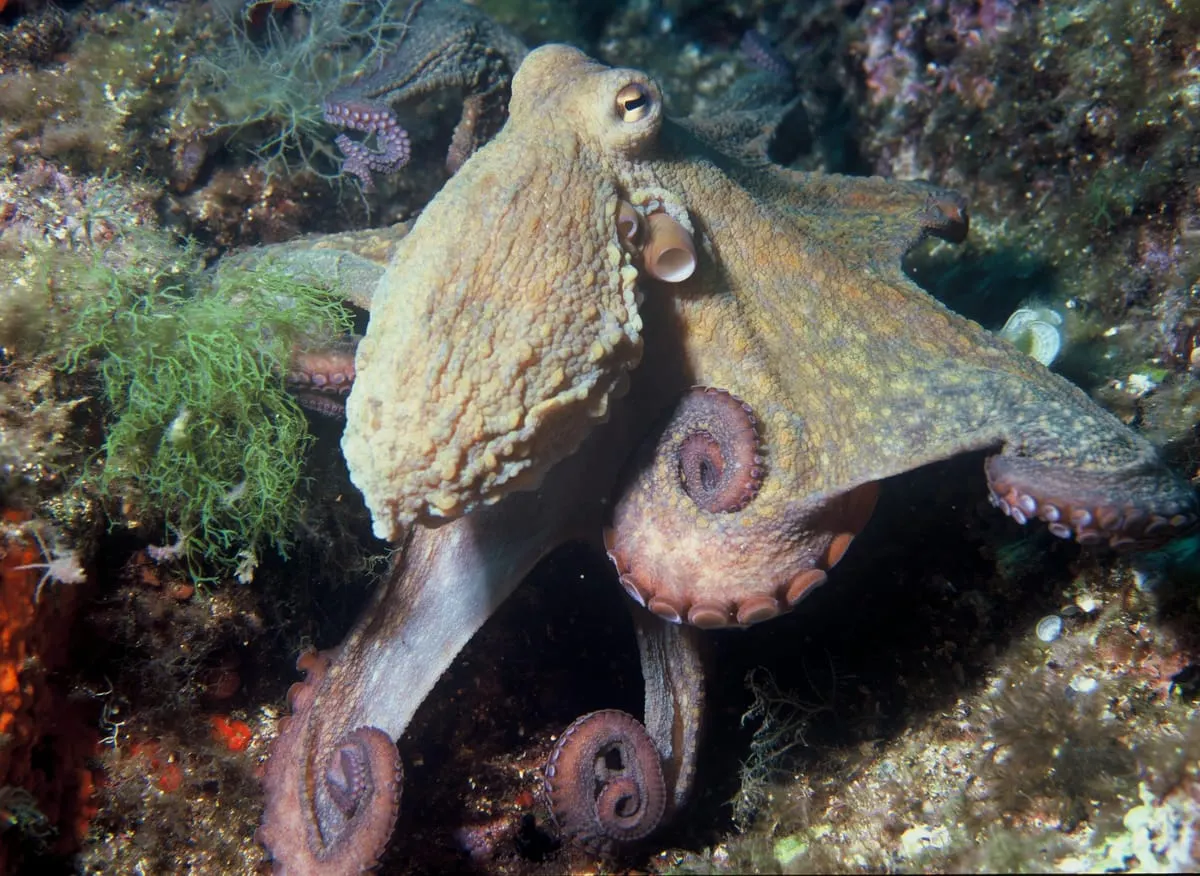
There's a famous kind of video where a large octopus, cornered in a tank or a tide pool, flattens itself and pours its entire body through a gap that looks far too small to be possible, a slot the width of a coin. It seems like a magic trick. The secret is that an octopus is carrying almost nothing rigid to get in the way.
A body with nothing to stop it
So do octopuses have bones? No, none at all. The soft body hides other surprises too, like three separate hearts. An octopus is a mollusc, an invertebrate, and it has no bony internal skeleton and no external shell, just soft tissue and muscle from end to end (Monterey Bay Aquarium). Its distant ancestors had shells, but in the octopus that shell has dwindled to almost nothing. There's no bony structure holding the body in one particular shape, which is exactly why it can change shape so freely.
To be precise, "no bones" isn't quite "nothing hard." An octopus does have a small piece of cartilage cradling its brain, and one notably tough tool. But it has no bony skeleton, and that's the headline.
The main hard biting part is the beak
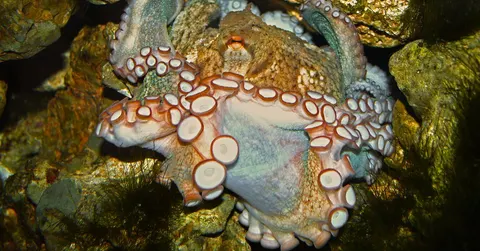
That one tough tool is the beak. Tucked at the center of the arms, where they all meet, an octopus has a sharp beak that looks a lot like a parrot's, made of chitin, the same hard material as an insect's shell (Seattle Aquarium). It uses the beak to bite into and crush hard-shelled prey like crabs and clams. Everything else about the animal is squishable. The beak is not.
If the beak fits, the octopus fits
This is where the bonelessness pays off spectacularly. Because the beak is the main rigid biting structure, it is a useful rule-of-thumb limit on where an octopus can go: if the beak can pass through an opening, much of the rest of the body may follow (Seattle Aquarium). The actual fit also depends on posture, body shape, and the geometry of the opening. A fully grown giant Pacific octopus can reportedly fit through a hole about the size of a lemon (Seattle Aquarium).
The way it moves without a skeleton is just as clever. An octopus arm is a muscular hydrostat, the same engineering as your tongue or an elephant's trunk: bundles of muscle work against each other to bend, stretch, stiffen, and grip, no bones required (Wikipedia). It can make any part of an arm rigid on demand, then go limp again a moment later.
So the answer to whether octopuses have bones is a clean no, and it turns out to be one of the best things about them. A skeleton is what stops the rest of us from squeezing under a door. Strip it away, leave only a beak and a body of clever muscle, and you get an animal that can be eight feet of strength one second and pour itself through a keyhole the next.
Keep wondering: the same boneless body pulls off a disappearing act in how octopuses change color, the deep dark glows in why sea creatures glow, and the world they live in goes down further than you think in how deep is the ocean.

Join the conversation
Comments are reviewed before they appear. Be kind and stay curious.
Loading comments…