
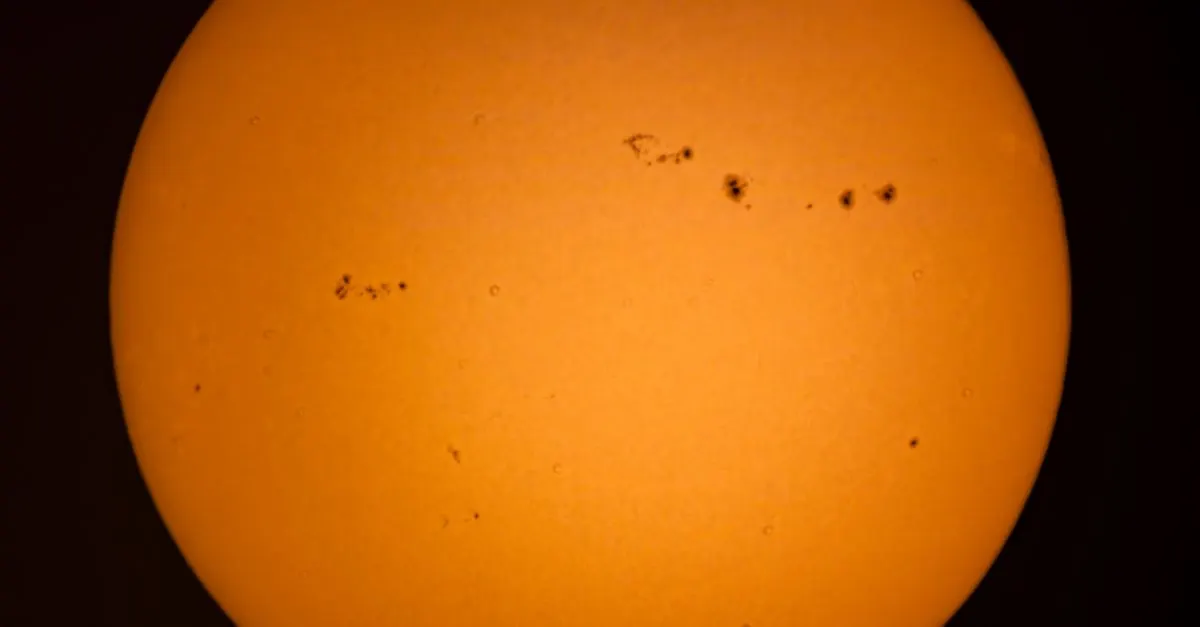
The Sun is a churning, roaring ball of plasma the size of a million Earths, and it sits in total silence. Look up at it and nothing reaches your ears, no hum, no rumble, no hint that anything is happening up there at all. That stillness is the strange part. The Sun is one of the loudest objects you will ever not hear, and the reason cuts straight to what sound actually is.
The Sun would hit roughly 100 decibels at Earth, if sound could reach us
If sound could somehow travel across space, estimates put the Sun at around 100 decibels by the time it reached Earth, about the volume of a rock concert (American Academy of Audiology). Some heliophysicists put the figure closer to 110 (Astronomy Magazine). Either way, the headline answer is a thought experiment, not a reading off a meter. Nobody has held a microphone to the Sun. The number comes from working out how much sound energy the Sun pours out and how far it would have to spread to reach us, so treat it as a careful estimate built for intuition, not a measured fact.
And the estimate is only the start of the strangeness, because that 100-decibel roar never actually arrives.
Why the roar never reaches you
Sound is not a thing that flies through space on its own. It is a wave of pressure, a pattern of squeezes and stretches passed from one molecule to the next. In air, that chain runs from molecule to molecule until it shakes your eardrum. Take the molecules away and the chain has nothing to pass through. The wave dies where it stands.
The space between the Sun and Earth is a near-vacuum, emptier than anything you could build in a lab. There is far too little matter out there to carry a pressure wave the 93 million miles to your ears. So the Sun could be screaming at any volume you like and the result on Earth would be the same: nothing. The same emptiness that makes space brutally cold and leaves space with no smell is what mutes the loudest engine in the solar system.
So "how loud is the Sun" really splits into two questions. How loud would it sound if the impossible were possible, which is the 100-decibel estimate. And how loud is it actually, deep inside, where there is plenty of matter to carry sound. That second question has a real, measured answer.
The Sun genuinely rings
Down inside the Sun there is no vacuum at all. It is packed with hot, dense plasma, and that gives sound waves something to move through. Heat rising from the core churns the outer layers in a roiling boil called convection, and all that motion sets off pressure waves that race through the Sun's interior and bounce around inside it.
Those waves make the whole star vibrate. The surface bobs gently up and down, and back in 1962 astronomers noticed it doing so with a regular beat of about five minutes. They called it the "five-minute oscillation," and we now know it is the surface signature of countless sound waves, formally called pressure waves or p-modes, trapped and resonating inside the Sun (PNAS). The Sun rings like a struck bell, only the bell is a star and the note takes minutes to complete.
Reading those vibrations is its own science, called helioseismology. Just as a geologist learns about the Earth's hidden layers by watching how earthquake waves travel, solar physicists learn what the Sun is like inside, its temperature, its currents, its rotation, by tracking how these sound waves move through it. The roar we can never hear turns out to be one of the best windows we have into a place no probe could ever survive.
You can actually listen to it
Here is the part that closes the loop. We cannot hear the Sun directly, but we have heard it anyway, by cheating.
Spacecraft like the SOHO observatory have spent decades measuring the tiny up-and-down motions of the Sun's surface. Those raw oscillations are far too slow and too faint for human ears, so scientists sped the data up by tens of thousands of times and shifted it into our hearing range. The result is a real audio recording of the Sun's vibrations, a deep, layered hum that NASA has published for anyone to play (NASA). It is not a sound effect or a guess. It is the Sun's own ringing, translated.
So the honest answer carries two halves, and both are worth holding at once. As a thought experiment, the Sun would blare at around 100 decibels if space could carry the noise, and it cannot, because sound needs a medium and space has almost none. But the Sun is genuinely, measurably loud on the inside, ringing with pressure waves we have learned to read and even to hear. The silence overhead is not emptiness. It is a roar with nowhere to go.
Keep wondering: find out how cold space really gets in that same near-vacuum, what the Sun's eventual death will look like, and why stars twinkle when our own star does not.

Join the conversation
Comments are reviewed before they appear. Be kind and stay curious.
Loading comments…