
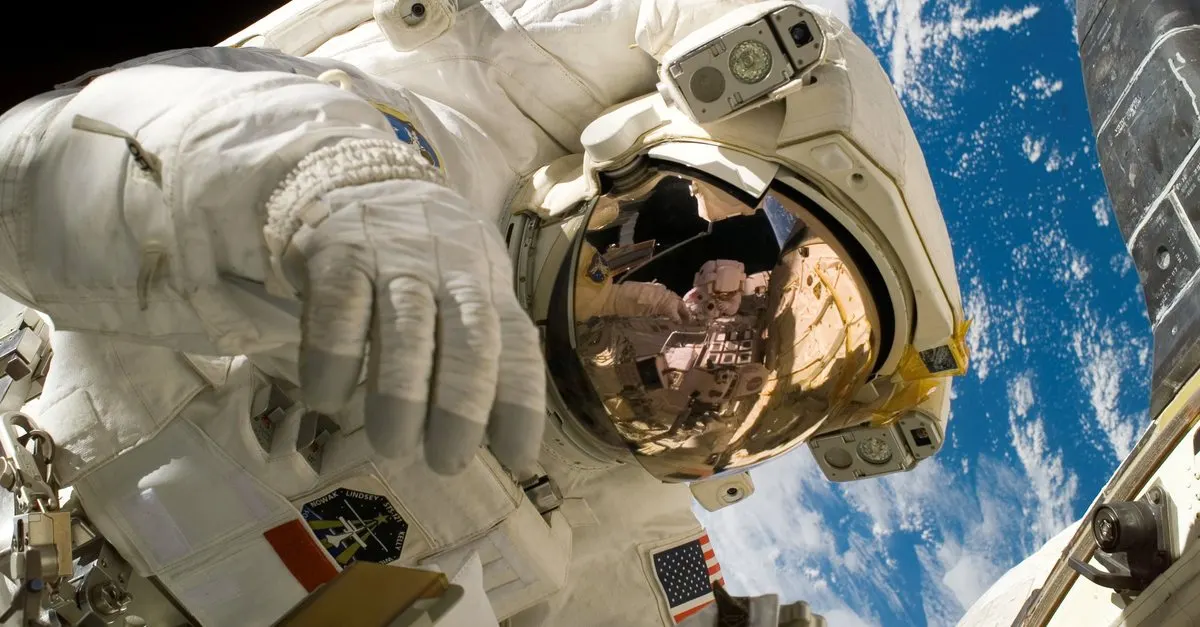
An astronaut comes in from a spacewalk, cracks the helmet seal, and the airlock fills with the reek of a fired pistol and a steak left too long on the grill. Nobody opened a window. Space has no air to smell. Yet the smell is real, and it shows up every time. What does space smell like, and where could a smell with no air to carry it come from?
What space actually smells like, according to the people who have been there
You cannot smell the vacuum of space, because smelling needs molecules drifting into your nose and a vacuum has almost none. What you smell is the residue: reactive stuff that clings to spacesuits, tools, and airlock walls during a spacewalk, then off-gasses once the astronauts repressurize and take their helmets off. The consistent description from crew after crew is a sharp, metallic, slightly sweet burnt odor, most often compared to seared steak, hot metal, welding fumes, and spent gunpowder. It is the smell of things that came back from outside, not the smell of outside itself.
The astronauts who came back reeking
NASA's Don Pettit wrote the most quoted account. After a spacewalk he found the odor stuck to his suit and gear, and he reached for the only comparison that fit. "The best description I can come up with is metallic; a rather pleasant sweet metallic sensation," he wrote, adding that "it reminded me of pleasant sweet smelling welding fumes. That is the smell of space" (Air & Space / Smithsonian, via Space.com). Pettit knew the reference firsthand from summers spent running an arc-welding torch.
Chris Hadfield, the Canadian commander of the International Space Station, has described the same thing: the airlock smelling of burnt steak and gunpowder after a walk outside. Hadfield also points out a strange catch. In orbit, fluid shifts up into your head and stuffs up your nose, so your sense of smell is dulled, like a permanent head cold (Canadian Space Agency). The space smell is one of the few that punches through anyway. A muffled nose is just one of the odd adjustments of orbital living, alongside puzzles as basic as how you go to the bathroom with no gravity to help.
Other crew agree it is unmistakable and hard to pin down. Astronaut Dominic "Tony" Antonelli said simply that "space definitely has a smell that's different than anything else," and former astronaut Thomas Jones likened it to ozone, the sharp tang you catch near a sparking electric motor (Live Science). Different noses, same neighborhood: hot, metallic, burnt.
The chemistry: dead stars and angry oxygen
There are two leading explanations, and they probably both play a part.
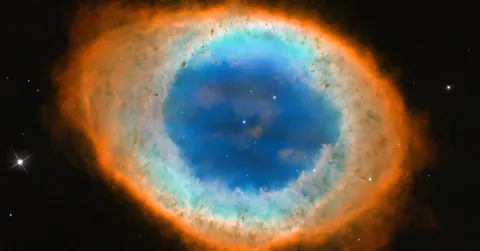
The first is polycyclic aromatic hydrocarbons, or PAHs. These are ring-shaped carbon molecules, the same family of compounds that gives you the smell of burnt toast, charred meat, soot, and car exhaust. Louis Allamandola, who founded NASA Ames Research Center's Astrophysics and Astrochemistry Laboratory, has explained that dying stars throw off carbon-rich soot chemically close to fossil fuel, and that this PAH-laden material drifts through the galaxy more or less forever (Mental Floss). Some of it settles onto a suit during a spacewalk and rides back inside. So part of the answer to what space smells like is, genuinely, the exhaust of stars that blew up long ago. Those same violent stellar deaths are where the heavy elements come from, including the gold forged when neutron stars collide.
The second explanation is atomic oxygen. In low Earth orbit, ultraviolet light splits ordinary oxygen molecules into lone, reactive oxygen atoms. Those single atoms stick to a spacesuit's outer layer. When the astronaut steps back into the airlock and air floods in, the loose atoms grab onto molecular oxygen and form ozone, O3, which has that classic metallic, electric bite (Space.com). That reaction happens right there on the returning gear, which is exactly why the smell hits hardest the moment the helmet comes off.
Here is my one opinion: the gunpowder comparison is the most honest one. Gunpowder smoke is partly burnt carbon and oxidized metal, which is more or less what a returning suit is coated in. The brain reaches for the nearest filed-away memory, and for a lot of these people that memory is a firing range or a welding shop.
NASA paid a chemist to bottle it
The smell mattered enough that NASA commissioned someone to recreate it for astronaut training, so crews would recognize the odor before they ever flew. In 2008 the agency brought in British chemist Steve Pearce, founder of Omega Ingredients, who spent about four years reverse-engineering the scent from astronaut interviews and chemical data (NPR). The training formula later went public as a fragrance called Eau de Space, funded through a 2020 Kickstarter that raised 614,376 dollars from 12,995 backers (Kickstarter). The descriptors Pearce worked from were a strange cocktail: seared steak, hot metal, spent gunpowder, and, oddly, raspberries and rum. That fruity note is no accident. Deep clouds in our galaxy contain ethyl formate, the ester behind raspberry flavor, which is why some astronomers joke the galactic core would taste of raspberries.
The vacuum itself is odorless and always will be. But the things that touch it come home changed, carrying the burnt-metal signature of a place no human nose was built for, a place that is also nearly empty of warmth, which is its own surprise once you learn how cold space really gets. It is a place ruled by forces stranger than smell, including black holes that slowly evaporate away over unimaginable spans of time. The next time you scorch a steak, you are smelling a cousin of the cosmos.
Keep wondering: the same dying stars that seed space with sooty smells also forge the metals in your blood, which is part of what happens when the sun dies; those PAHs drift across distances that strain belief, so it helps to grasp how big is the universe; and the atmosphere that bends and scatters starlight is the same reason why do stars twinkle.
Join the conversation
Comments are reviewed before they appear. Be kind and stay curious.
Loading comments…