
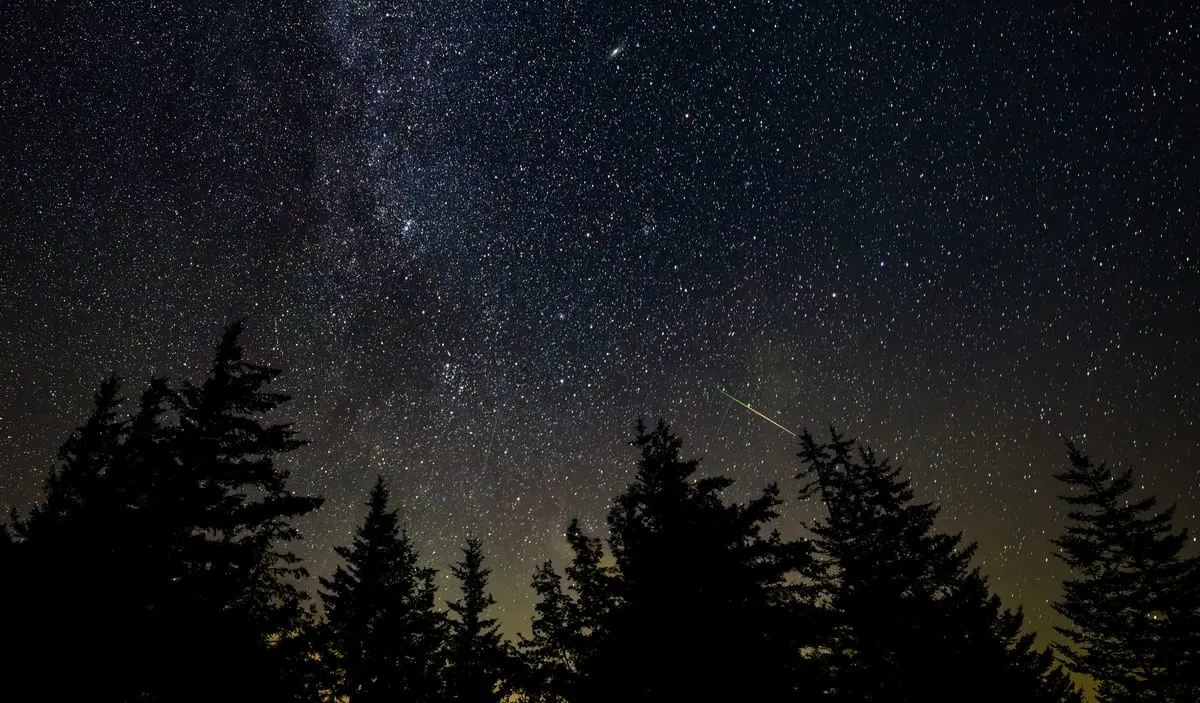
You see a streak flash across the night sky and someone shouts "shooting star!" Someone else says "meteor," and a third person mentions the "meteorite" that landed in a field somewhere. They are all talking about the same lump of rock, just at three different moments of its life. The whole meteor vs meteorite question comes down to one simple idea: the name depends on where the rock is.
One rock, three names
Astronomers use three words for what is essentially a single object passing through three stages, sorted by location (NASA):
- Meteoroid while it is still out in space.
- Meteor while it is streaking and burning through the atmosphere.
- Meteorite once it survives and lands on the ground.
Get that and you have the whole thing. The rest is just detail worth knowing.
The meteoroid: the rock in space
Out in the dark, it is a meteoroid. NASA defines meteoroids as "space rocks that range in size from dust grains to small asteroids" (NASA). Most are tiny, broken bits chipped off asteroids or shed by comets as they loop around the Sun. They drift along their own orbits until one of them crosses paths with Earth.
The meteor: the flash, not the rock
This is the one people get wrong most. A meteor is not an object. It is the light. As the American Meteor Society puts it, "whenever a meteoroid plows into the Earth's atmosphere, it will create a brief flash of moving light in the sky, called a meteor" (American Meteor Society).
And that glow is not the rock rubbing against the ground or even simple friction. It happens high up, around 80 to 120 kilometers, where the meteoroid slams into air so fast that it crushes and superheats the gas in front of it, making a long, glowing column of excited atoms. A "shooting star," then, is not a star, and the rock causing it is often no bigger than a pebble.
The meteorite: the survivor
Most meteoroids never make it. The fiery passage destroys them completely, and they vanish as a streak and nothing more. Only when a piece survives all the way to the surface does it earn the last name. As NASA says, "when a meteoroid survives a trip through the atmosphere and hits the ground, it's called a meteorite." The survivors that get found are usually small, somewhere between a pebble and a fist.
A couple of bonus terms round it out. A fireball is just a very bright meteor, brighter than the planet Venus in the sky. A bolide is a fireball that ends in an explosion, the rock visibly shattering. And a meteor shower, like the Perseids, is Earth plowing through the trail of dusty debris a comet left behind, so dozens of meteoroids burn up in a single night.
So next time someone points at a streak of light and calls it a falling star, you will know the truth: it is a meteor, made by a meteoroid, and if any of it reaches the ground, only then is it a meteorite, a piece of space you could pick up and hold, much like the cosmic origins behind where gold comes from.
Keep wondering: the night sky is full of misunderstood sights, from why stars twinkle but planets don't to the violent cosmic story of where gold comes from. More at Space & Cosmos.


Join the conversation
Comments are reviewed before they appear. Be kind and stay curious.
Loading comments…